
DNS queries travel unencrypted across the internet, and without DNSSEC, anyone between you and a DNS server can alter the response. An attacker can redirect nytimes.com to a phishing site, and your browser would never know the address was tampered with. DNSSEC fixes this by adding cryptographic signatures to DNS records, letting resolvers verify that responses are authentic and unmodified.
The system has been around since 2005, yet adoption sits below 30 percent of domains. The signing chain is complicated, operational mistakes can take entire domains offline, and the security benefit often feels abstract compared to the very real risk of breaking your site. By the end of this guide, you'll understand how DNSSEC works, why so few organizations have deployed it, and whether your own domains need it.
What DNSSEC is and what problem it solves
DNSSEC is a suite of DNS extensions that adds cryptographic signatures to DNS records. When you query a domain, DNSSEC lets your resolver verify that the answer actually came from the authoritative name server and wasn't tampered with in transit.
Traditional DNS has no authentication. Anyone on the network path between you and a DNS server can forge responses and redirect your traffic to malicious servers. The two main attacks DNSSEC prevents are cache poisoning, where an attacker injects fake records into a DNS resolver's cache, and DNS spoofing, where forged responses redirect users to phishing sites or intercept their connections.
DNSSEC is different from encrypted DNS protocols like DNS over HTTPS (DoH) or DNS over TLS (DoT). DNSSEC proves the DNS response is authentic. Encryption hides your queries from eavesdroppers but doesn't verify the answer came from the right source. They solve different problems, and you can use both together.
How the DNSSEC signing chain works
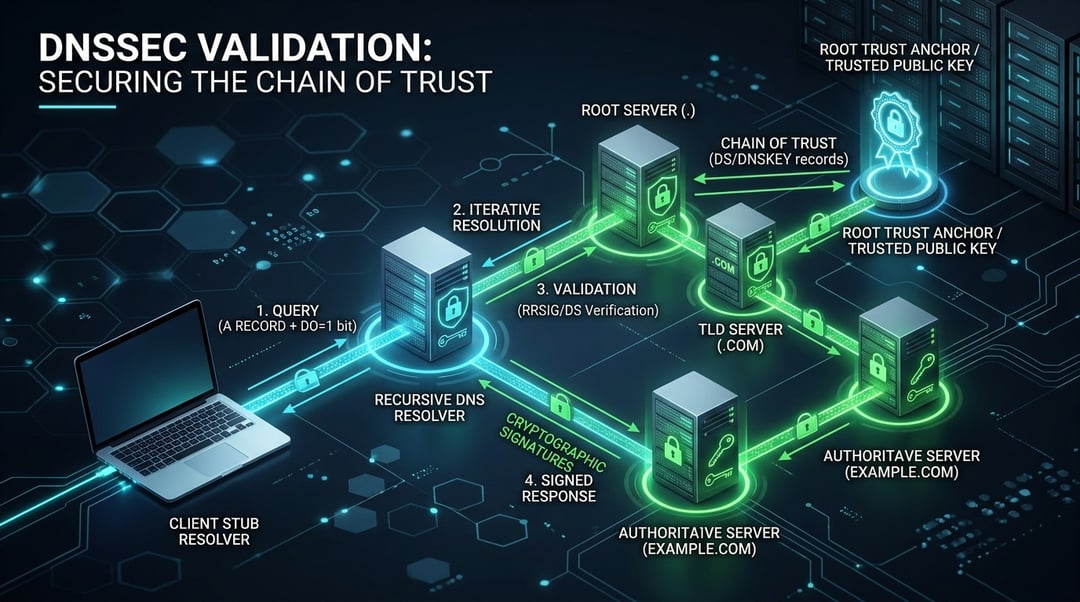
Each DNS zone signs its records with a private key, then publishes both the records and their cryptographic signatures. The security model relies on a chain of trust that starts at the root zone and extends downward through each level of the domain hierarchy.
The root zone signs the public keys of top-level domains like .com and .org. Those TLDs then sign the keys for individual domains registered under them. When your resolver requests a signed record, it receives the answer along with an RRSIG record containing the signature. The resolver verifies each signature using the DNSKEY record, which holds the zone's public key. DS records at the parent zone prove the child's key is legitimate, linking each level together.
If any signature fails validation, the resolver rejects the response entirely rather than returning potentially tampered data to your application.
Why DNSSEC adoption remains below 30 percent
Roughly 25 to 30 percent of domains sign their zones, but validation rates are lower still. The operational burden explains much of the resistance. DNSSEC requires periodic key rotation, strict clock synchronization across infrastructure, and produces responses large enough to break networks with outdated MTU assumptions or broken EDNS0 implementations. The failure mode is particularly unforgiving: a misconfigured signature or expired key makes the entire domain unreachable rather than silently falling back to insecure resolution. That risk discourages deployment even when administrators understand the protocol.
Encrypted DNS protocols like DNS-over-HTTPS and DNS-over-TLS gained traction faster because they solve the more common threat—eavesdropping on local networks—without requiring coordination between registrars, registries, and authoritative servers. A resolver operator can enable DoH unilaterally. DNSSEC demands changes at every layer.
When DNSSEC matters and when it does not
DNSSEC offers real protection on hostile networks where DNS traffic can be intercepted and modified, such as public WiFi or compromised ISPs. Infrastructure targets like registrars, hosting providers, and large DNS operators benefit most because attackers targeting these organizations often begin with DNS hijacking.
For typical home users on trusted networks browsing HTTPS sites, the benefit is marginal. HTTPS already encrypts the connection and validates the server certificate, catching most spoofing attempts even if DNS responses were tampered with.
DNSSEC enables advanced protocols that depend on authenticated DNS data. DANE uses DNSSEC to bind TLS certificates to DNS records, and some certificate transparency systems rely on signed records. Even partial deployment raises costs for attackers: if a domain is signed, hijacking it requires compromising the private key or the parent zone, not just poisoning a cache.
Should you enable DNSSEC for your own domain or resolver
DNSSEC solves a real problem—DNS cache poisoning and spoofing—but its complexity has kept adoption low. For most personal use, HTTPS already covers the last-mile authentication gap that DNSSEC was designed to close. If you manage a domain that handles sensitive queries, run infrastructure others depend on, or operate on hostile networks regularly, enabling DNSSEC and validating responses adds meaningful protection. Otherwise, focus first on encrypted DNS (DoH or DoT) to prevent local eavesdropping, then evaluate DNSSEC if your threat model or dependencies (like DANE) require authenticated DNS records. The signing chain works, but only when both the domain operator and the resolver commit to it.


