
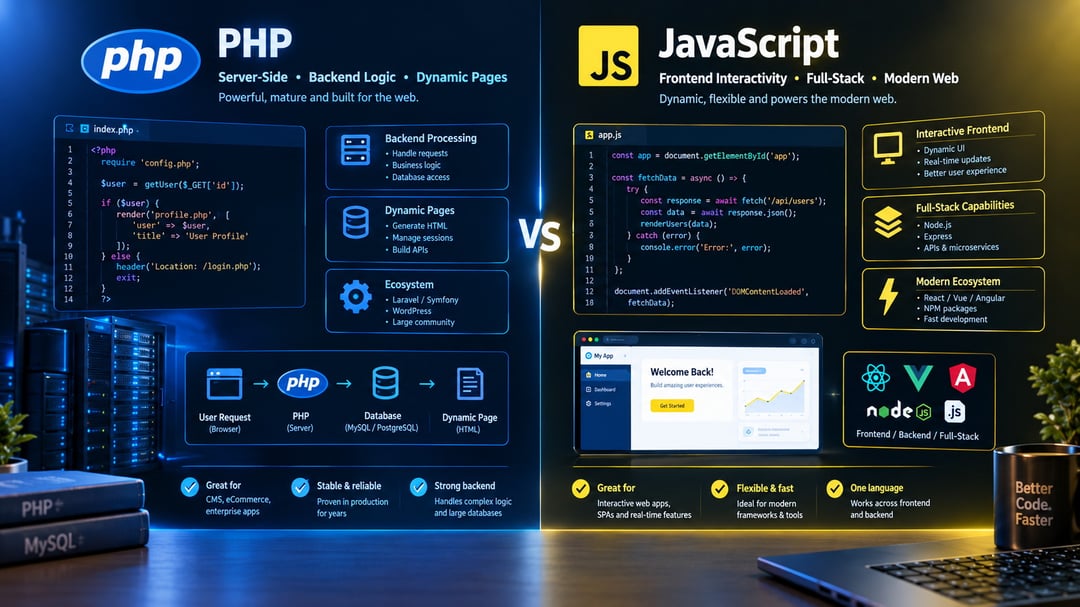
Choosing between PHP vs JavaScript for web development means deciding whether to specialize in a proven server-side language or bet on a unified ecosystem that runs everywhere. PHP still powers most of the web through WordPress, Laravel, and countless legacy systems. JavaScript, with Node.js, lets you write both frontend and backend in one language, which sounds efficient until you hit the differences between browser and server environments.
The decision depends on what you're building, whether you need to work with existing codebases, and how much complexity you're willing to manage. By the end, you'll know which language fits your project, which frameworks matter, and what each choice costs you in the long run.
Server-side capabilities and deployment
PHP was built from the ground up for server-side web development. You write PHP files, drop them into a web directory, and they run. JavaScript started as a browser language and gained server-side abilities in 2009 when Node.js gave it access to file systems, networking, and process control.
That history shapes how you host and deploy each language. PHP runs on nearly every shared hosting plan because it integrates directly with Apache and Nginx through modules. You upload files via FTP, and the web server executes them on request. Node.js requires a VPS or a platform that supports long-running processes because Node applications stay in memory and listen on specific ports. You manage the process with PM2 or systemd, configure a reverse proxy, and handle restarts yourself.
PHP includes built-in functions for HTTP headers, cookies, sessions, and file uploads. Node.js treats HTTP as one capability among many, so you install Express or Fastify to handle routing and request parsing. Both approaches work, but PHP removes a configuration step that Node.js makes explicit.
Framework ecosystems and learning curves
PHP's mature frameworks ship with most decisions already made. Laravel includes authentication, database migrations, and an ORM out of the box. Symfony offers similar structure. Both frameworks stay stable across versions, and upgrades follow predictable paths. You can build a full application by following the framework's conventions rather than assembling libraries yourself.
JavaScript splits into server and client frameworks. Express gives you routing and middleware but leaves architecture choices to you. NestJS adds structure similar to Laravel but requires understanding TypeScript and decorators. Next.js handles React rendering patterns but introduces its own caching and data-fetching rules. The flexibility means you choose your stack, but it also means researching which libraries work well together and keeping multiple dependencies current.
PHP's procedural syntax makes the basics accessible. You can write functioning code before learning objects or design patterns. JavaScript's asynchronous model requires understanding promises and callbacks early, and the ecosystem changes quickly. A tutorial from two years ago may recommend packages that are now deprecated or replaced.
Full-stack development and language consistency
JavaScript lets you write both frontend and backend code in the same language, which eliminates the mental overhead of switching between PHP's server syntax and JavaScript's client-side patterns. You can share validation logic, data transformation utilities, and type definitions across your stack. A single team member can move between frontend components and API routes without changing languages or development environments.
PHP requires you to maintain separate validation rules and business logic on the server while duplicating some of it in JavaScript for client-side responsiveness. This introduces more code to maintain and creates opportunities for drift between client and server implementations.
The separation can work in your favor when teams are specialized. If you have dedicated backend developers who prefer PHP's explicit request-response model and frontend developers who focus on JavaScript frameworks, the language boundary matches your team structure. PHP developers can work without needing to understand React or Vue internals, while frontend developers interact through clean API contracts.
The unified JavaScript approach feels faster for small teams and prototypes. The PHP separation makes more sense when you have distinct backend and frontend roles.
WordPress, legacy systems, and application complexity
PHP powers 43% of the web largely because of WordPress, Drupal, and similar CMSs. If your project extends an existing PHP codebase or integrates with WordPress plugins and themes, staying in PHP avoids rewriting working systems. Shared hosting providers universally support PHP, while Node.js often requires VPS or container deployments.
Real-time features expose a fundamental difference. JavaScript handles WebSockets and asynchronous events natively through its event loop. Building a live chat or collaborative editor in Node.js means working with the language's design rather than against it. PHP traditionally operates in request-response cycles; adding WebSockets requires third-party libraries like Ratchet or deploying a separate Node.js service alongside your PHP application.
Scalability patterns diverge similarly. PHP's stateless request model scales horizontally by adding application servers behind a load balancer. Node.js uses an event-driven, single-threaded model that handles many concurrent connections per instance but requires careful CPU-bound task management.
Let application requirements lead. Choose JavaScript when real-time interactivity is central. Choose PHP when content management, existing infrastructure, or team expertise make it the practical path forward.
Conclusion
Start by clarifying what you're building. If you're working with WordPress, maintaining legacy systems, or joining a team with an established PHP stack, the decision is already made. If you're starting fresh, JavaScript gives you one language across frontend and backend, which simplifies development and deployment.
Next, evaluate your hosting constraints. Shared hosting favors PHP. Cloud platforms and containerized deployments work equally well with either, though Node.js requires slightly more configuration knowledge upfront.
Finally, consider your timeline and existing skills. If you already know JavaScript for frontend work, extending it to the backend with Node.js is faster than learning PHP's syntax and conventions. If you're new to both, JavaScript's unified toolchain and modern frameworks will serve you better long-term. Pick the language that matches your project requirements and team expertise, not the one with more market share.