
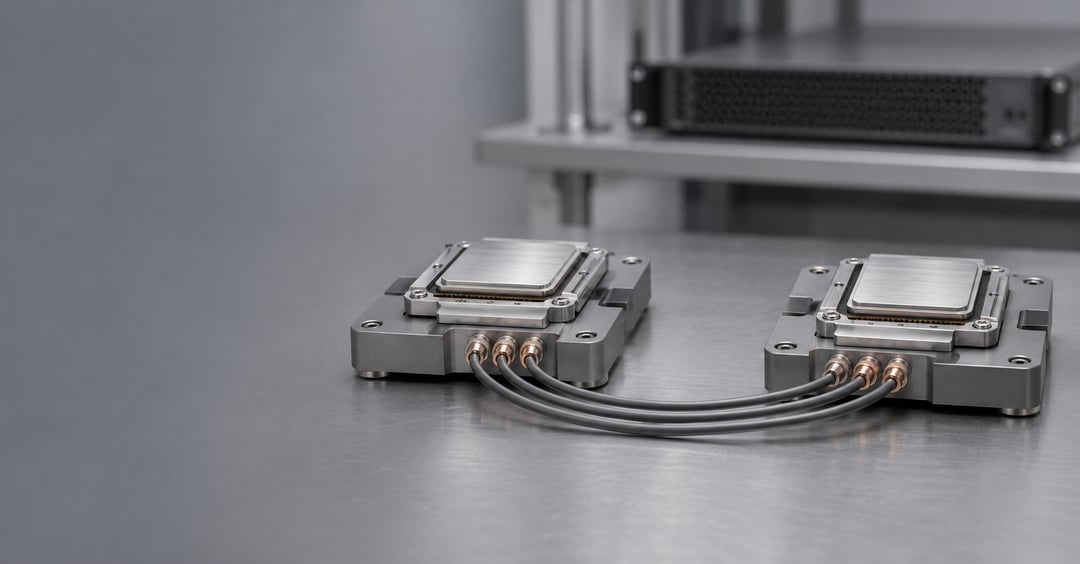
NVIDIA, IBM and the U.S. Department of Energy’s Fermi National Accelerator Laboratory plan to pair NVIDIA DGX B200 systems with IBM quantum computers in a modular codesign platform. Researchers will use the platform to study quantum error correction and develop algorithms for high-energy and nuclear physics. The partners also want to find out how to link several quantum processors so they can tackle calculations too large for a single device, a step toward fault-tolerant quantum computers.
How Fermilab will study linked quantum processors
The first experiments will simulate communication between quantum processors. Researchers will use those simulations to see how errors on the links and delays in communication affect performance. In a later phase, Fermilab’s Superconducting Quantum Materials and Systems (SQMS) Center plans to add its own superconducting cavity hardware for use as quantum memories.
Fermilab intends the platform to become a research hub where scientists develop algorithms and benchmarks for problems involving particle interactions, neutrino physics and nuclear simulations. IBM’s quantum computing leadership pointed to fundamental scientific problems that remain beyond the reach of classical computers alone. Fermilab’s technology leadership sees the project as a step toward developing the capabilities and research community a future DOE quantum computing user facility would need.
NVIDIA’s decoder speeds up error-correction research
In a separate release, NVIDIA introduced TCBP-JOBS, a decoding algorithm included in its CUDA-Q QEC 0.9.0 library. A decoder reads qubit measurements to identify likely errors so they can be corrected. Faster decoding lets researchers test candidate error-correction codes more quickly.
NVIDIA says TCBP-JOBS decodes up to 13,000 times faster than existing leading algorithms. The company also reports that its decoder reduced the computing time for research into new quantum designs from 12 weeks to 45 minutes.
Slurm can schedule quantum processors alongside CPUs and GPUs
The companies extended Slurm, the open-source scheduler used on many large supercomputers, to manage quantum processors. The integration uses IBM’s open-source, vendor-agnostic Quantum Resource Management Interface, which IBM built with NVIDIA and Pasqal. Supercomputing centers can use the integration to schedule work on quantum processors alongside CPU and GPU jobs in the same queue.
IBM also reported a related result from its work with RIKEN and NVIDIA. The team used quantum hardware and GPUs to simulate an iron-sulfur cluster, achieving 79 times the accuracy of earlier runs of the same experiment. NVIDIA’s quantum computing research leadership pointed to the need to develop quantum processors and accelerated computing together.


