
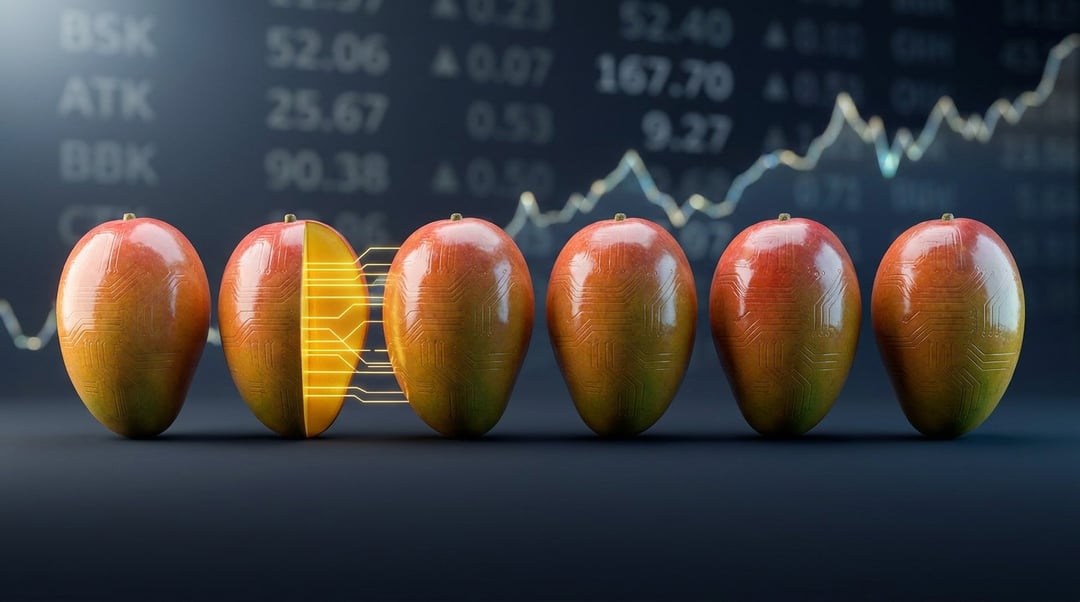
What MANGOS Actually Stands For
For more than a decade, FAANG was the shorthand everyone reached for when they talked about who really ran tech. Facebook (now Meta), Amazon, Apple, Netflix, and Google (now Alphabet) — five names, one slightly menacing acronym, and a tidy way to point at the companies pulling the strings.
That's starting to feel dated. The new label making the rounds is MANGOS, and it's a very different lineup: Meta, Anthropic, Nvidia, Google, OpenAI, and SpaceX. Sweet on the tongue, sure. But anyone who's ever bitten into an unripe mango knows the fruit can turn sour and downright unpleasant fast — which, honestly, is a fitting metaphor for a group of companies whose long-term payoff is still very much a question mark.
The throughline here is obvious once you see the names. This isn't a club built around social feeds, phones, and streaming. It's built around AI and the agentic, autonomous tech that's swallowing the industry's attention right now.
The IPO Wave Driving the Shift
The reason this is happening now, in the summer of 2026, comes down to a cluster of blockbuster public offerings landing more or less at once.
SpaceX is lined up to go public Friday, and it's expected to break records on the way out the door. Anthropic has its own pending IPO that's also poised to set records. And OpenAI, not one to be left behind, is racing to keep pace with — or outdo — its biggest rivals with a public offering of its own that could be record-breaking too.
Put all three together and the math gets interesting. Assuming these debuts go off as planned, the tech world is about to crown a whole new set of public-company overlords. And as these companies go, so goes the rest of the industry. That's not hype talk — it's just how the gravitational pull of the biggest players tends to work.
Why FAANG Is Quietly Slipping Out of the Conversation
Here's the thing, though: FAANG isn't dead. Let's not get carried away. Amazon and Netflix are still enormously powerful, and writing them off would be foolish.
But power and momentum aren't the same thing. Streaming and e-commerce — the businesses that made Netflix and Amazon household giants — just don't feel groundbreaking the way they used to. Amazon's cloud arm is arguably a different story, but the consumer-facing stuff has settled into "mature and profitable" territory rather than "reshaping the future."
Meanwhile, the AI and agentic companies are the ones everybody's watching, betting on, and arguing about. That's the energy shift MANGOS is really capturing. It's less about who's biggest today and more about who's defining what comes next.
Where the MANGOS Name Came From
This wasn't a Wall Street invention or a branding exercise. The acronym was floated by developers @krishdotdev and @lilscoot on X, and it caught fire from there. It's now going viral — the kind of organic, bottom-up coinage that sticks precisely because nobody in a boardroom planned it.
That's part of the charm. FAANG had that same off-the-cuff quality once, and look how long it lasted.
The Bigger Question Hanging Over the New Overlords
So, farewell to FAANG and long live the MANGOS — with one giant asterisk.
All of this optimism rests on a bet: that these companies turn out to be a nourishing foundation for a healthy economy, one powered by the autonomous AI age everyone keeps promising. That's the rosy version.
The sour version? An unpalatable future where the same technology leaves a lot of us jobless and broke. Nobody knows yet which way the fruit ripens. And maybe that uncertainty is the most honest thing you can say about the whole shift — it's exciting, it's enormous, and it could go either way.
Frequently Asked Questions
What does the MANGOS acronym stand for?
MANGOS refers to Meta, Anthropic, Nvidia, Google, OpenAI, and SpaceX — a proposed new grouping of tech's most influential companies, leaning heavily toward AI and agentic technology rather than the social, streaming, and e-commerce focus of the old guard.
How is MANGOS different from FAANG?
FAANG stood for Facebook (now Meta), Amazon, Apple, Netflix, and Google (now Alphabet). MANGOS swaps in companies tied to the AI boom and drops the players whose core businesses — like streaming and e-commerce — feel less groundbreaking today than they once did.
Who came up with the MANGOS acronym?
It was proposed by developers @krishdotdev and @lilscoot on X, and it's since gone viral.


