
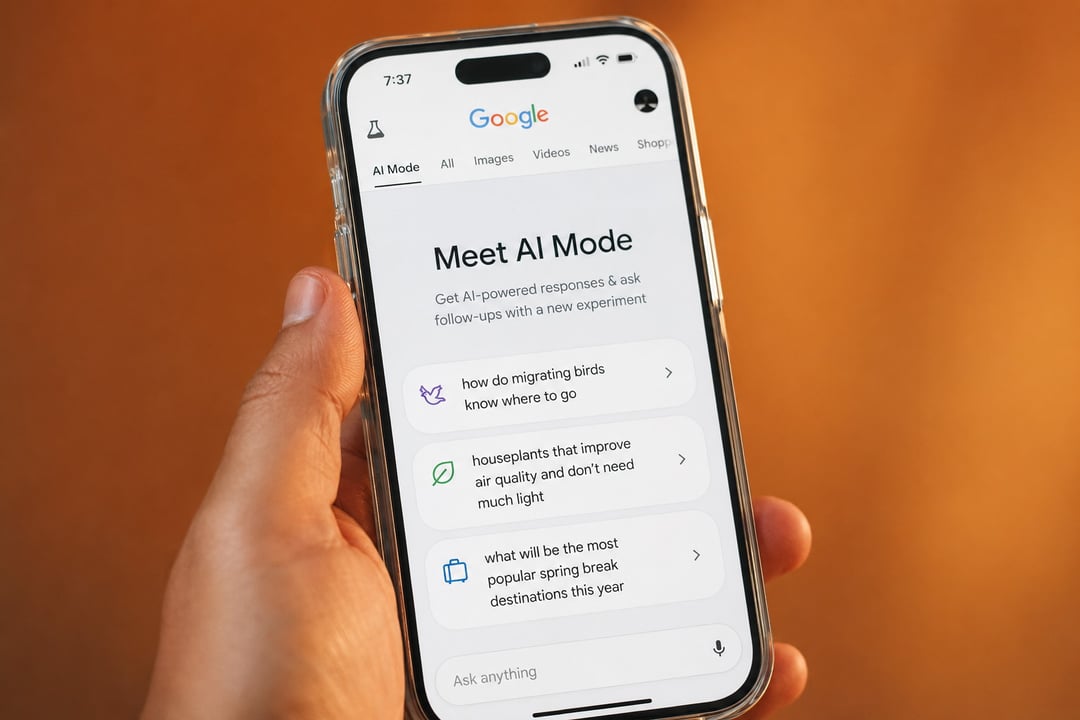
Referral traffic from Google Search to publisher websites dropped 34% over the past twelve months, according to Chartbeat figures shared with Axios. The decline tracks the steady replacement of ranked links with AI-generated answers delivered directly on the results page — a shift that began when Google introduced AI Overviews in 2024 and picked up speed as the company folded those summaries into a broader conversational product.
The pain has not been distributed evenly. Measured across a two-year window, small publishers surrendered 60% of their search referrals. Medium-sized publishers lost 47%. Large publishers, with stronger brand recall and more direct-traffic insulation, gave up 22%. Scale, in other words, has become a form of defense: the smaller the operation, the more completely it depended on Google to hand it an audience, and the more exposed it was when that hand closed.
AI Mode and the Collapse of the Ten Blue Links
Google's AI Mode, which has run on Gemini 3.5 Flash since its worldwide launch at Google I/O on May 19, now resolves the majority of queries on the page itself. The product passed 1 billion monthly users by May 2026. Liz Reid, who leads Search at Google, described the change as the most significant reworking of the search box in over 25 years.
Trade coverage found that by July 10, ranked links had been pushed beneath the fold for many query types — and in some cases removed from the visible response altogether. That structural change matters more than any single ranking fluctuation. A page that once earned a click by placing third in a list of ten now competes for inclusion inside a synthesized paragraph, where there may be no list at all.
Why the Ranking Model Broke
The traditional search economy rested on a simple exchange: publishers supplied indexable content, Google supplied a link, and the click carried commercial value. AI-generated answers keep the first half of that trade and quietly drop the second. The information still comes from published pages. The visit does not necessarily follow.
Shopping Queries: 95% Fewer Product Listings
A study from Productrise released this week measured the gap directly in commerce. Tracking more than 100,000 shopping queries over a 21-day period in July, researchers found AI Mode surfaced roughly 95% fewer product listings than standard search results.
|
Result type
|
Average product listings per response
|
|
Standard search results page
|
~22.5
|
|
AI Mode answer
|
4.3
|
The compression is severe, but not everyone reads it as pure loss. Callum Lockwood, SEO director at Re:Signal, cautioned that a smaller number of products inside one AI response does not automatically translate to fewer opportunities across an entire conversational session. A user who asks three follow-up questions may encounter more merchandise in total than a user who scans one dense results page and leaves. The visibility isn't gone so much as redistributed across turns of a dialogue — which requires an entirely different measurement approach than counting positions on a single page.
From SEO to GEO: Optimizing for Inclusion, Not Ranking
The industry's answer to the traffic decline has a name: generative engine optimization, or GEO. Where SEO aimed to win a position in a ranked list, GEO aims to shape content so it gets pulled into the AI-generated answer itself. The unit of success moves from the click to the citation.
Axios, the publisher that released the Chartbeat data, offers a useful case study in what that looks like in practice. Its Smart Brevity format — which opens with the single most important point and arranges the remaining information in descending order of importance — has made it one of the publishers most frequently surfaced by leading large language models. The format was designed years ago for readers with limited time. It turns out to suit machines with limited context budgets just as well.
What SEO Analysts Recommend
The broad consensus among practitioners centers on three practices:
- Structured data. Machine-readable markup that removes ambiguity about what a page contains and who it's about.
- Clear sourcing. Explicit attribution and verifiable claims, which make a page safer for an AI system to cite.
- Summarizable content. Writing organized so that an accurate summary can be extracted without distortion — a direct benefit of front-loading conclusions rather than burying them.
Each of these serves the same underlying goal: reduce the work an AI system must do to trust and reuse the material. Content that resists easy summarization simply loses to content that doesn't.
Publishers Are Rebuilding Around Owned Channels
Rather than waiting for organic search referrals to recover, publishers are moving faster into channels they control outright. Newsletters, live events, dedicated apps, and direct AI-licensing agreements have all absorbed investment that would previously have gone toward search visibility. The strategic premise is that the referral relationship is not paused but permanently altered.
Axios framed the mental shift plainly: the more sophisticated publishers have stopped viewing AI engines as a source of referral traffic and now treat them as a distribution layer — a place where the brand appears and is credited, rather than a turnstile that sends readers home.
Authenticity Becomes a Competitive Signal
The same period has produced a countervailing push around content provenance. Substack announced a partnership last week with Pangram, an AI-detection tool, and used the occasion to criticize platforms it says reward fakeness — pointing at LinkedIn, where AI-generated posts have saturated feeds. The bet is that as synthetic content becomes cheap and abundant, demonstrable human authorship gains value rather than losing it. For publishers being scraped and summarized by AI systems, provable originality is both a defensive credential and a marketing position.