
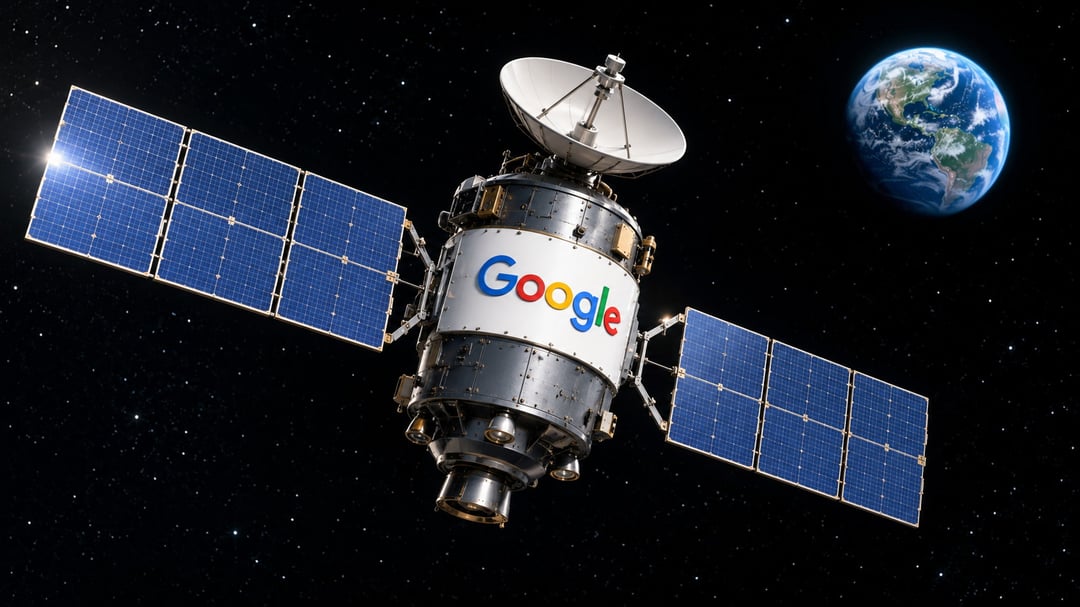
Google is moving Project Suncatcher from an idea into an engineering test. The company plans to launch its first test satellite, called MVP, on October 1 aboard a SpaceX Falcon 9 rocket.
The satellite is intended to test whether AI computing can operate in orbit. Google has explored the concept of space-based AI data centers for almost a year, and this first launch puts that work into a real-world environment.
Why Google Is Considering AI Data Centers in Orbit
AI requires substantial power, while building additional data centers on Earth is becoming more difficult because of physical limits and public pushback.
Google says solar panels in the right orbit could generate up to eight times more energy than panels on Earth. In orbit, they could also receive sunlight nearly all the time.
That energy potential is the central idea behind Project Suncatcher: use solar power in space to run AI computing hardware rather than relying solely on ground-based data centers.
What Google’s MVP Test Satellite Includes
MVP is roughly refrigerator-sized. It carries four of Google’s TPU chips, providing computing capacity comparable to one data center server.
Its solar panels produce around one kilowatt of electricity, about the same amount of power used by a hair dryer.
The satellite will process simple AI queries for one year. It may remain in orbit for up to six years before burning up during reentry.
Cooling AI Chips in Space
Keeping the chips cool has been Google’s biggest technical challenge. Conventional cooling fans do not work in space, so the company developed a layered cooling system instead.
Heat moves away from the chips through several materials:
- A putty-like material
- Aluminum
- Copper
- A radiator panel that releases heat into space
Even with this setup, the chips can operate for only about 15 minutes at a time before they must power down and cool off.
Radiation is another issue for computing hardware in orbit. Google’s tests found that the chips handled radiation well, and a simple restart usually resolved glitches.
Google’s Plans for Future Space-Based AI Computing
Google does not expect Project Suncatcher to become usefully operational within the next few years. James Manyika compared the effort to Google’s long development path for self-driving cars.
Still, the company has plans beyond the MVP mission. Google intends to launch two more satellites next year and eventually operate fleets of more than 80 satellites together.
Google is not alone in exploring orbital data centers. SpaceX, Blue Origin, and other companies have proposed large satellite constellations that could function as data centers in space.
If Google’s work succeeds, some future Gemini responses could be processed in orbit without users noticing where the computing happened.