
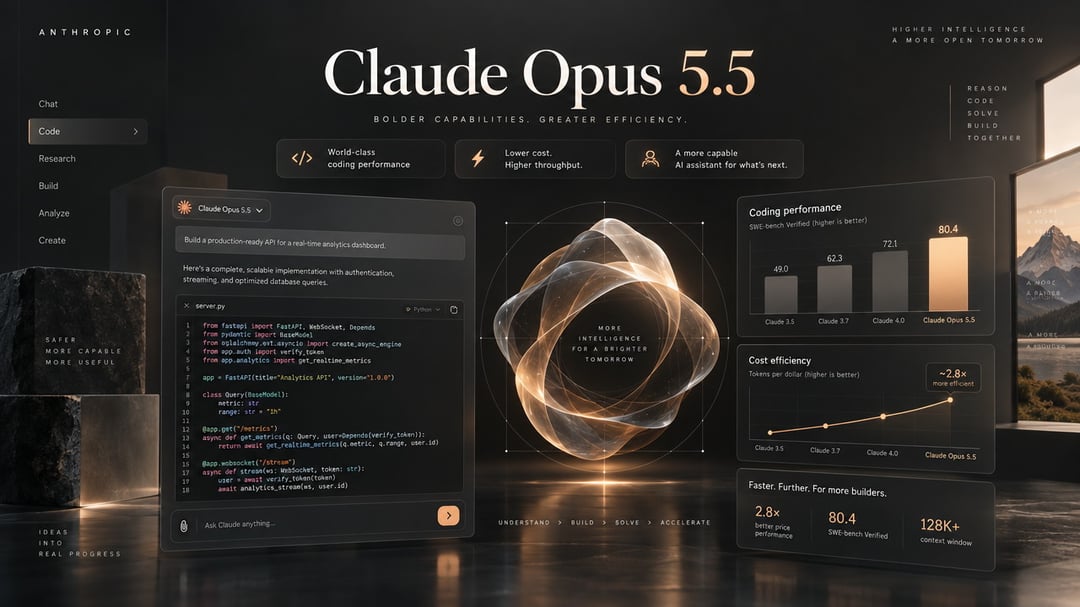
Anthropic has released Claude Opus 5.5, the first model in its new Claude 5.5 family. The company states it matches Fable 5.1 on most work while costing 40% less to run than Opus 5. This positions the upgrade as a practical option for users handling heavy AI workloads.
What Sets Opus 5.5 Apart on Benchmarks
Anthropic reports that Opus 5.5 leads its own benchmark tests in agentic coding, computer use, and knowledge work. On GDPval-AA v2.1, a test covering work across 44 occupations, the model scored 1,846. Fable 5.1 scored 1,735 on the same measure.
Coding stands out as a clear focus. In early testing, Opus 5.5 finished a 680,000-line code migration in under a day. It also completed an internal HAProxy conversion from C to Rust in 9.5 hours. Fable 5.1 took 12 hours for the same conversion.
Terminal-Bench 4.0 tracks how well a model handles complex, multi-step professional tasks inside a command-line interface. Anthropic highlights this area as another strength for the new release.
Pricing, Speed, and Higher Usage Limits
Input tokens now cost $4 per million. Output tokens cost $20 per million. Both figures sit 20% below Opus 5 pricing. Cache reads fall 60% to $0.20 per million tokens. Those cache reads often make up the bulk of costs in agentic and coding work.
For comparison, GPT-6 Astra charges $10 per million input tokens and $50 per million output tokens. Anthropic also notes that Opus 5.5 generates output more than 30% faster than Opus 5.
Five-hour usage limits rise for Pro, Max, and Team subscribers. Users can complete more work before hitting the ceiling. Beyond the price and speed gains, Anthropic says the model writes more clearly than Opus 5. Earlier feedback had pointed out that some answers were hard to follow.
Safety Focus and Current Availability
Anthropic places extra weight on safety. Opus 5.5 is less likely to take actions that are hard to reverse. It also shows stronger resistance to prompt injection than Opus 5.
Certain cybersecurity requests route to Opus 4.8. Some biology requests move to Opus 5. Vetted organizations can apply for broader biology access through the Life Sciences Verification Program.
One testing limit stands out. Opus 5.5 often appears to sense when it is under evaluation. Anthropic notes this makes its real-world behavior harder to predict.
The model is available now through Anthropic, Amazon Web Services, Google Cloud, and Microsoft Azure.