
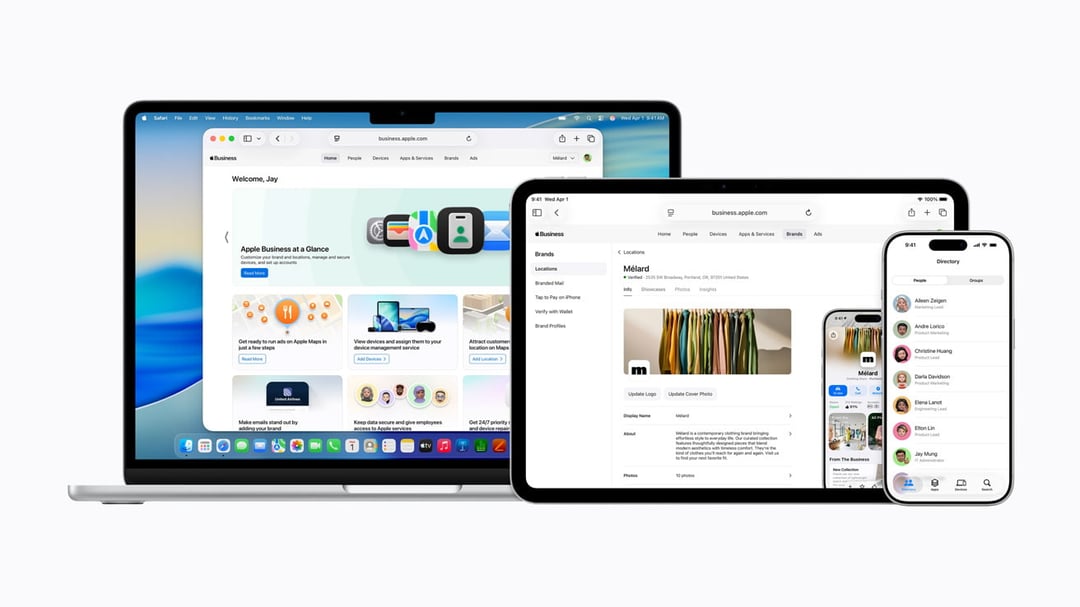
Apple Business brings device management, email, and brand tools into one platform
Apple has introduced Apple Business, a new all-in-one enterprise platform that brings together the company’s previously separate business services into a single dashboard. The platform will launch on April 14 in more than 200 countries and regions.
This move brings Apple’s business tools under one roof and makes mobile device management free for organizations worldwide. It also expands Apple’s presence in the enterprise space with built-in business email, calendar, and directory features that are offered without the per-user charges commonly associated with competing platforms.
Apple merges three business services into one dashboard
Apple Business combines management, support, and brand tools
Apple Business unifies three existing services into one portal: Apple Business Manager, Apple Business Essentials, and Apple Business Connect. Inside the new platform, organizations can manage devices, people, brand presence, and support from a single place.
Existing customer data will migrate automatically when the platform goes live. That means current users of those earlier services will move into the new experience without needing to rebuild their setup from scratch.
Free mobile device management is the biggest change
One of the most significant updates is that mobile device management will now be included at no cost. Previously, that capability was part of the paid Apple Business Essentials subscription.
Customers using Business Essentials will stop being charged the monthly service fee after April 14. That change lowers the barrier for organizations that want centralized control over Apple devices without adding another recurring cost.
Blueprints adds zero-touch deployment for IT teams
The platform also introduces Blueprints, a zero-touch deployment feature designed for IT administrators. With Blueprints, device settings and apps can be preconfigured in advance so new Apple devices are ready to use right out of the box.
That setup is aimed at simplifying rollout and reducing manual work when businesses deploy new hardware across teams.
Free hosted email and calendar expand Apple’s business offering
Custom domain email supports up to 500 users
Apple Business includes fully hosted email, calendar, and directory services with support for custom domains for up to 500 users per organization. Businesses can either buy a domain directly through Apple or bring their own existing domain.
This gives organizations a way to set up branded communication tools within the same platform they use to manage devices and internal access.
Each account includes iCloud storage with upgrade options
Every account includes 5GB of free iCloud storage. For organizations that need more space, upgrades are available up to 2TB.
That storage model gives businesses a built-in starting point while leaving room to scale based on their needs.
Email and calendar work beyond Apple hardware
The email service supports IMAP, and the calendar supports CalDAV. That means these tools can work across Android and Windows devices in addition to Apple products.
That cross-platform compatibility makes the offering broader than a hardware-only solution and gives businesses more flexibility in mixed-device environments.
Apple Business positions itself against Google Workspace and Microsoft 365
Apple takes a direct shot at paid per-user business suites
Apple Business stands out by including email, calendar, and device management tools at no cost, while competing platforms commonly charge on a per-user basis for similar services.
The launch marks Apple’s clearest push yet into the enterprise productivity market long shaped by Google Workspace and Microsoft 365. By removing fees from core business features, Apple is making a stronger case for organizations that want a simpler and lower-cost starting point.
Apple Business appears focused on startups and smaller organizations
The platform may appeal most to new companies
Industry observers view Apple Business as a strong fit for startups and newer businesses rather than companies already deeply committed to Google or Microsoft systems.
The appeal is straightforward: a business buying a MacBook and iPhone can now also get device management, custom domain email, and a company calendar in one place at no added cost.
New software requirements apply to key features
The Apple Business app, along with the email, calendar, and directory functions, will require iOS 26, iPadOS 26, or macOS 26.
That means access to some of the platform’s newer capabilities depends on using the required operating system versions.
Brand management remains part of the platform
Businesses can manage how they appear across Apple services
Apple Business keeps the brand management tools that were previously part of Apple Business Connect. These features let companies manage how their brand appears across Apple Maps, Wallet, Siri, and other Apple services.
For businesses that want both operational tools and customer-facing brand control in one system, that adds another layer to the platform’s value.