
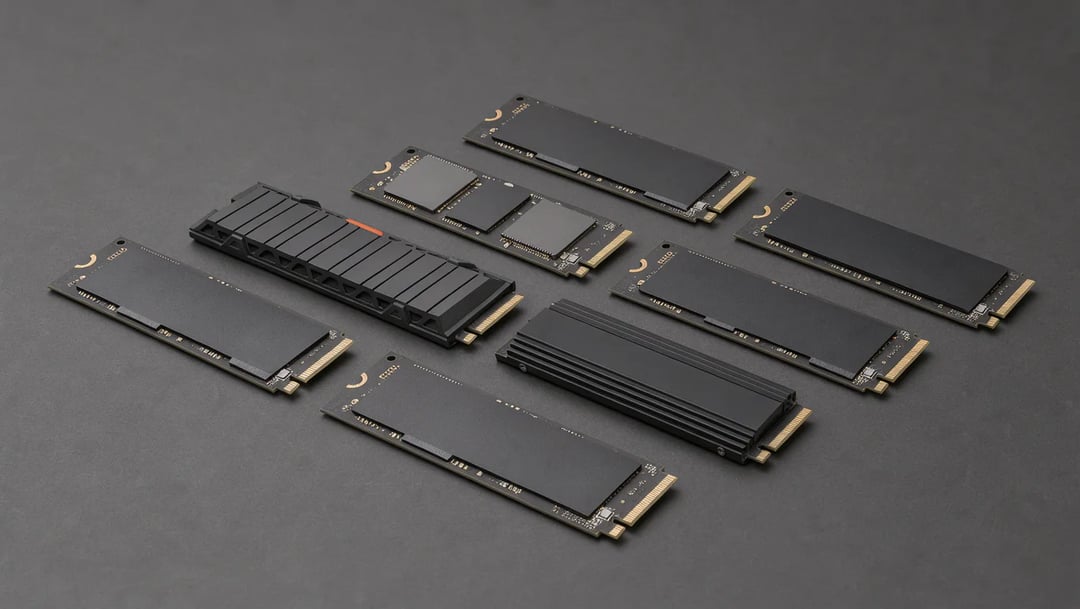
Buying a fast SSD on a budget is harder than it looks, because spec sheets push peak speeds while hiding whether a drive has its own DRAM cache. This guide covers the 8 Best Budget PCIe 4.0 and 5.0 NVMe SSDs With DRAM Cache Worth Buying Today, from the Crucial T500 and WD_BLACK SN850X to the PCIe 5.0 Crucial T700 and Corsair MP700 Pro SE.
You will learn when DRAM matters for gaming, development or office work, and when a cheaper DRAMless drive is enough. You will also see whether PCIe 5.0 is worth the extra cost over PCIe 4.0, and what trade-off comes with each pick.
By the end, you can match a drive to your workload and budget, check that your motherboard or laptop supports it, and avoid paying for speed you will not notice.
How we chose these budget NVMe SSDs with DRAM cache
Every drive here had to pass the same six checks: confirmed onboard DRAM, PCIe generation, sustained write behavior, heat, endurance and warranty, and value per terabyte. Some SSD lines ship with different components across production runs, so verify the exact model and capacity before you buy.
DRAM cache vs DRAMless SSD comes down to how the drive tracks where your data lives. A DRAM chip holds that map on the drive itself. DRAMless models borrow a slice of system memory through the host memory buffer (HMB), which works well for light use. Most people browsing and gaming will not notice the gap. Heavy mixed workloads, such as compiling code, running virtual machines or copying large project folders while other tasks run, are where onboard DRAM keeps response times steadier.
PCIe 5.0 SSD value is harder to justify on a budget. The interface raises peak bandwidth, but most everyday and gaming tasks rarely use it, while the drives cost more and run hotter, often needing a good heatsink. For example, a game that loads in about the same time on either generation gives you nothing for the extra spend. We treat PCIe 4.0 as the default and PCIe 5.0 as a deliberate choice.
We quote no prices or benchmarks here. Check the current listing before you commit.


