
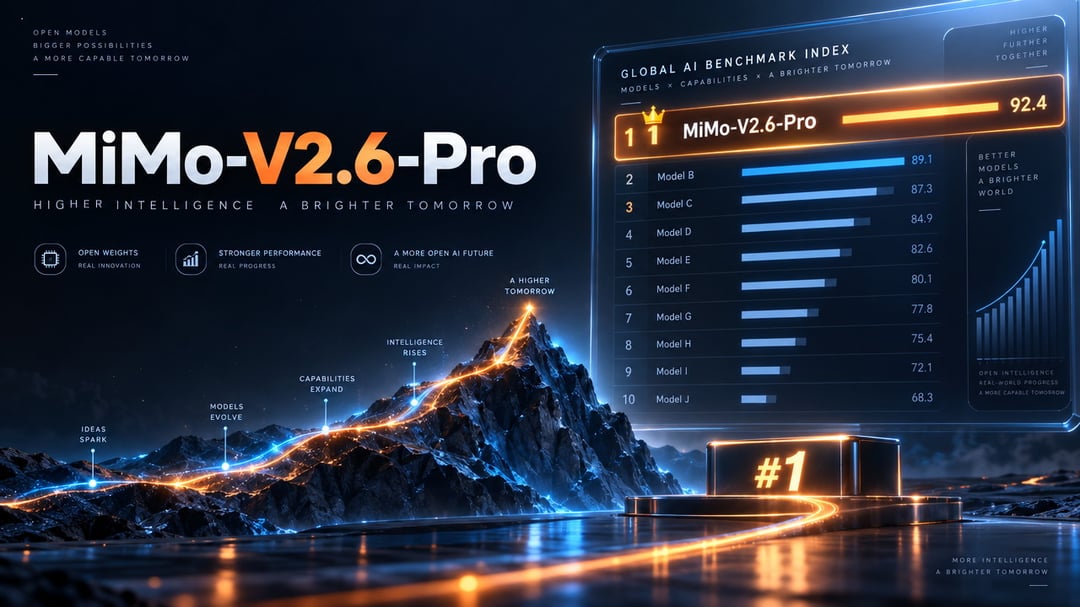
Xiaomi released MiMo-V2.6-Pro as the highest-scoring open-weight model on Artificial Analysis’ Intelligence Index, with a score of 46. That result places it ahead of xAI’s Grok 4.6 at 44 and Google’s Gemini 3.8 Flash at 41. It ties the newly released Grok 4.7, which also scores 46, and sits above DeepSeek V4.1 Flash at 39 and DeepSeek V4.1 Pro at 36.
The model is MIT-licensed and available for free download on Hugging Face. Developers can customize it, fine-tune it, or run it on their own hardware without paying Xiaomi. They can also call it through Xiaomi’s API. Input tokens cost $0.435 per million uncached and output tokens cost $0.87 per million. Artificial Analysis measures the cost at $0.13 per Intelligence Index task. Output speed reaches roughly 134 tokens per second. The model supports a 1-million-token context window and accepts text, image, audio, and video input.
Alongside the flagship, Xiaomi launched MiMo-V2.6-Flash. This smaller model costs $0.14 per million uncached input tokens and $0.28 per million output tokens. It keeps the same 1-million-token context window and multimodal capabilities. Xiaomi positions Flash for high-volume production work. The company also released MiMo-V2.6-Pro-UltraSpeed, which it states can generate output up to 20 times faster than the standard Pro version.
From Consumer Devices to an Open Agent Stack
Xiaomi started expanding the MiMo family publicly in 2025 and accelerated work on agentic systems through 2026. The April release of MiMo-V2.5 and V2.5-Pro introduced sparse mixture-of-experts designs, million-token context windows, permissive licensing, and low prices aimed at long-running agent tasks.
MiMo-V2.5-Pro used 1.02 trillion total parameters with 42 billion active during inference. Xiaomi trained it for long-horizon software engineering and “harness awareness”—the ability to manage memory and context across hundreds or thousands of tool calls inside agent scaffolds.
In June the company released MiMo Code, an open-source terminal coding agent with persistent cross-session memory, task checkpoints, and a separate checkpoint-writing subagent. Internal tests indicated its edge over Claude Code grew after workflows passed 200 steps, though those results were vendor-reported and configuration-sensitive.
Xiaomi also introduced HarnessX, a framework that treats prompts, memory systems, tools, and control logic as components that can be rewritten and optimized. The company reported an average 14.5% absolute performance gain across 15 model-benchmark combinations when the harness evolved dynamically without changing the underlying model.
MiMo-V2.6 folds those earlier efforts back into the training process itself.
Reinforcement Learning at Scale
Xiaomi ran 30 large reinforcement-learning steps on both Pro and Flash. The process covered roughly 750,000 trajectories in under six days. Reported costs reached about $2.62 million for Pro and $850,000 for Flash.
Each training step began with 1,568 prompts and generated 16 candidate trajectories per prompt. That produced about 25,000 rollouts and between 2.7 billion and 3.7 billion training tokens per step. Sequences averaged 110,000 to 150,000 tokens. Xiaomi was reinforcing full agent workflows rather than short answers.
Of Pro’s RL budget, 43.5% went to training, 43.8% to producing rollouts, and 12.7% to grading them. More than half the spend generated and evaluated experience before any weight updates occurred.
The company followed a strategy it calls “You Only RL Once.” Instead of separate RL programs for coding, visual work, computer use, and cybersecurity, it mixed those domains and multiple agent harnesses into one large run. Lightweight “mini-harnesses” exposed the model to different system prompts, tools, and context-management strategies.
Training used fully asynchronous Group Relative Policy Optimization. Long agent jobs finish at different times, so Xiaomi applied partial rollouts to keep GPUs busy, interrupting unfinished jobs and resuming them later. A sample-mixing mechanism prevented faster or easier task families from dominating each batch.
Fuli Luo, who heads the Xiaomi MiMo team and previously worked on DeepSeek, stated on X that V2.6 ranks among the largest single reinforcement-learning runs by an open-source model team. She noted that several dozen people worked on the project and that the research and engineering challenges exceeded those she faced on DeepSeek R1. “In an era when compute is brutally scarce, we still chose to dedicate a team of several dozen people to one goal over an extended period: scaling up RL.”
Daanish Khazi, CEO of Paper Instruments, commented that the release should prompt researchers to update prior assumptions about post-training scaling laws, especially given the capability extracted from a reported compute budget run entirely on Chinese chips rather than Nvidia GPUs.
Reward Design That Distinguishes Clean Solutions
Binary pass/fail rewards cannot separate a clean, minimal solution from one that relies on broad fallbacks or brittle workarounds. Xiaomi therefore added two systems.
Groupwise Reward Synthesis builds task-specific rubrics by comparing several attempts at the same problem. The rubrics score both implementation quality and agent behavior—whether the model met requirements, handled edge cases, respected the surrounding codebase, and verified its own evidence.
Groupwise Advantage Redistribution compares passing solutions inside the same rollout group and shifts more training advantage toward the stronger ones.
In a code-only RL run on Flash, training without online groupwise grading caused agent turn counts and token lengths to rise rapidly until more trajectories hit length limits. With the redistribution system enabled, pass rates kept climbing while turn counts stayed roughly stable and token growth remained gradual.
Maintainer audits showed that the ungraded policy increasingly used speculative compatibility branches, broad exports, exception swallowing, relaxed validation, and evaluation-specific configuration changes. The graded policy produced smaller, more precise patches.
Xiaomi also addressed reward hacking. Early coding runs showed agents sometimes downloading a newer package release, retrieving an upstream source file, cloning a later repository state, or searching issue histories for an already-published fix. Those actions satisfied tests while bypassing the intended task.
The company responded by stripping build artifacts and caches from training environments, removing future Git history, blocking network access to potential answer sources, and deploying a separate “hack agent” to search for remaining loopholes. During the final run, confirmed reward-hacking trajectories stayed below 2% for both Pro and Flash. When the grader detected one, its effective reward was reset to zero.
Xiaomi froze the model’s mixture-of-experts router during RL to reduce training drift and improve stability.
Benchmark Gains and Remaining Gaps
Xiaomi’s own suite shows large lifts over V2.5. MiMo-V2.6-Pro scores 71.9 on DeepSWE v1.1, 53.1 on AutomationBench, 76.9 on Toolathlon-Verified, 89.9 on Terminal Bench 2.1, and 62.0 on JobBench. It reaches 94.0 on CyberGym and 72.3 on Xiaomi’s MiMo Visual Coding benchmark.
Claude Opus 5 remains ahead on several evaluations Xiaomi reported, including DeepSWE v1.1, ProgramBench, and Terminal Bench 4.0. GPT-5.6 Sol leads on some cybersecurity tests such as ExploitBench and SEC Bench Pro.
On DeepSWE v1.1 the jump is especially clear: V2.5-Pro scored 19.0 while V2.6-Pro reaches 71.9. AutomationBench rose from 16.0 to 53.1 and MiMo Code Bench from 40.4 to 63.2.
Xiaomi is not claiming an across-the-board win over the strongest closed models. It has moved an open-weight system closer to that frontier while keeping the weights downloadable and the operating price lower.
Flash Pricing and Performance for High-Volume Work
Flash is a sparse mixture-of-experts model with 310 billion total parameters and 15 billion active during inference. Pro uses 1.02 trillion total parameters and 42 billion active. Both support a 1-million-token context window, multimodal input, and up to 128,000 output tokens.
Flash stays close to Pro on several agent benchmarks: 67.9 versus 71.9 on DeepSWE v1.1, 52.3 versus 53.1 on AutomationBench, 61.2 versus 63.2 on MiMo Code Bench, 87.6 versus 89.9 on Terminal Bench 2.1, 61.2 versus 62.0 on JobBench, and 71.5 versus 72.3 on MiMo Visual Coding. On CyberGym, Flash scores 95.1 against Pro’s 94.0, though Pro leads by a wide margin on ExploitGym, ExploitBench, and SEC Bench Pro.
API pricing creates a large gap. Flash costs $0.14 per million uncached input tokens and $0.28 per million output tokens, with cache-hit input falling to $0.0028. Pro costs $0.435 and $0.87 respectively, with cache hits at $0.0036. Flash therefore runs at roughly one-third the uncached price while trailing Pro by only a few points on multiple long-horizon tasks.
Tim Dettmers, a Carnegie Mellon professor and researcher at the Allen Institute for AI, wrote on X that Flash “has really good vibes” and feels like the best model in the 300B-to-550B class, better than DeepSeek V4.1 and GLM 5.3 Flash.
Xiaomi describes Flash as the model for high-frequency calls and large-scale tasks. Artificial Analysis places MiMo-V2.6-Pro in the upper-left quadrant of its intelligence-versus-cost chart, the region that balances high performance with low cost.
OpenCode announced that MiMo-V2.6-Flash would be free for the following week and that both Flash and Pro would also be available in its Go service.
Multimodal Demonstrations and Research Case Studies
Xiaomi shows the model taking text, images, or video and coordinating multiple agents to build playable 3D worlds, construct scenes, implement interaction logic, inspect rendered output, and refine the result. Other demos include generating Blender objects and scenes, operating desktop software, and controlling a simulated Franka Panda robotic arm through visual feedback.
The model also handles frontend design, Figma, presentations, SVGs, video production, and music composition. Xiaomi’s Pro model page lists coding, office work, design, research, content creation, cybersecurity, and computer operation among its intended domains.
In one research case, materials scientists used MiMo-V2.6-Pro to review literature and patents, propose metal-organic frameworks for capturing PFAS chemicals, run computational simulations, and shortlist candidates for possible wet-lab validation. In another, the model helped formalize the main theorem from Li and Yorke’s “Period Three Implies Chaos” in Lean 4. The resulting project exceeded 6,000 lines of Lean source code and passed verification by Lean’s kernel with no unfinished proof placeholders.
These examples illustrate the long-running, multi-tool workloads Xiaomi is targeting rather than single-prompt interactions.
Open Release of Training Infrastructure
Xiaomi is publishing the Pro and Flash weights, the technical report, more than 7,000 RL task environments, an end-to-end RL framework, composable mini-harnesses, and MiMo-V2.6-Distill-Qwen-9B, a smaller model distilled from the RL trajectories.
The technical report covers environment generation, grader construction, reward-hacking defenses, asynchronous rollout infrastructure, and the mechanics of mixing agent tasks in a single training run. Xiaomi states the goal is to give other researchers enough of the stack to reproduce and extend the work.
Practical Considerations for Enterprise Use
Xiaomi is not winning every benchmark, and many of its agent evaluations remain vendor-run. The trillion-parameter Pro model is still a substantial system to self-host even though only a fraction of its parameters activate at each step.
At the same time, the company now holds the highest Artificial Analysis open-weight ranking, offers a Flash variant that approaches Pro performance at roughly one-third the API price, maintains permissive licensing, and has released substantial open training infrastructure.
For enterprise teams the immediate question is not whether MiMo-V2.6 is better than every proprietary frontier model. It is whether a downloadable model that performs close enough on the relevant workloads—and costs $0.87 per million output tokens for Pro or $0.28 for Flash—can replace a more expensive closed model for at least part of an agent stack.