The Omnissa State of Digital Workspace 2026 Report: What the Data Actually Shows
A major global study of business device data has finally provided concrete numbers for a long-standing debate in IT departments—and the news isn’t great for Windows. Omnissa, a company specializing in digital work platforms, analyzed anonymous data from millions of managed devices across more than 17 industries worldwide throughout 2025. The results reveal a complicated IT environment where the rise of AI, a mix of different platforms, and uneven security practices are making it harder than ever to manage enterprise systems.
Windows vs. macOS Stability: The Numbers That Stand Out
Forced Shutdowns, App Crashes, and Hangs
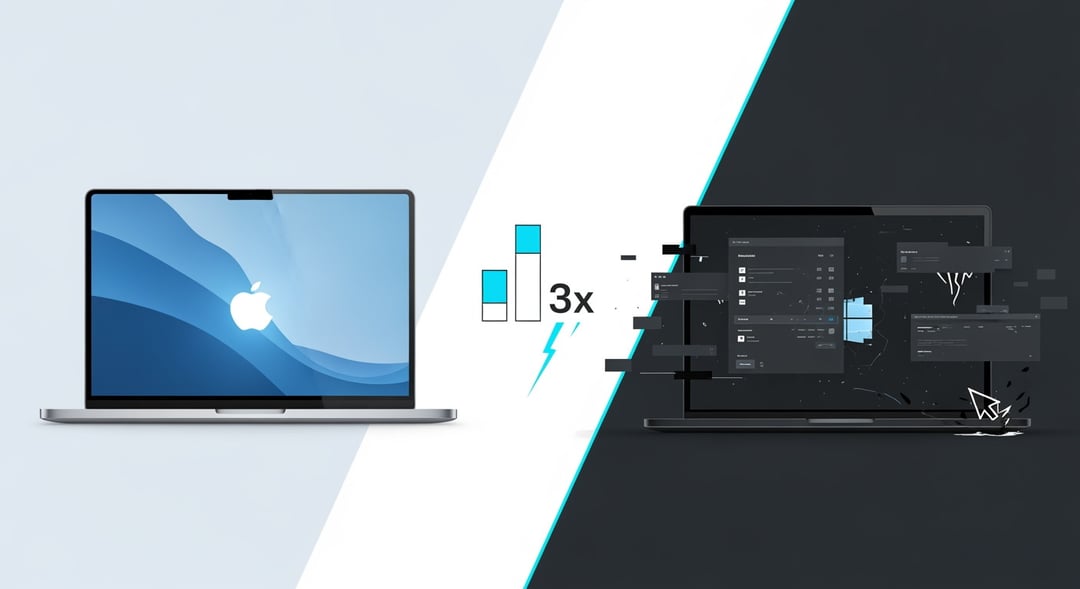
The productivity gap between Windows and macOS in enterprise settings is more concrete than most IT leaders probably want to admit. According to Omnissa's telemetry data, Windows devices experienced 3.1 times more total forced shutdowns than macOS devices. That's not a rounding error — that's a structural difference in how often employees are yanked out of their workflow by a machine that simply stops cooperating.
It doesn't stop there. Windows also logged 2.2 times more total application crashes than macOS, and — perhaps most striking — 7.5 times more app hangs. An app hang is that maddening moment when the software is technically still running but completely unresponsive. You're sitting there, clicking, waiting, wondering if it's going to come back. Multiply that across thousands of employees and you start to see why this matters at scale.
The Real Cost: 24 Minutes of Lost Focus Per Disruption
Here's what makes these numbers genuinely alarming from a business perspective. Omnissa's research highlights that employees need almost 24 minutes to refocus after a single disruption to their workflow. So every crash, every hang, every forced shutdown isn't just a few seconds of inconvenience — it's potentially half an hour of fractured concentration. When you're dealing with 3x more forced shutdowns on Windows devices across an entire organization, the cumulative productivity loss becomes significant fast.
Hemant Sahani, Vice President of Product Management at Omnissa, framed the challenge this way: converging device experience, security, and management telemetry gives teams the context they need to close the gap between what they assume is happening in the workspace and what the data actually shows is occurring.
Shadow AI: The Governance Gap Growing Inside Enterprise Walls
AI App Usage Surged Nearly 1,000% in 2025
One of the most striking findings in the report has nothing to do with crashes — it's about the explosion of AI tool adoption inside organizations. AI assistant app usage grew nearly 1,000% in 2025 across all major operating systems. That's not a typo. And the critical detail is that much of this growth is happening outside IT governance, as employees bring their own preferred tools into daily workflows without formal approval or oversight.
Copilot, ChatGPT, and Gemini Dominate Enterprise Devices
The report's data on specific AI tools is revealing. Copilot was deployed on 97.5% of enterprise-managed mobile devices across both iOS and Android — a sign of how aggressively Microsoft has pushed its AI assistant into the enterprise stack. But employees aren't just using what IT gives them. ChatGPT was found installed on 91% of enterprise-managed iOS systems, and Gemini on 61% of enterprise-managed Android systems — both employee-installed, both operating largely outside formal IT governance structures.
This creates what Omnissa calls a "shadow perimeter" — a growing blind spot where the tools employees actually rely on diverge from the ones IT teams have visibility into and control over.
Security Hygiene: Regulated Industries Are Falling Behind
Healthcare, Pharma, and Education Ranked Lowest for Compliance
You'd expect the most heavily regulated industries to have the tightest security posture. The data suggests the opposite. Omnissa found that healthcare, pharma, and education ranked lowest in maintaining device updates and ensuring data encryption — the two most basic pillars of endpoint security hygiene.
Specifically, more than 50% of Windows and Android devices in healthcare and pharma were five major OS updates behind. Five. That's not a patch or two — that's a significant exposure window. And in education, more than 50% of desktops and mobile devices were unencrypted, meaning sensitive data sits on devices with essentially no protection if those devices are lost or compromised.
These aren't edge cases. They represent systemic compliance gaps that create serious risk for organizations that, by definition, handle some of the most sensitive data in existence.
Device Lifecycles and Total Cost of Ownership
Macs as Six-Year Assets, Windows PCs as Three-Year Assets
The report also surfaces an interesting economic reality around device lifecycle planning. Organizations purchasing Macs are effectively treating them as six-year assets, while those purchasing Windows PCs are working with a three-year asset lifespan. That difference has real implications for total cost of ownership calculations — a longer-lived device spreads its upfront cost over more years of productive use.
Windows Dominates Government, Android Leads Frontline Verticals
Not every industry is moving in the same direction. Government environments continue to lean heavily on Windows desktop platforms, with the report noting 2x desktop growth in government over the past year. On the other end of the spectrum, frontline-heavy sectors like retail and wholesale show a clear concentration of ruggedized Android devices, which account for 34% of Android devices in those verticals. Transportation environments show a strong preference for iPad Mini, which represents 53% of all iPads in that sector.
Methodology
The research draws on anonymized and aggregated telemetry data collected from millions of enterprise endpoints between January and December 2025. The dataset spans enterprise environments globally, covering more than 17 industries including high tech, retail, healthcare, financial services, education, and government. Telemetry signals were derived from device, application, and system activity across supported endpoints and operating systems, with all data analyzed in aggregate to surface trends across the digital workspace.