That Right-Click? Yeah, That's Windows 95 Calling
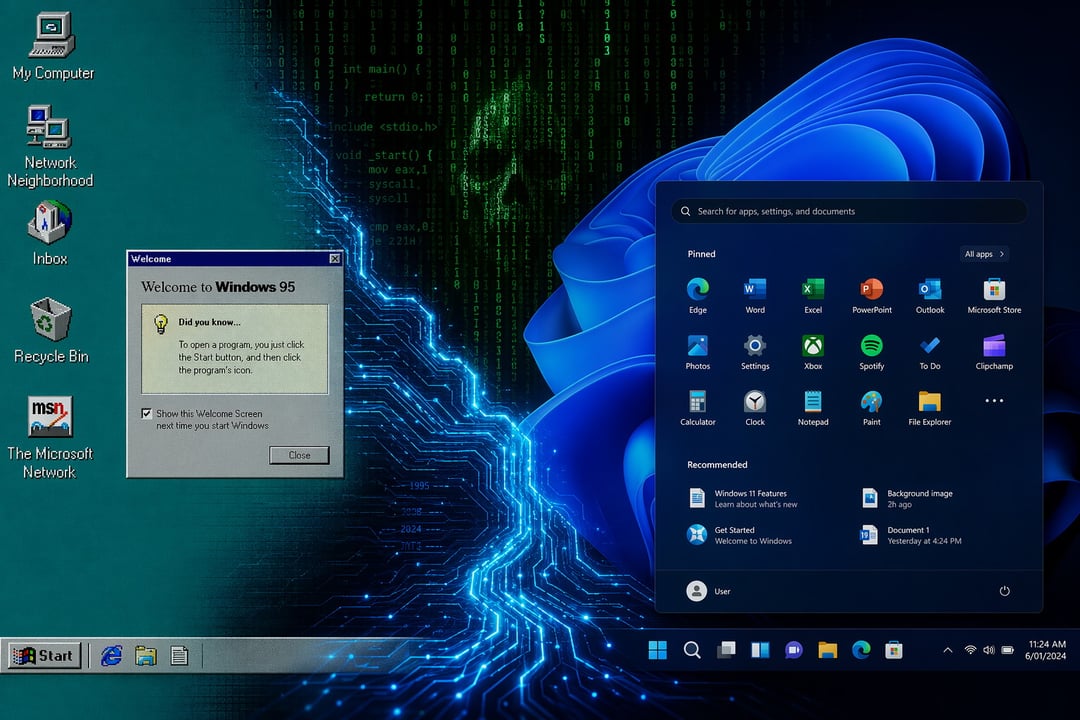
You know that moment when you right-click a file on your shiny Windows 11 machine — the one Microsoft keeps calling the most modern, most secure Windows ever — and a little context menu pops up? Feels pretty normal, right? Pretty current?
Here's the thing. That action is powered by code written in the 1990s.
Not inspired by the '90s. Not loosely based on something old. Actual legacy code, still quietly doing its job under the hood of the most up-to-date version of Windows, decades after anyone expected it to still be around.
The Win32 API: A Relic That Refuses to Die
We're talking about the Win32 API — the programming interface that became the backbone of Windows development back in the Windows 95 era. It had actually been implemented in Windows NT before that, but Windows 95 is when it really took hold. And it's still there, right now, powering basic functions inside Windows 11.
Mark Russinovich — Microsoft Azure's Chief Technology Officer and the founder of Microsoft Sysinternals — recently said the quiet part out loud in a video posted to social media by the Microsoft Dev Docs account. Nobody in the '90s expected Win32 to still be a first-class API in 2026. His words, not mine. He put it pretty candidly:
"Did anyone in the 90s expect Win32 to still be a first-class API surface in the year 2026? And I think I can safely answer, 'No.' Nobody, I think, would've expected that because we were thinking flying cars and moon stations by the year 2026."
Flying cars. Moon stations. Instead, we got... Win32. Still running. Still essential.
Why Nobody Pulled the Plug on It
So why is this ancient API still alive? Russinovich has a pretty clear answer: it became the bedrock. So many apps, so many technologies, so many whole ecosystems got built on top of Win32 that removing it would be like yanking the foundation out from under a skyscraper. You just... don't do that.
And it's not like Microsoft didn't try to move on. They attempted a reboot of the Windows API surface with something called WinRT — a more modern interface that was supposed to take over. It didn't play out the way anyone hoped. The gap between the old Win32 client world and the browser's HTML/JavaScript world proved too wide to bridge cleanly. So Win32 stuck around.
Honestly, there's something almost poetic about it. The tech industry sprints toward the future every single year — new models, new frameworks, new everything — and yet some of the most fundamental things just don't budge. They work too well. They're too deeply woven in.
It's Not Just Win32 — Other Old-Timers Are Still Running, Too
Russinovich used the rest of his video to point out a few other tools that were written decades ago and are still very much in active use. Sysinternals itself — the suite of Windows troubleshooting utilities he founded — is one of them. So are Sysmon and ZoomIt. These aren't museum pieces. They're working tools that IT professionals reach for regularly, even today.
Sysmon, in fact, has gotten so useful that Microsoft has moved toward baking it directly into Windows 11 itself. That's not the behavior of a dying legacy tool — that's a promotion.
What This Actually Tells Us About Windows
Here's what I take away from all this: Windows isn't really a clean, modern operating system. It's more like a city that's been continuously inhabited for decades. Some neighborhoods have been completely rebuilt. Others still have the original plumbing from 1995. And the whole thing keeps running because, somehow, the old pipes and the new glass towers learned to coexist.
Microsoft can call Windows 11 modern all they want — and in many ways it is. But underneath the rounded corners and the AI features, there's a quiet layer of '90s code just doing its thing, completely unbothered.