
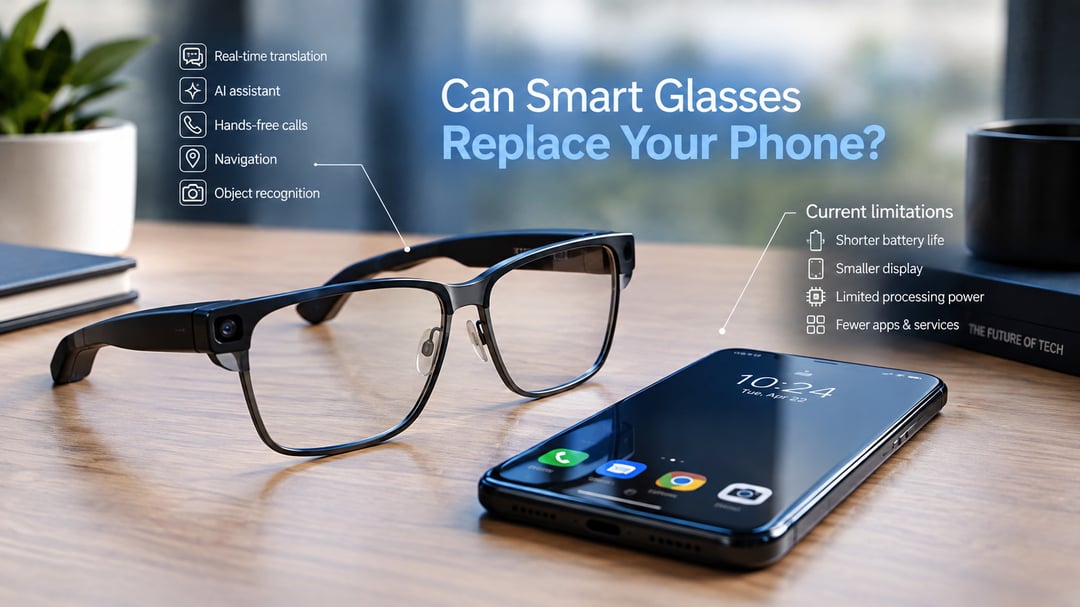
Smart glasses make an appealing promise: look ahead, speak naturally, and get directions, translations, messages, or a camera without reaching into your pocket. It’s easy to picture them replacing the smartphone.
That won’t happen soon.
Smart glasses will likely take over short, hands-free tasks first. The smartphone will remain the better tool for work, browsing, payments, long messages, and anything that needs a large screen or precise input. The real shift won’t be one device suddenly replacing another. It’ll be a gradual change in which device you use for each moment.
Will Smart Glasses Replace the Smartphone? The Realistic Answer
Smart glasses can replace parts of smartphone use. They can’t yet replace the smartphone as a complete personal computer.
A capable pair of glasses could handle quick interactions: receiving an urgent message, asking for a restaurant recommendation, taking a photo, listening to a call, following walking directions, or translating a street sign. These are moments when pulling out a phone feels slightly clumsy.
But phones handle more than quick interactions. They’re cameras, wallets, navigation tools, identity devices, workstations, entertainment screens, and private communication hubs. A person can review a spreadsheet, compare flight options, edit a photograph, approve a bank transfer, or write a detailed message on a phone. Smart glasses still struggle with each of those jobs.
That distinction matters. Smart glasses may reduce how often you look down at a phone. They won’t make the phone unnecessary until they can match its versatility without becoming heavy, distracting, or socially uncomfortable.
Why Smart Glasses Have a Harder Hardware Problem
A smartphone has room for a large battery, high-performance processor, camera system, antennas, cooling components, and a bright display. It sits in your hand or pocket, so weight and heat are manageable.
Glasses sit on your face. Every extra gram matters.
A smartphone replacement needs cameras, microphones, speakers, wireless radios, sensors, processing power, and some form of display. It must fit that hardware into a frame people are willing to wear for several hours. It also can’t get warm near the temples, slide down the nose, or make the wearer look like they’re preparing for a spacewalk.
That’s the engineering gap.
Battery Life Is the First Major Limit
Battery capacity remains the biggest obstacle to truly independent smart glasses. Cameras, displays, location services, microphones, cellular radios, and AI features all consume power. Run several at once, and battery life drops quickly.
Audio-first glasses have a simpler job. They can play sound, handle calls, accept voice commands, and capture occasional photos or videos while keeping power demands relatively controlled. Display-based augmented reality glasses face a much tougher equation because bright visual overlays need energy, especially outdoors.
People expect a phone replacement to last most of a day. A device that needs charging after a few hours is an accessory, not a replacement.
Displays Must Work in the Real World
A tiny display can show a notification or navigation arrow. That doesn’t mean it can replace a smartphone screen.
For smart glasses to replace the smartphone, users would need text that stays readable in sunlight, visuals that remain sharp without blocking their real-world view, and a wide enough field of view for maps, media, and useful interface elements. The display must also stay subtle. Nobody wants a bright rectangle floating in front of their eyes while crossing a busy street.
There’s a tension here: more display capability usually means more bulk, heat, battery drain, and cost. Smaller and lighter glasses may look better, but they often deliver less visual information.
Input Is Still an Unsolved Problem
Touchscreens work because they’re fast, private, and predictable. You can type a message silently, correct a mistake, browse a page, or tap through an app without explaining yourself out loud.
Voice control works well for simple commands: “Call Sarah,” “Set a timer,” or “What’s the weather?” It becomes less useful in noisy cafés, crowded trains, meetings, or private conversations. And nobody wants to dictate a sensitive bank message while standing in a checkout line.
Gesture controls, eye tracking, frame touchpads, rings, and wristbands may improve the situation. Still, none has proven as universally capable as a phone screen. Smart glasses will need a practical mix of voice, touch, gesture, and companion devices rather than one magic input method.
Privacy Could Slow Adoption as Much as Hardware
Smart glasses with cameras raise a simple social question: how do people know when they’re being recorded?
Visible recording lights, clearer consent policies, and responsible software design will matter. The issue becomes more sensitive in schools, workplaces, healthcare settings, gyms, and private gatherings. A technically excellent product can fail if people around the wearer don’t trust it.
AI features add another layer. Glasses may hear spoken questions, see text, identify objects, track location, and send information to cloud services for processing. Consumers will want direct answers about what the device stores, where data goes, and whether someone nearby can tell when recording begins.
The industry cannot treat privacy as a checkbox. It’s part of the product experience.
Realistic Timelines for Smart Glasses and Smartphone Replacement
Near Term: A Smartphone Companion
Over the next few years, smart glasses will likely become more useful as companion devices. Expect better camera capture, audio, notifications, translation, navigation prompts, and AI voice assistance.
The phone will still provide cellular connectivity, storage, app access, account security, and heavier computing power. In other words, the glasses may make the phone less visible, but the phone will remain close by.
Medium Term: Fewer Reasons to Pull Out Your Phone
As battery efficiency, on-device AI, displays, and controls improve, smart glasses could take over many short interactions. Travelers, cyclists, field workers, content creators, and people who benefit from accessibility features may lead adoption.
This is where smart glasses could meaningfully change habits. You may check directions through a glance instead of opening a map. You may capture a moment without holding a phone. You may ask for information without stopping what you’re doing.
But longer tasks will still move back to the phone, tablet, or laptop.
Long Term: Replacement Requires Several Breakthroughs at Once
For smart glasses to replace the smartphone, manufacturers need to solve several problems together:
- All-day battery life in a lightweight frame
- Bright, clear displays that work outdoors
- Private and reliable input methods
- Independent cellular connectivity
- Secure payments and identity verification
- Comfortable prescription-lens options
- Strong privacy protections people actually trust
- An app ecosystem built for glanceable, hands-free computing
That is a tall order. Progress in one category won’t be enough.
Smart Glasses May Become an Ambient Computer Instead
The more realistic future is not “smart glasses kill the smartphone.” It’s a division of labor.
Smart glasses could become the ambient interface: the device that gives you quick information when you need it. Your smartphone could remain the private, powerful device in your pocket for detailed work, secure transactions, and screen-heavy tasks.
Think of the glasses as the window and the phone as the engine.
So, will smart glasses replace the smartphone? Not in the near future. They’ll replace small smartphone moments first, then reshape which device we reach for by default. That may be less dramatic than a phone-free future, but it’s far more believable.