
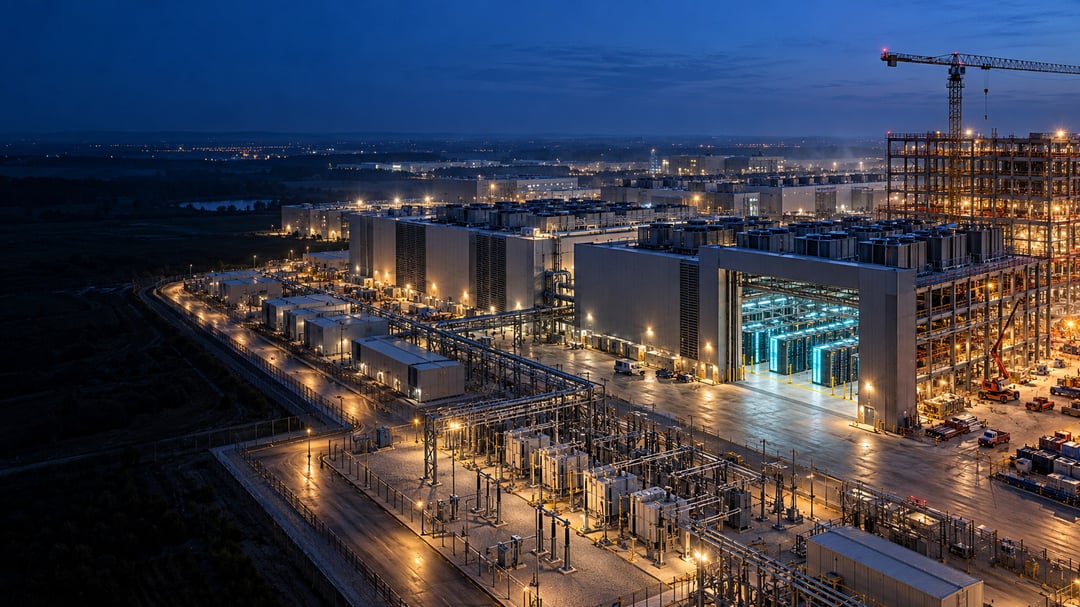
Why software companies need physical infrastructure
Understanding why Big Tech is spending billions on AI data centers requires separating immediate computing demand from expectations about future profits. These facilities support model development, customer requests, and products that companies hope will generate lasting revenue.
The business case becomes clearer through three distinctions: spending versus operating costs, training versus everyday usage, and commercial demand versus speculative expansion.
How much is Big Tech spending on AI infrastructure?
Capital expenditure, usually shortened to capex, pays for assets such as servers, buildings, and electrical equipment. It differs from ongoing expenses such as electricity and maintenance.
In its third-quarter results, Amazon projected approximately $220 billion in cash capex for 2026. Meta forecast $135 billion to $145 billion, including principal payments on finance leases.
Why headline spending totals need context
Those figures cover companywide investment rather than an exact AI budget. Forecasts also differ from completed spending and lease accounting complicates comparisons. Adding headline figures without checking their definitions can produce misleading totals.
Why Big Tech is spending billions on AI data centers
The companies share infrastructure requirements but their routes to earning money differ.
Selling AI computing through cloud platforms
Amazon, Microsoft, and Google sell computing capacity and AI services to other organizations. Expanding infrastructure allows them to serve customers without requiring those customers to build their own facilities.
Alphabet’s third-quarter disclosure identifies enterprise AI infrastructure and solutions among Google Cloud’s growth drivers. This connects construction spending with an existing commercial business.
Improving search, advertising, and workplace software
Infrastructure also supports products companies already sell at enormous scale. Alphabet links AI investment with increased search usage. Meta reports advertising benefits through stronger engagement, recommendations, and monetization.
Microsoft points to adoption across Copilot products in its earnings discussion. These are management assessments rather than independent measurements of each investment’s profitability.
Securing capacity before competitors do
Companies also build ahead because insufficient capacity can restrict sales. Microsoft reported customer demand exceeding available supply. The strategic inference is straightforward: waiting for complete certainty could leave customers purchasing capacity elsewhere.
What makes AI data centers so expensive?
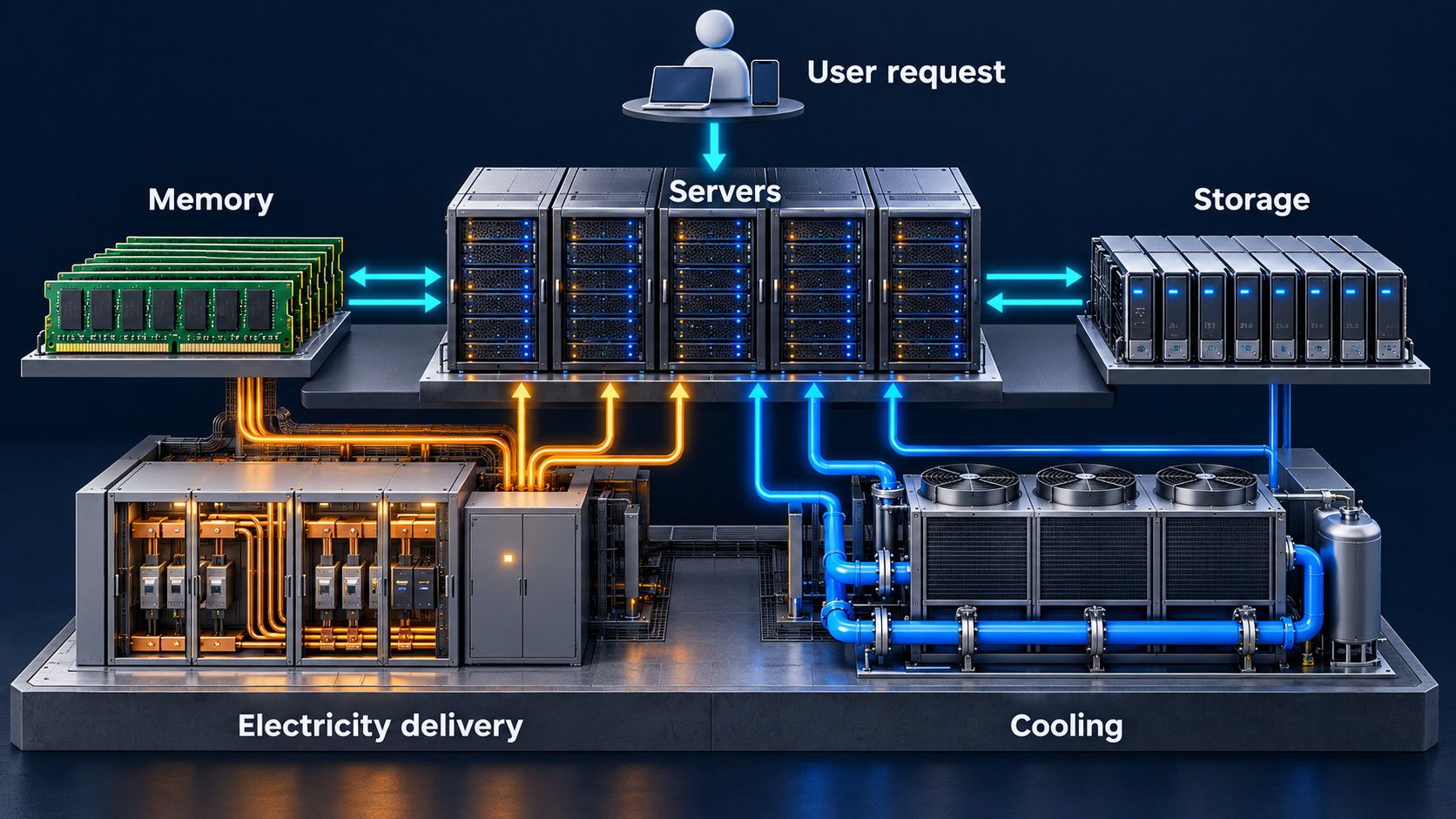
AI infrastructure spending purchases an interconnected computing system rather than chips alone.
Training models and running everyday requests
Training develops a model’s capabilities through computational work on data. Inference uses the trained model to produce outputs.
A deployed chatbot therefore keeps requiring computing resources after training finishes. Serving additional requests creates continuing capacity needs rather than a single development expense.
Chips, networking, cooling, and power equipment
Accelerators need memory, storage, and fast connections to operate effectively together. Power equipment and cooling must support the resulting installation.
NVIDIA’s infrastructure documentation describes coordinated computing, networking, power, and cooling. Its architecture explains the components involved without establishing universal costs or guaranteed investment returns.
Why electricity can limit AI data center expansion
Available funding cannot eliminate physical constraints on bringing computing capacity online.
Grid connections and equipment bottlenecks
The International Energy Agency’s updated analysis identifies constraints involving grid connections, transformers, and other energy equipment. A completed building cannot deliver its intended capacity without sufficient reliable power.
These requirements influence where developers build and when facilities become usable. Buying more processors cannot solve an electricity connection delay.
Efficiency improvements versus growing demand
The IEA projects global data center electricity consumption rising from 485 terawatt-hours in 2025 to approximately 950 terawatt-hours in 2030. These figures cover all data centers rather than AI facilities alone.
Efficiency per task and total consumption measure different things. More efficient systems can still consume more electricity overall when demand grows sufficiently.
What could prevent AI infrastructure spending from paying off?
Building capacity creates the opportunity to earn revenue without guaranteeing adequate returns.
Demand, utilization, and equipment replacement
Underused equipment generates less revenue against the investment required to install it. Hardware replacement also creates different economics from maintaining buildings.
Microsoft distinguishes shorter-lived computing assets from longer-lived infrastructure in its disclosures. Evaluating both as one uniform investment obscures their different replacement requirements.
Revenue growth does not automatically establish profitability
Electricity, maintenance, and depreciation affect the economics after construction finishes. Depreciation spreads an asset’s recorded cost across its expected useful life.
Assessment therefore requires operating margins and cash generation alongside revenue growth. Alphabet explicitly cautions that reported results do not establish future performance. Strong adoption alone doesn't settle the investment case.
Conclusion
Sustained demand explains why Big Tech is spending billions on AI data centers. Cloud services and existing products offer ways to monetize capacity.
The remaining test is whether usage and operating returns justify equipment costs, construction, and continuing expenses. Spending establishes capacity; successful economics require more than capacity alone.
FAQ
Why does AI need specialized data centers?
Large AI workloads benefit from coordinated accelerators, fast networking, and infrastructure designed for demanding power and cooling requirements.
Does every AI request require new model training?
Ordinary requests use inference with an existing trained model. They still require computing resources each time the service responds.
Is all Big Tech capital spending related to AI?
Companywide capex also includes other assets and business requirements. Headline totals therefore cannot establish precise spending exclusively attributable to AI.
Could more efficient AI reduce infrastructure demand?
Efficiency can reduce resources required per task or workload. Total infrastructure demand also depends on usage growth and increasingly demanding applications.


