
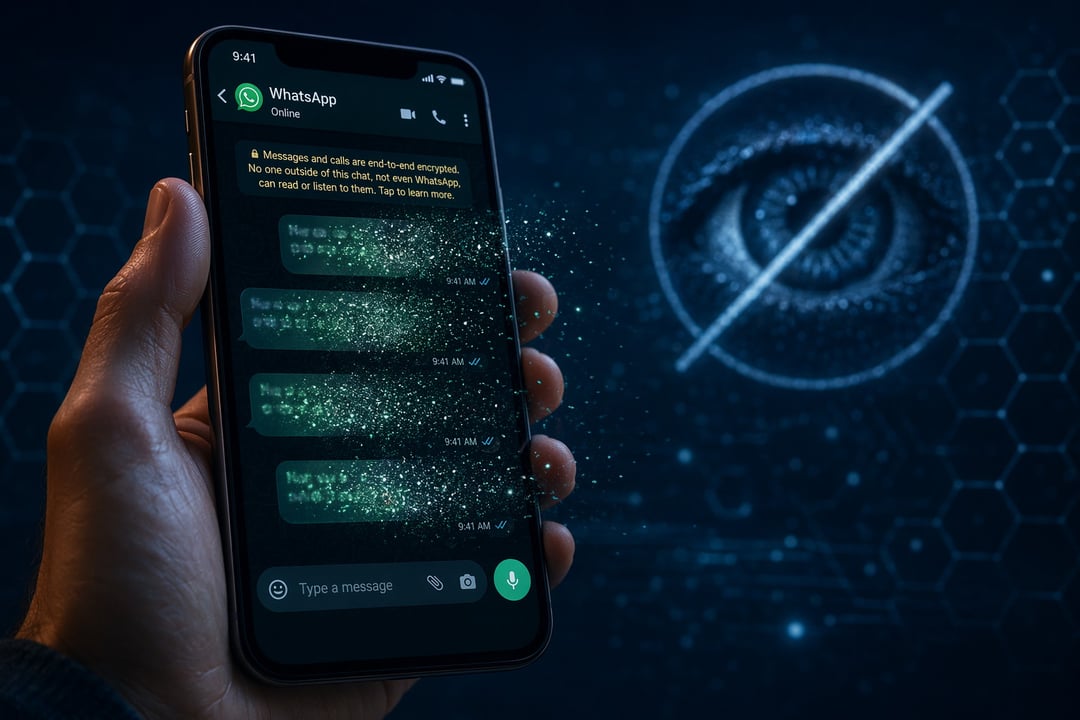
The Privacy Problem Nobody Was Really Solving
Here's the thing about AI chatbots: we've all been using them for questions we'd never type into a Google search. Health stuff. Relationship stuff. The kind of thing you'd ask a doctor or a lawyer if you could afford one on a Tuesday afternoon. And the entire time, every single major AI assistant — OpenAI, Google, Anthropic — has been storing that conversation by default.
That's... not great, honestly.
Meta just did something about it, at least on WhatsApp. The company launched Incognito Chat for Meta AI this week, and the pitch is genuinely different from what anyone else is offering. Not just "we won't use your chats for ads" different. More like "we technically cannot read them" different.
What Incognito Chat Actually Does
When you switch into Incognito Chat mode on WhatsApp or the Meta AI app, your messages get processed inside something Meta calls Private Processing — a secure enclave running on Meta's servers where even Meta's own engineers, logging systems, and commercial pipelines can't see what's happening.
The model can read your query and respond to it. But the contents never leave that enclave in a readable form.
And when the session ends? The conversation is deleted. There's no server-side record. You can't pull up your Incognito Chat history later because there's simply nothing stored to pull up.
That second part is actually underrated. A deleted conversation means even if your device gets compromised somehow, there's less residue sitting around between sessions. It's a practical benefit that goes beyond the headline privacy claim.
How It Compares to Everyone Else's "Private" Mode
Other AI apps have incognito modes too — but Meta's announcement takes a pointed shot at those. The company's framing is direct: those other modes "can still see the questions coming in and the answers going out."
The honest comparison here is Apple Intelligence, which routes certain queries through Apple's Private Cloud Compute — a similar enclave-based architecture. That's probably the closest existing analogue to what Meta has now shipped inside WhatsApp.
OpenAI, Google, and Anthropic each store conversation histories by default, with varying levels of user control. None of them have shipped an equivalent to this kind of server-side architectural privacy guarantee at scale.
The Technical Foundation: WhatsApp's Private Processing
This didn't come out of nowhere. Meta published the Private Processing architecture back in April 2025, specifically designed to let AI features run on encrypted data inside Trusted Execution Environments on Meta's servers. Incognito Chat is the first time that architecture has been deployed behind an actual user-facing feature at this scale.
Meta has also published a technical whitepaper on the cryptographic design, explicitly inviting outside review. That posture matters — it's not just a press release claim.
But here's where honesty kicks in: whether the implementation holds up under real scrutiny is a genuinely open question. Trusted Execution Environment systems have been audited and criticized across the industry. Researchers have demonstrated side-channel attacks against similar architectures from Apple, Google, and major cloud providers. And the model's resistance to a legal subpoena specifically hasn't been tested in court yet.
Why Meta Built This for WhatsApp
WhatsApp has been built for a decade around end-to-end encryption as its core identity. That created an awkward problem: a conversational AI assistant needs to read your messages to be useful. Those two things don't naturally coexist.
Private Processing is Meta's attempt to square that circle. The commercial logic is pretty clear — if you're going to bring AI into one of the world's most privacy-conscious messaging apps, you have to find a way to do it that doesn't blow up the brand promise that made the app what it is.
What's Coming Next: Sidechat
There's a second feature in the pipeline called Sidechat with Meta AI. Also protected by Private Processing, it'll let you get AI help inside an existing WhatsApp conversation — with the assistant aware of the chat's context — but with the AI's responses kept invisible to the other people in that conversation.
Meta said Sidechat is coming to WhatsApp "in the coming months," without a specific date attached.
It's an interesting design. Think about it: you're in a group chat trying to figure out logistics or settle a debate, and you can quietly consult an AI without broadcasting that you're doing it. Whether that feels useful or a little weird probably depends on the conversation.
The Awkward Timing
Incognito Chat launched at the end of a rough couple of weeks for Meta internally. The company had employees protesting new mouse-tracking software that monitors keystrokes and cursor movements on Monday, and sits about a week out from layoffs of roughly 8,000 staff.
There's a certain tension in a company rolling out a consumer privacy feature while simultaneously expanding internal employee surveillance. Inside Meta, the apparent bet is that moves like Incognito Chat will outweigh those optics — at least in the public-facing story.
Incognito Chat with Meta AI is rolling out on WhatsApp and the Meta AI app this week, with broader availability over the coming months.