
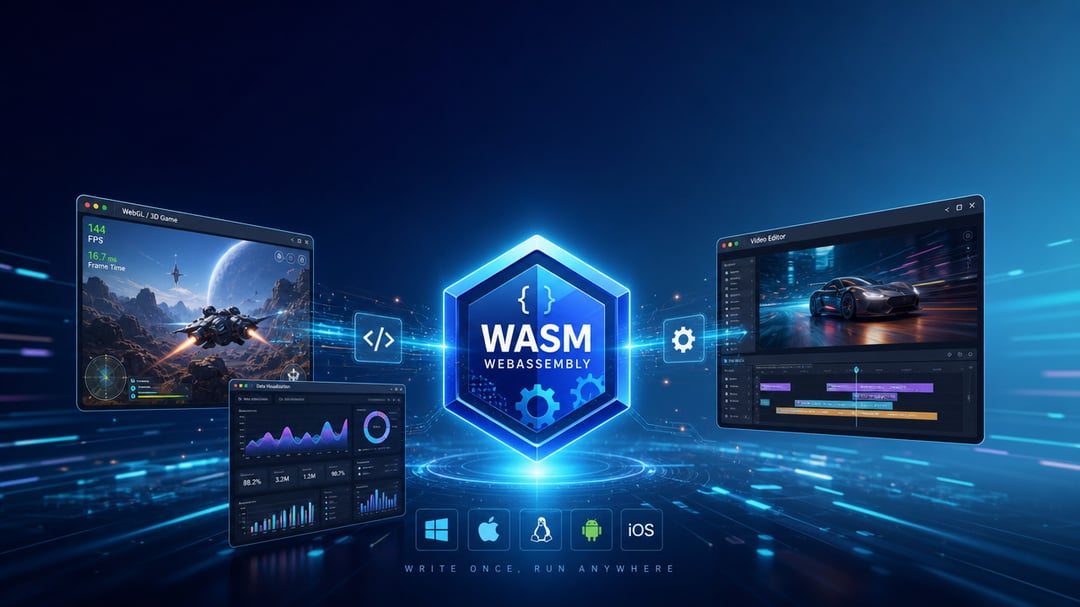
A few years ago, running a full video editor or a CAD tool inside a browser tab sounded like a stretch. Now apps like Figma and Google Earth do exactly that, and they feel almost as responsive as software installed on your machine. The technology quietly making this possible is WebAssembly, often shortened to Wasm. This article breaks down what it actually is, what it's used for, and why it's become a serious part of modern web development.
What Is WebAssembly (Wasm), Exactly?
WebAssembly is a low-level binary format that runs in the browser alongside JavaScript. Instead of writing code the browser has to interpret line by line, developers compile it into Wasm ahead of time, so the browser can execute it almost as fast as native code on your computer.
How WebAssembly Differs From JavaScript
JavaScript is interpreted (or just-in-time compiled) as the page runs, which is flexible but has performance limits. WebAssembly is compiled in advance, so it skips a lot of that overhead. The two aren't rivals, though. Wasm handles the heavy computational work, while JavaScript still manages the page, the user interface, and communication with the browser.
Core Technical Traits
A few things make WebAssembly stand out:
- Speed — it runs close to native performance, even for demanding tasks.
- Portability — the same Wasm file runs across Chrome, Firefox, Safari, and Edge without changes.
- Security — it executes in a sandboxed environment, isolated from the rest of the system.
- Language flexibility — code written in C++, Rust, Go, and other languages can compile down to Wasm, not just JavaScript.
What Is WebAssembly Used For? Core Use Cases
High-Performance Web Applications
This is where WebAssembly shows up most visibly. Photo and video editors, 3D design tools, and browser-based games all lean on it to handle processing that would otherwise choke a browser tab.
Porting Existing Codebases to the Web
Companies with mature C or C++ applications don't have to rebuild them from scratch to bring them online. They can compile the existing codebase to Wasm and ship it as a web app, which saves enormous development time for engineering and simulation software especially.
Blockchain and Smart Contracts
Some blockchain platforms use WebAssembly as the runtime environment for executing smart contracts. It gives them a fast, predictable, and portable execution layer that isn't tied to one specific programming language.
Edge and Serverless Computing
Cloud providers have started adopting Wasm runtimes for edge functions because they start up almost instantly and use fewer resources than traditional containers. For workloads that need to spin up fast and scale down just as quickly, that matters.
Cross-Platform App Development
Because Wasm isn't locked to the browser alone, teams can write core application logic once and deploy it across web, desktop, and mobile targets, cutting down on duplicated code.
Real-World Examples of WebAssembly in Action
- Figma rebuilt performance-critical parts of its design tool using WebAssembly, which noticeably improved load times and responsiveness for large files.
- Google Earth runs its full 3D mapping experience directly in the browser, something that would have required a native app a decade ago.
- AutoCAD's web version brings a genuinely complex desktop application online without gutting its capabilities.
Why Developers and Businesses Are Adopting WebAssembly
The appeal comes down to a few practical wins. It's fast enough to handle work that used to require native software. It's portable, so one build works everywhere. It's sandboxed, which keeps security concerns contained. And it lets teams reuse code they've already written instead of starting over in JavaScript.
Current Limitations of WebAssembly
It's not a fit for everything. Debugging Wasm is still harder than debugging JavaScript, tooling is less mature, and it has no direct access to the DOM, so it still needs JavaScript to handle the interface. For a simple marketing site or a basic content page, none of this complexity is necessary.
What's Next for WebAssembly?
The WebAssembly System Interface (WASI) is extending Wasm's reach beyond the browser entirely, into servers and edge environments. That shift is part of why interest in Wasm keeps growing well outside its original use case.


