
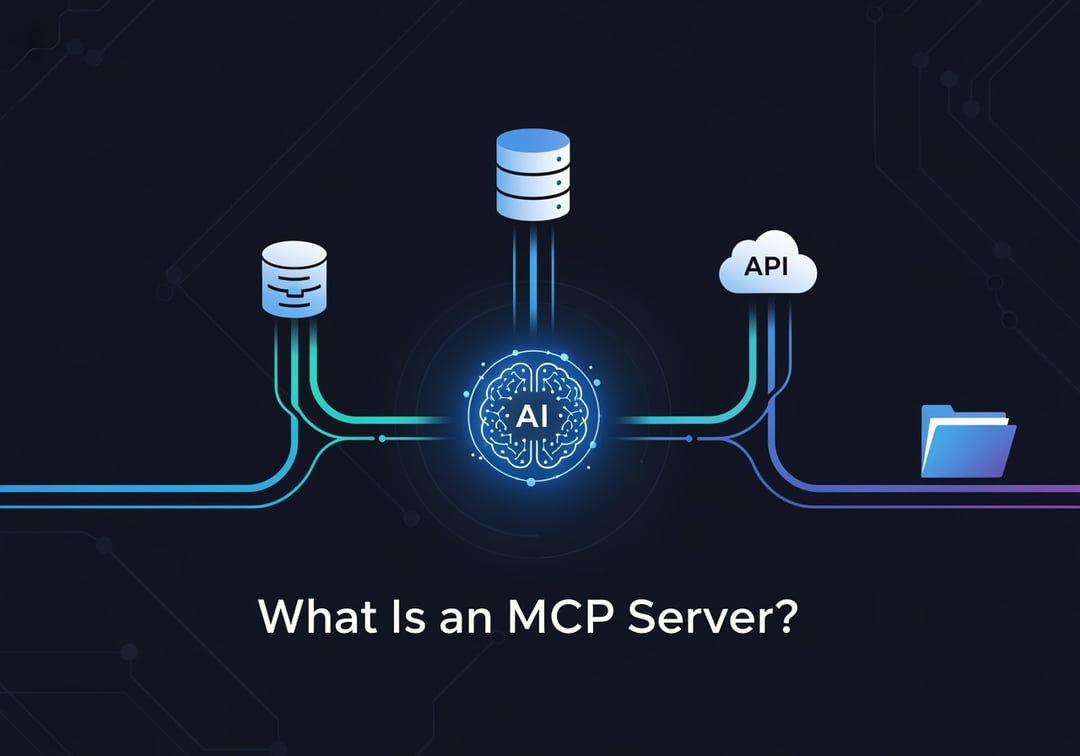
Artificial intelligence has transformed how we work and create. Yet for all their sophistication, AI models remain fundamentally isolated from your actual data. They cannot access your databases or check your files or pull real-time information from your tools. This creates a frustrating gap between what AI can do in theory and what it can accomplish in practice. MCP servers bridge this divide.
The Problem MCP Servers Solve
Modern AI models are great at creating text, spotting patterns, writing code, summarizing documents, and answering questions. But they work in isolation. They don’t have access to the systems where your real data is stored. Your customer database is out of reach. Your internal documents stay private. Your API endpoints aren’t connected. Because of this, AI’s potential to help your business is limited.
The core issue is context. AI models trained on public data cannot access private information. They cannot see your files or query your systems. Without context, even the most powerful AI produces generic outputs that lack relevance to your specific situation. You ask a question and receive an answer that sounds correct but misses the point entirely.
MCP servers solve this problem. They create a standardized pathway between AI models and your data sources. Instead of building custom integrations for every tool and database, developers can implement a single protocol that works across systems. The protocol acts as a universal adapter.
A Plain-English Definition of an MCP Server
An MCP server is a type of software that lets AI models connect to and get information from different data sources using a standard set of rules called the Model Context Protocol. You can think of it like a translator that helps AI systems find and understand data from things like databases, APIs, file systems, and other applications.
The protocol is important because it sets standard rules for how AI systems ask for information and how data sources reply. Before MCP, developers had to create a separate connection for each integration. For example, connecting an AI to a database needed different code than connecting it to a file system. MCP gets rid of this inconsistency.
Think of it like a restaurant: the kitchen makes the food but doesn’t deal directly with customers. Instead, waiters act as go-betweens—they take orders from customers and deliver the food back to them. MCP servers work in much the same way. They receive requests from AI models, gather data from different sources, and return it in a format the AI can understand.
How MCP Servers Actually Work
The system has three main parts. The AI model sends requests as the client. The MCP server manages the communication between components. The data source supplies the needed information.
When you ask an AI a question that requires specific data, several steps occur. First, the AI recognizes it needs external information. It sends a request to the MCP server describing what it needs. The MCP server translates this request into the appropriate format for the target data source. The data source processes the request and returns the results. The MCP server formats this response for the AI. Finally, the AI incorporates the information into its answer.
This standardized flow eliminates the complexity that previously made AI integrations so difficult. Developers no longer need to write custom code for each connection. Instead, they implement MCP once and connect to any compatible data source.
What You Can Connect an MCP Server To
MCP servers are flexible and can connect to many types of data. A common example is connecting to databases. SQL databases, NoSQL systems, and cloud data warehouses can all provide information to AI models through MCP servers.
API services work similarly. REST APIs, GraphQL endpoints, and web services all become accessible to AI systems. This means your AI can query external services and incorporate real-time data into its responses.
File systems provide another connection type. Local files, cloud storage buckets, and document repositories all become viable information sources. Your AI can read your documentation and incorporate relevant sections into answers.
Tool integrations extend capabilities further. Project management systems, communication platforms, and business applications can all connect through MCP. The specific connections depend on implementation but the principle remains consistent.
Why Developers and Businesses Should Pay Attention
The main advantage is that it makes integration much simpler. Before, connecting AI to three different data sources meant doing three separate projects. With MCP, you only need to set up the protocol once to connect to all of them. This speeds up development a lot.
Scalability improves as well. Adding new data sources no longer requires rebuilding integrations from scratch. The protocol handles the standardization so you can focus on the important data rather than how to connect it.
Security and governance also improve with structured AI-data interactions. MCP provides clear pathways for authentication and authorization. You maintain control over what information AI systems can access.
Getting Started
If you want to explore MCP servers, start by understanding your data setup. Figure out what information AI models might need to help you more effectively. Then look into the MCP options that work well with your existing technology.
The ecosystem is changing quickly, with new connectors and tools appearing all the time. However, the main idea stays the same: building standard ways for AI systems to access the data they need.
MCP servers represent a significant step forward in making AI genuinely useful for real business scenarios. They transform AI from an isolated text generator into an integrated system that understands your specific context. That transformation changes everything.