
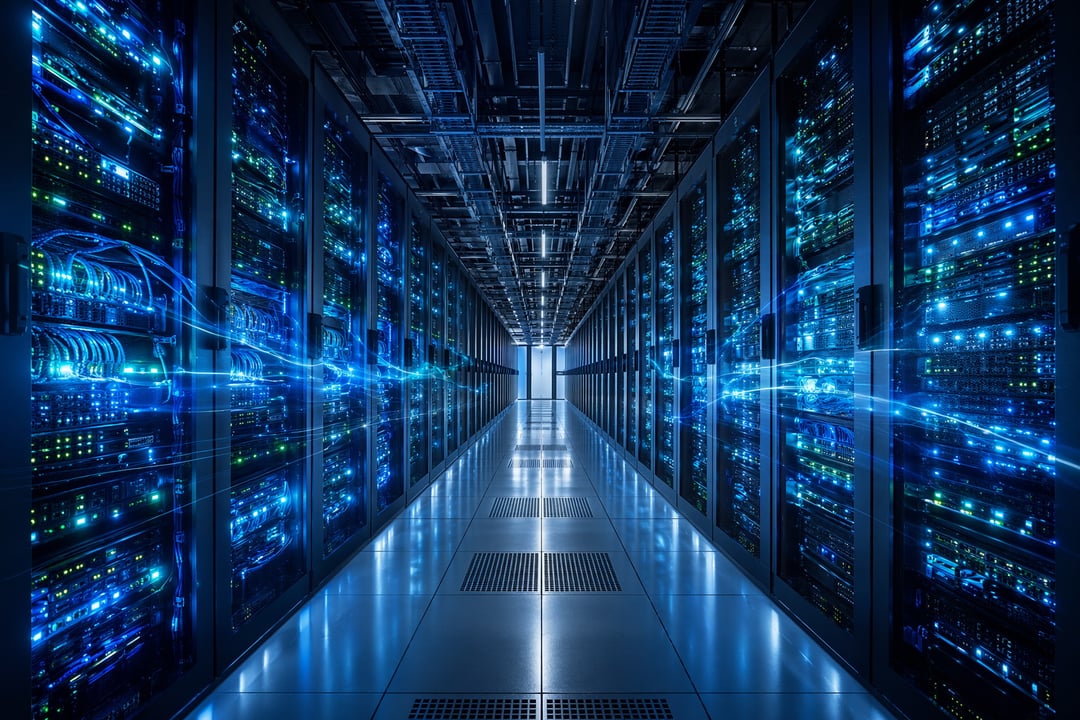
Every time you stream a movie, upload a photo, check your bank balance, or open a cloud document, something physical happens somewhere. Not in a vague “internet cloud” floating above us. In a real building. With power lines, cooling systems, locked doors, fiber cables, humming servers, backup generators, and people watching dashboards at odd hours.
That building is a data center.
So, what happens inside a data center? In simple terms, it stores data, processes requests, moves information across networks, protects systems from failure, and keeps everything powered and cooled around the clock. It’s the place where digital life becomes physical.
What Is a Data Center?
A data center is a specialized facility that houses computing equipment. Inside, you’ll find servers, storage systems, networking hardware, security tools, electrical systems, cooling equipment, and monitoring platforms. Together, these systems support websites, apps, cloud platforms, business software, payment systems, medical records, streaming services, and plenty more.
Think of a data center as the engine room of the internet. You usually don’t see it. You’re not meant to. But if it stops working, everyone notices fast.
The “cloud” is really just someone else’s servers running in one or many data centers. Cloud providers such as AWS, Microsoft Azure, and Google Cloud operate vast networks of these facilities across the world. They place computing resources close to users so apps load faster and services stay reliable.
What Happens When You Click, Stream, or Upload?
Let’s say you open a website. Your phone or laptop sends a request through your internet provider. That request travels across networks until it reaches the data center hosting the website or application.
Inside the data center, the request may pass through routers, firewalls, load balancers, application servers, and databases. One server might verify your login. Another might fetch your profile. A storage system might retrieve an image or document. Then the response travels back to your device in milliseconds.
It feels instant. But under the hood, a lot just happened.
The same basic pattern applies when you watch a video, send an email, join a video call, or save a file to cloud storage. Your device asks for something. The data center processes that request. Then it sends the result back.
Speed matters here. Even small delays can make a website feel sluggish or a video call feel awkward. That delay is called latency. To reduce it, companies often use multiple data centers in different regions. Some also use edge data centers, which are smaller facilities placed closer to users and devices.
Servers, Storage, and Networks Do the Digital Work
Servers are the core machines inside a data center. A server is basically a powerful computer designed to provide services to other computers. It might run a website, host a database, process transactions, support virtual desktops, train AI models, or manage business applications.
Most servers sit in tall metal cabinets called racks. Walk through a data center floor and you’ll see long rows of these racks filled with machines. Lights blink. Fans roar. Cables run overhead or beneath the floor. It’s tidy for a reason. A messy cable path can block airflow, slow repairs, or make a simple maintenance task painfully risky.
Storage systems hold the data those servers need. That can include photos, videos, emails, customer records, backups, application logs, and massive datasets. Good data center storage must be fast, reliable, secure, and easy to expand.
But storage hardware can fail. Drives wear out. Controllers break. Cables get damaged. So data centers use redundancy. They copy data across multiple drives, systems, or even separate facilities. If one component fails, another can take over.
Networking connects everything. Switches move data between servers inside the facility. Routers send traffic between networks. Firewalls inspect traffic and block suspicious activity. Fiber optic cables carry huge amounts of information at high speed.
If servers are the muscles, the network is the nervous system. It lets every part of the data center coordinate with every other part.
Power and Cooling Keep Everything Alive
Data centers use a lot of electricity because servers run constantly. They don’t sleep at night. They don’t take weekends off. The facility also needs power for storage systems, networking gear, cooling equipment, security systems, lighting, and monitoring tools.
Power usually enters from the utility grid. From there, it moves through transformers, switchgear, uninterruptible power supplies, power distribution units, and finally into racks of equipment. If grid power fails, batteries instantly keep systems running while generators start. That handoff must happen smoothly because even a short interruption can knock systems offline.
Cooling is just as important. Every computation creates heat. Multiply that by thousands of servers and the room becomes a giant heat problem.
Most data centers use carefully controlled airflow. Cold air enters the front of server racks. Hot air exits the back. Facilities often arrange racks into hot aisles and cold aisles so warm and cool air don’t mix too much. Sensors track temperature and humidity across the floor.
More advanced facilities may use liquid cooling, especially for high-density workloads like artificial intelligence and high-performance computing. Liquid removes heat more efficiently than air, which matters when racks draw enormous amounts of power.
Security and Monitoring Protect the Facility
Data center security starts outside the building. Facilities often use fencing, cameras, guards, vehicle barriers, badge readers, biometric checks, visitor logs, and mantraps. A mantrap is a secure entry space where one door must close before the next opens. It sounds dramatic because it is. Physical access to servers is a serious risk.
Cybersecurity adds another layer. Firewalls, encryption, identity controls, network segmentation, intrusion detection, and logging help protect systems and data. Strong digital defenses matter. But honestly, they don’t mean much if someone can simply walk in and touch the hardware.
Monitoring never stops. Data centers track temperature, humidity, power load, battery health, generator readiness, network traffic, server performance, and access events. Operations teams watch for small signs of trouble because small problems can snowball quickly.
A failing fan. A rising rack temperature. A storage error. A network spike. Any one of these can become a real incident if nobody catches it early.
Redundancy Keeps Services Online When Parts Fail
The central design idea inside a data center is simple: assume things will break.
That sounds pessimistic. It’s actually practical.
Data centers duplicate critical systems so one failure doesn’t bring everything down. They may use multiple power feeds, backup generators, redundant cooling units, extra network links, replicated storage, and clustered servers. Engineers describe designs with terms such as N+1 or 2N, which show how much backup capacity exists.
Some facilities follow availability frameworks such as the Uptime Institute Tier Standard, which helps classify data centers by resilience and maintainability.
The goal is not perfection. The goal is continuity. When something fails, users should never know.
Data Centers Are Becoming More Efficient
Modern data centers face a tough challenge. Demand keeps growing because of cloud computing, streaming, AI, remote work, analytics, and connected devices. At the same time, operators must reduce energy waste and environmental impact.
One common efficiency metric is PUE, or Power Usage Effectiveness. It compares total facility energy use with the energy used by IT equipment. The closer the number gets to 1.0, the more efficiently the facility uses power. Organizations such as The Green Grid have helped popularize this metric.
Efficiency efforts include better cooling design, renewable energy procurement, server consolidation, heat reuse, smarter workload placement, and more efficient hardware. It’s not glamorous work. But it matters.
The Internet Has a Physical Address
What happens inside a data center is both technical and strangely human. Machines process requests. Storage systems protect information. Networks move data. Cooling systems fight heat. Power systems prevent outages. Security teams guard access. Engineers monitor the whole thing.
And all of it happens so your app opens, your payment clears, your file saves, and your video keeps playing.
The digital world feels invisible because data centers are built to make it feel that way. Behind every smooth online moment, there’s a real facility working very hard to make technology seem effortless.