
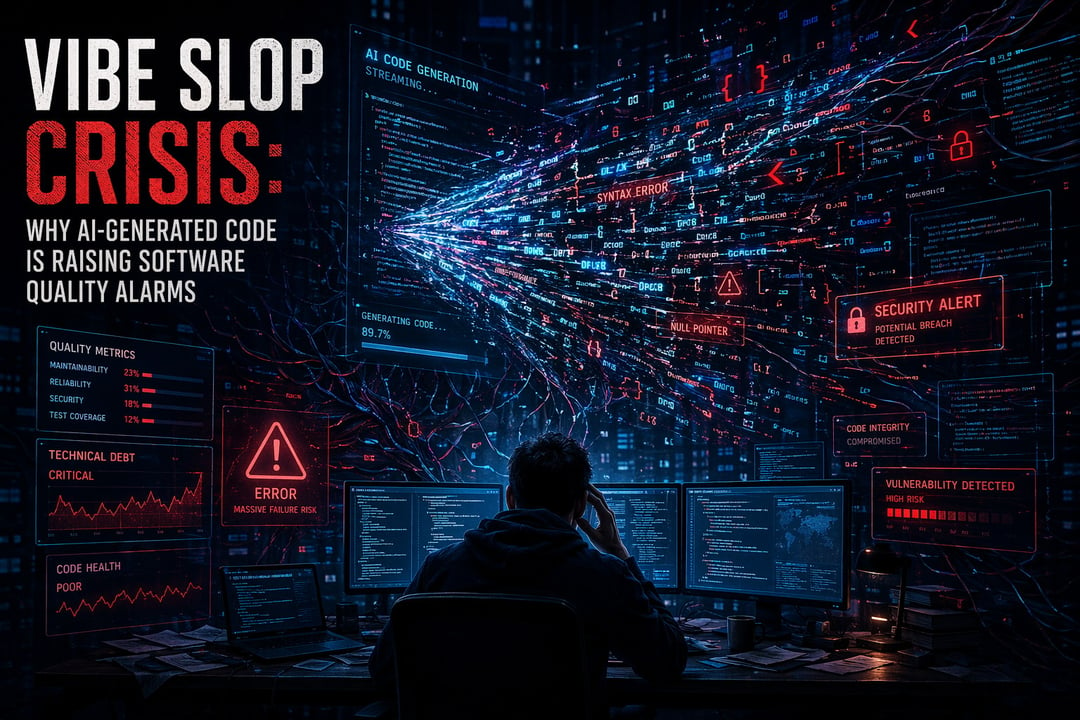
Engineers behind the OpenClaw AI agent system are warning that “vibe slop” could flood the software ecosystem with weak, risky, and difficult-to-maintain code. The concern comes as AI-powered coding has shifted from an experimental novelty into a common practice across the tech industry.
The phrase blends two ideas already circulating in AI discussions. The first is “vibe coding,” a term associated with AI researcher Andrej Karpathy, used to describe the practice of creating software by explaining what you want in plain English to an AI chatbot. The second is “AI slop,” a label often used for low-quality machine-generated content that has spread across online platforms.
Put together, “vibe slop” describes what happens when the serious work of software engineering gets replaced by quick AI prompting. Instead of carefully designing, testing, securing, and maintaining software, developers—or even untrained users—may lean on AI tools to produce code they do not fully understand.
That’s the core worry. Not that AI can generate code, but that people may trust that code without being able to evaluate it.
How Vibe Coding Can Become Vibe Slop
Vibe coding starts with a simple promise: describe software in natural language, and an AI tool helps build it. For experienced developers, that can be useful. But the danger appears when the process becomes a shortcut around engineering discipline.
Software is not only about getting something to run. It also has to be reliable. It needs to be secure. It has to make sense months later when someone needs to update it, audit it, or fix it under pressure.
Vibe slop emerges when those deeper responsibilities are skipped. The result may be code that looks functional on the surface but carries hidden weaknesses underneath. And because AI can generate code quickly, the amount of poorly understood software can grow at a speed that traditional review processes may struggle to match.
The warning is especially serious for users who rely on AI-generated code they cannot evaluate or maintain. If they do not understand what the code is doing, they may also miss the security risks, structural flaws, or long-term maintenance problems baked into it.
OpenClaw and the Broader AI Agent Security Debate
OpenClaw, an open-source AI agent framework formerly known as MoltBot and Clawdbot, has become part of a wider security discussion around AI coding tools and autonomous agents.
The framework gives AI agents broad system-level abilities. These agents can execute commands, modify files, and interact with external services. That kind of access can make AI agents powerful, but it also makes security concerns much sharper.
Security researchers have identified more than 140,000 OpenClaw instances exposed to the open internet. Many of those instances were found leaking API keys and credentials. Multiple high-severity vulnerabilities have also been disclosed since January, and companies including Meta have restricted internal use of the tool.
That combination—wide permissions, exposed instances, credential leaks, and serious vulnerabilities—shows why the vibe slop warning is not only about messy code. It is also about the risks created when AI-generated or AI-managed systems touch real infrastructure.
Why Poorly Understood AI Code Creates Downstream Risk
OpenClaw’s creator, Peter Steinberger, has previously pushed back against the negative tone around “vibe coding,” calling the term “a slur” in an interview. But the engineers warning about vibe slop are focused on a more specific concern: what happens after the code is generated.
The problem is not simply whether AI can produce code. The bigger issue is whether people using that code can judge its quality, secure it, and maintain it over time.
When users generate software they cannot assess, several risks stack up:
- Code may work without being safe.
- Hidden vulnerabilities may go unnoticed.
- Credentials or API keys may be exposed.
- Maintenance may become difficult or impossible.
- Security teams may inherit systems no one fully understands.
And that’s where “slop” becomes more than an insult. It becomes a description of software that enters the ecosystem faster than people can properly inspect it.
Vibe Slop Is Part of a Wider AI Quality Problem
The concern is not limited to software. Similar patterns are appearing in scientific research, where the phrase “hypothesis slop” has been used to describe a rise in low-quality AI-generated research ideas and writing.
The CTO of an AI co-scientist startup warned that the same dynamics affecting software quality may also threaten academic inquiry. The concern is that AI can generate plausible-sounding material at scale, even when the underlying reasoning, accuracy, or originality is weak.
A Forbes analysis found that submissions to a leading management journal rose 42% after the introduction of ChatGPT. AI-heavy manuscripts were described as harder to read, more jargon-filled, and much more likely to be rejected. Nature also reported that preprint repositories and conference organizers are dealing with entirely AI-generated papers containing fabrications.
The pattern is familiar: AI makes production easier, but quality control becomes harder. Whether the output is code, research, or written content, the pressure moves downstream to the people and systems responsible for checking it.
Technical Debt Was Already a Trillion-Dollar Problem
The vibe slop warning lands against an already difficult backdrop: technical debt in legacy software. The existing burden is described as a $1.52 trillion problem, with outdated and clunky software continuing to strain enterprise budgets.
AI coding tools could add a new layer to that problem. If organizations rapidly generate code that few people understand, they may create fresh technical debt at unusual speed. Instead of modernizing systems cleanly, they could end up with more software that is poorly documented, weakly reviewed, or hard to secure.
That is the practical danger. AI-generated code may feel efficient in the moment, but if it is not designed, tested, and secured properly, the real cost shows up later.
The Importance of Addressing the Vibe Slop Crisis in Software Teams
The warning around vibe slop is ultimately a warning about responsibility. AI tools can accelerate coding, but they do not remove the need for engineering judgment.
Software teams still need to understand what they are building. They still need to test. They still need to secure systems before exposing them to users, customers, or the open internet. And they still need to maintain what they ship.
The biggest risk is not that AI writes code. It is that AI-generated code may be treated as finished software before anyone has done the hard work of making it trustworthy.