
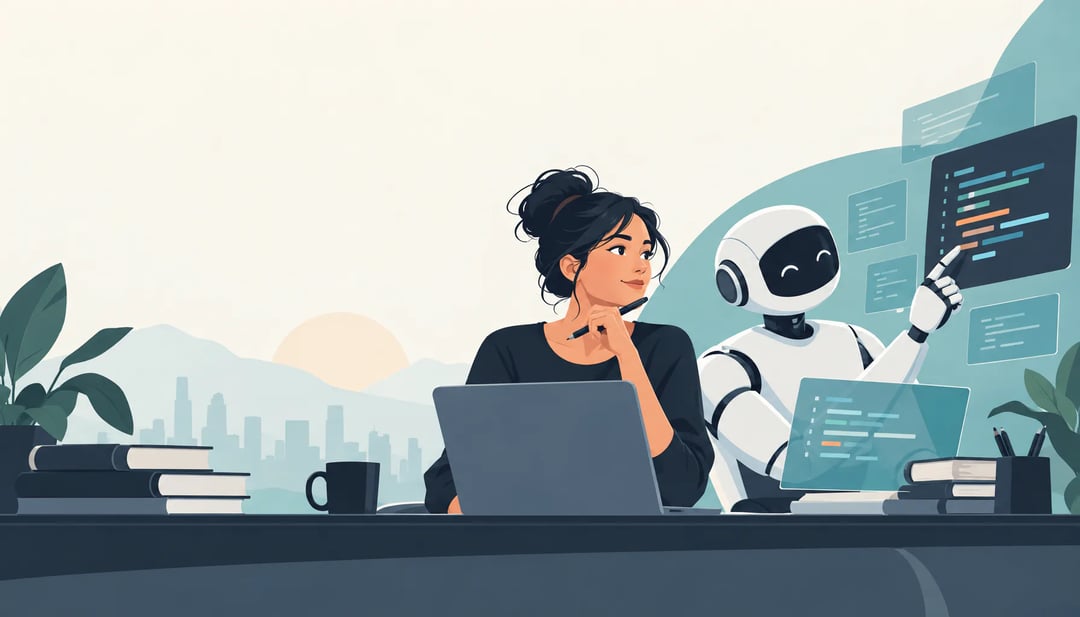
Will Vibe Coding Replace Programmers? For teams already using AI to generate code, the harder question is who checks the result when the app breaks, exposes data, or fails to meet a real user need. Vibe coding can handle routine tasks such as drafting functions, connecting services, and building simple prototypes, often faster than writing everything by hand. But speed does not remove the need for judgment. People still choose what to build, test whether it works, protect users, and maintain the software after launch. Programming jobs will likely change as these tools improve, not disappear overnight. By the end, you will know where vibe coding helps, where it creates risk, and how to use it without building fragile software.
Vibe coding changes how software gets made, not who is responsible
Vibe coding means telling an AI tool what you want in ordinary language, then letting it generate or modify the code. A prompt such as "add a password reset flow" can produce a useful starting point faster than writing every file by hand. That automation does not answer whether the flow handles expired links, protects account data, connects correctly to the existing database, or works well on a phone.
Programming involves more than producing syntax. Someone still needs to understand the product, the people using it, and the risks involved. They must check the AI's output, test expected and unexpected inputs, review permissions and security decisions, and diagnose failures in the real environment where the software runs. Deployment settings, third-party services, browser compatibility, logs, and maintenance all matter. Generated code can compile successfully while failing under real traffic or creating a costly problem later. Vibe coding changes who writes more of the code, not who is accountable for the software.
AI coding tools are good at routine development tasks
Where vibe coding saves time
AI coding tools can turn a plain request into a working prototype, such as a contact form, dashboard, or simple mobile interface. They can generate boilerplate for routes, database models, and input validation, suggest fixes when errors appear, explain unfamiliar functions, and draft setup instructions.
This helps beginners building their first project, small teams without a dedicated specialist, and experienced developers focused on architecture and product decisions. A developer can request a basic settings page, review the generated code, and adapt it instead of writing every component from scratch.
The limits of generated code
Generated code still depends on the quality of the request and the developer's review. An AI tool may assume the wrong data format, miss unusual user input, or suggest insecure handling of passwords and private data. It can struggle with incomplete requirements, such as what should happen when a payment fails or a network connection drops. Code may run while still being wrong for the product.
Human programmers still make the decisions AI cannot own
Understanding the problem
Vibe coding can turn "build a support dashboard" into a working prototype, but it cannot decide what "working" means. A team must define users, permissions, failure cases, and priorities. Contractors might need read-only access, while managers can export customer data. That choice affects the architecture and cannot be safely inferred from a prompt. Humans also decide whether to build a quick internal tool or a system expected to handle years of use.
Reviewing risk and quality
An AI-generated implementation still needs tests for expected and edge cases, code review for logic and maintainability, and security checks for exposed data, weak authentication, and unsafe dependencies. Someone must maintain it after launch, fix defects as requirements change, and answer when it fails. AI can suggest code for an upload feature, but a programmer must check file validation, access controls, and recovery behavior before approval. The model produces an option. A person or team decides whether it fits the product and is safe to deploy.
Vibe coding will reshape programming jobs instead of erasing them
Vibe coding shifts some programming work away from typing every line and toward describing goals, reviewing generated code, connecting services, and maintaining the result. A nonprogrammer might use AI to build a personal budgeting tool or internal dashboard. They still need to check whether calculations are correct, user data is protected, and the tool works when requirements change.
For professional developers, the bigger opportunity is handling larger systems with AI assistance. They may generate routine components quickly, then spend more time deciding how databases, APIs, authentication, and user interfaces should fit together. That requires more than prompt-writing. Clear communication helps turn vague requests into workable specifications. Product judgment separates useful features from unnecessary ones. Security awareness helps catch exposed credentials, unsafe permissions, and weak input handling. Technical fundamentals make code review meaningful.
As these tools improve, more people may create small software projects, while experienced developers take responsibility for complex systems, integrations, reliability, and long-term maintenance.
How to use vibe coding without creating fragile software
Start with a clear goal and a small scope. Ask an AI tool to build a form that saves one type of record, rather than trusting a vague prompt to produce an entire application. A narrow request makes the output easier to inspect and test.
Read the generated code before using it. Check how it handles invalid input, login failures, missing records, and other important paths. Test those cases yourself, especially wherever the app can delete data, charge a customer, or change permissions. Keep API keys, passwords, and personal information out of prompts and source code, and do not deploy code you cannot explain or maintain.
You do not need to become an expert first, but basic programming concepts help you verify AI output, troubleshoot failures, and spot unsafe shortcuts or slow approaches. Treat vibe coding as an accelerator and collaborator, not an unsupervised replacement for engineering judgment.
Will Vibe Coding Replace Programmers? What to Do Next
Vibe coding can help you move from an idea to a working prototype faster, but speed does not remove responsibility. Start with a narrow goal and a small piece of software rather than asking an AI tool to build an entire application in one pass. Review the generated code, test the paths that matter, and keep sensitive data out of prompts and untrusted systems. If you cannot explain how the code works or maintain it when requirements change, it is not ready to deploy. You do not need to become an expert programmer before using these tools, but basic programming, security, and debugging knowledge will help you catch bad assumptions. Treat AI as a productive collaborator, not the person accountable for the result.