
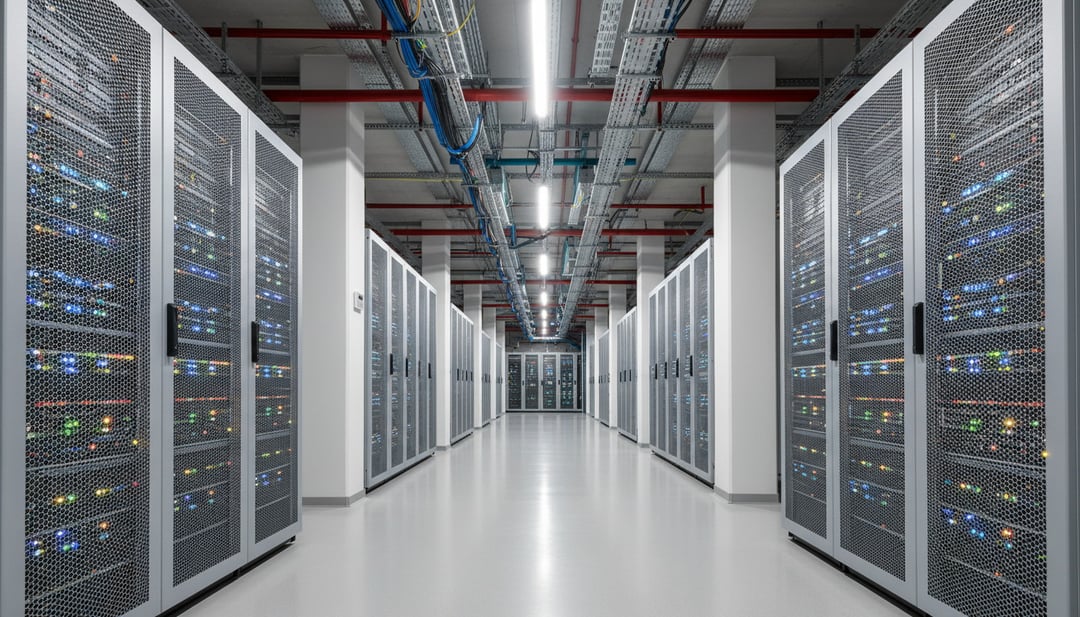
Why so many US AI data centers are being delayed or canceled
American AI companies are moving fast to build new data centers, but the pace of construction is running into hard limits. The biggest problems are not demand or ambition. They are power availability, electrical equipment supply, and the practical reality of how long these projects take to complete.
Estimates from Sightline Climate suggest that between 30% and 50% of AI data centers planned for deployment in the US this year will either be delayed or canceled. That is a huge share of the pipeline, and it points to a market where expansion plans are outpacing the systems needed to support them.
The core issue is simple: many projects cannot secure enough electricity to run new facilities, and many also struggle to obtain critical electrical components needed to finish construction.
US data center capacity planned through 2026
Across 140 construction projects, data centers representing at least 16 gigawatts of capacity are expected to come online before the end of 2026. But the gap between announced plans and actual progress is hard to ignore.
Only about 5 gigawatts are currently under construction. At the same time, typical build times run from 12 to 18 months. Another 16 gigawatts remains in the announced stage without clear signs of movement.
That mismatch matters. If only a fraction of the planned capacity is actively being built, and if projects generally need a year or more to finish, then staying on schedule becomes much harder.
The announced pipeline looks larger than active progress
The numbers suggest that the US AI data center buildout is still heavily weighted toward plans rather than completed execution. A large amount of future capacity has been proposed, but much less is visibly moving through construction.
That creates uncertainty around how much of the current pipeline will actually be delivered on time.
2027 projects are also showing the same pressure
The same pattern is already visible in projects aimed at 2027. More than 25 gigawatts are scheduled for that period, yet less than 10 gigawatts is currently under construction.
In other words, the pressure is not limited to one year. The backlog appears to be extending forward.
Power supply is a central bottleneck for AI data centers
Insufficient power grids remain one of the biggest obstacles. AI workloads require large amounts of electricity, and that demand is drawing more attention as new facilities are proposed and built.
This is not just a technical issue. It is also becoming a local concern in communities near proposed sites, especially where residents have seen energy bills rise.
Rising energy demand is increasing local scrutiny
As AI data centers expand, their electricity needs are becoming more visible to the public. Communities near planned developments are paying attention to the impact on local energy systems and household costs.
A recent Pew Research survey found that Americans are wary of AI data centers because of environmental and energy concerns. Even so, the same survey showed cautious optimism around the possibility of job creation.
That combination says a lot. People may see potential economic upside, but they are also uneasy about the pressure these facilities can place on energy infrastructure.
Planned power sources include the grid, nuclear, and renewables
Many of the planned facilities are expected to rely on a mix of local grid power and independent energy sources. Those sources include nuclear and renewable energy.
That mix shows how developers are trying to reduce dependence on already strained grid systems. But it also suggests that grid access alone is not enough to support the scale of expansion being planned.
Electrical equipment shortages are slowing data center construction
Power is only part of the problem. Hardware supply is another major constraint, especially when it comes to essential electrical infrastructure.
Bloomberg reports that key components such as batteries and transformers have become a serious obstacle. These are not optional extras. They are foundational pieces required to complete and operate data centers.
Without them, even projects with strong demand and financing can stall.
AI demand is already affecting the broader tech market
AI data centers have already shifted production capacity away from parts of the consumer technology market. Memory, storage, and CPUs have been pulled toward AI infrastructure, and that shift has raised prices for those components as well as for products that depend on them, including PCs and game consoles.
That tells us something important about the scale of this buildout. The demand coming from AI is not isolated to one corner of the industry. It is already reshaping supply across multiple categories.
Transformers and batteries are a more basic problem
While memory and processors get a lot of attention, the shortage of batteries and transformers may be even more limiting for new facilities. These are core electrical components, and without them, construction and operations cannot move forward as planned.
That makes the bottleneck more structural than temporary. It is not only about computing gear. It is also about the physical systems that make a data center function.
Domestic manufacturing is not keeping up with AI infrastructure needs
Efforts to reshore manufacturing have not yet closed the gap between domestic production and AI sector demand. Even with policy pressure aimed at bringing more manufacturing back to the US, production capacity still falls short of what the market currently needs.
For now, American AI companies are still relying on Chinese components to cover the shortfall.
Reliance on imported components remains in place
Despite efforts tied to steep tariffs on China and other exporters, US manufacturing output is still not enough to meet current infrastructure requirements. That leaves developers dependent on imported electrical components to keep projects moving.
This reliance highlights a practical tension in the market. Companies want to build quickly, but the supply chain for crucial equipment is still constrained.
Recent data center delays show this is not a new problem
Sightline's outlook reflects trends already seen last year. Manufacturers delayed 26% of announced capacity and pushed back commercial operations for another 10%.
That earlier slowdown helps explain why the current outlook is so cautious. These delays are not appearing out of nowhere. They follow a pattern that is already visible in the market.
Completion targets are becoming harder to hit
Only about half of recent projects are meeting completion targets. And it is still unclear how many more will remain on schedule through the rest of the year.
That uncertainty comes from the same set of issues repeating across the market: limited power, delayed electrical equipment, long construction timelines, and a project pipeline that is larger than the visible pace of execution.


