
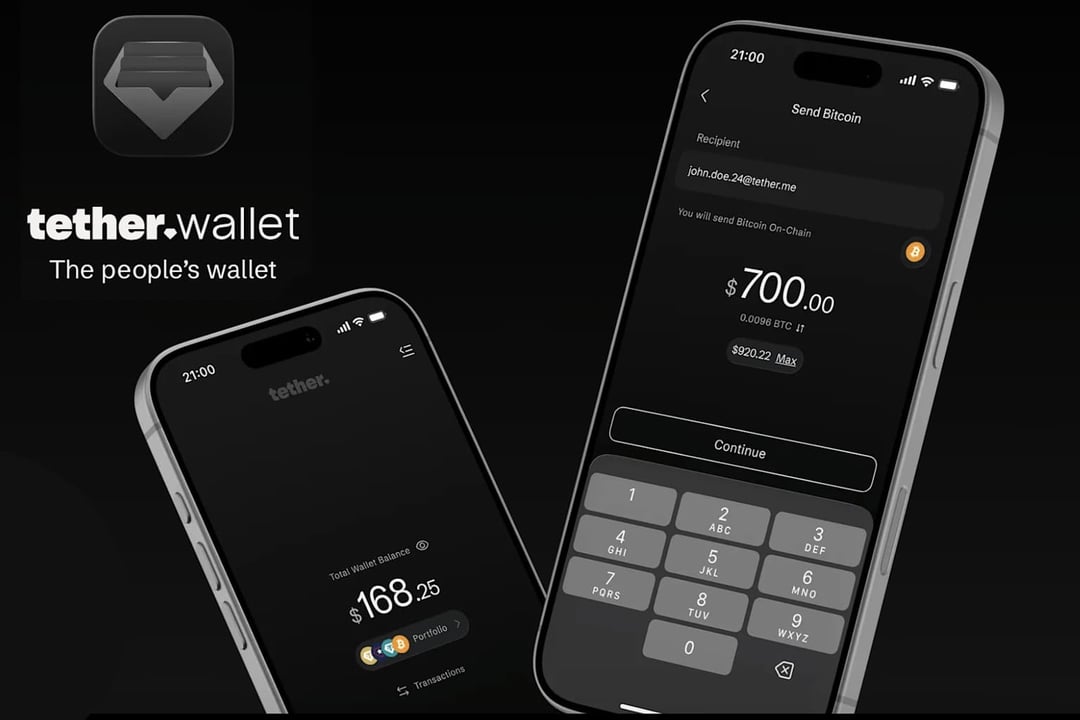
Tether Wallet Brings Self-Custody to Consumers
Tether has launched tether.wallet, a self-custodial digital wallet that puts the company’s payment infrastructure directly into the hands of consumers for the first time. The wallet supports USDT, the U.S.-regulated USAT stablecoin, gold-backed XAUt, and Bitcoin.
It works across several networks, including Ethereum, Polygon, Arbitrum, and the Bitcoin Lightning Network. That cross-network support gives the wallet a broader payments footprint while keeping the product focused on a limited set of assets.
Branded as “the People’s Wallet,” the launch signals a clear shift in direction. Tether has largely functioned as behind-the-scenes infrastructure for the crypto economy. With this release, the company moves from serving mainly as backend plumbing to offering a direct consumer-facing product.
Key Tether Wallet Features for Crypto Payments
Pay Fees With the Asset Being Sent
One of the wallet’s main features is the ability to pay transaction fees using the same asset being transferred. That removes the common need to hold a separate gas token for each blockchain.
For users, that means fewer steps and less friction. Instead of managing extra tokens just to complete a transfer, they can move funds without that added requirement.
Human-Readable Usernames Instead of Wallet Addresses
The wallet also lets users send funds through readable usernames such as [email protected] rather than relying on long wallet addresses.
That change makes transactions feel more accessible and easier to navigate. It simplifies a part of crypto that has often felt cumbersome for everyday users.
Supported Assets and Networks
Tether.wallet supports:
- USDT
- USAT
- XAUt
- Bitcoin
The wallet operates across:
- Ethereum
- Polygon
- Arbitrum
- Bitcoin Lightning Network
This setup keeps the product tightly scoped while still covering several of the most relevant payment rails tied to Tether’s broader ecosystem.
From Infrastructure Provider to Consumer Product
A Strategic Shift in Tether’s Wallet Push
This launch builds on a direction that CEO Paolo Ardoino has been signaling for more than a year. In late 2025, Tether open-sourced its Wallet Development Kit, a modular toolkit for building self-custodial wallets.
The company first deployed that toolkit through a partnership with video platform Rumble in January. That move showed Tether was not just experimenting with wallet tooling in theory. It was already starting to put the framework into practical use.
Earlier Signals Around a Self-Custodial Mobile App
In December 2025, Ardoino posted a hiring call for a lead engineer to build what he described as a “100% self-custodial” mobile app. The app was described as being limited to four assets: Bitcoin, USDT, XAUt, and USAT.
The plan also included integrated local AI capabilities powered by Tether’s QVAC platform. That earlier hiring signal now looks closely aligned with the product direction seen in tether.wallet.
Tether’s Wallet Reach and Market Presence
Tether said that more than 570 million wallets had utilized its technology as of March 2026. That figure points to the scale of the company’s reach and the depth of its presence in the digital asset economy.
It also reinforces Tether’s standing in emerging markets. The reported usage highlights how deeply the company’s stablecoin infrastructure has penetrated regions where crypto-based value transfer has become especially relevant.
A Crowded Self-Custody Wallet Market
Rising Competition in Self-Custody Payments
The wallet enters a market that is getting more competitive. Just days before this launch, Exodus Movement announced Exodus Pay, a feature that allows users to spend crypto at merchants accepting Visa or Apple Pay while keeping full control of their funds.
That timing matters. It shows that companies across the sector are pushing harder to make self-custody more practical for everyday payments, not just asset storage.
Regulatory Signal for Wallet Software
The broader environment may also be turning more favorable for self-custody products. On April 13, the U.S. Securities and Exchange Commission issued guidance stating that software facilitating wallet-based crypto transactions does not constitute brokerage activity.
That clarification could benefit the wider self-custody sector. For wallet providers, it offers a regulatory signal that software tools supporting user-controlled transactions may be viewed differently from traditional brokerage functions.
Tether’s Broader Expansion Around Payments and Infrastructure
Tether’s wallet ambitions sit inside a wider expansion strategy. The company has invested $150 million in Gold.com, funded Bitcoin infrastructure startups such as Ark Labs and Utexo, and completed an integration to bring USDT to Bitcoin through the Lightning Network’s Taproot Assets protocol in March.
Taken together, those moves show that the wallet is not an isolated release. It fits into a larger pattern of investment across Bitcoin infrastructure, payments, and asset-linked products.
Why Tether Wallet Matters for Consumer Crypto Use
The biggest change here is not just that Tether launched another wallet. It’s that the company has taken infrastructure it historically operated behind the scenes and packaged it as a direct consumer product.
That matters because the product is designed to reduce two common points of friction in crypto payments: the need for separate gas tokens and the difficulty of using long wallet addresses. By allowing fee payment in the transferred asset and replacing complex addresses with readable usernames, tether.wallet is built to make self-custodial payments feel simpler and more usable.
And that’s really the core of the move. Tether is taking tools that powered large parts of the crypto economy in the background and turning them into something consumers can use more directly.