
The future rarely arrives with a dramatic soundtrack. More often, it slips into daily life through software updates, cheaper devices, better batteries, smarter medical tests, and tools that suddenly make old habits feel clumsy.
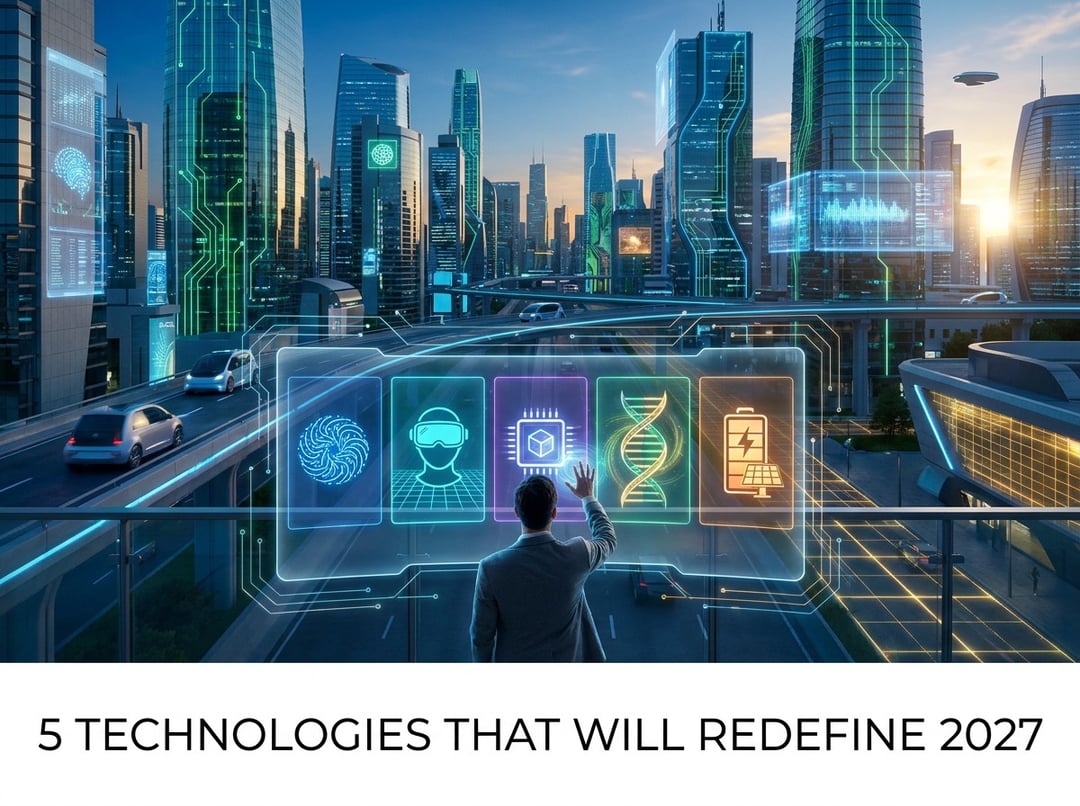
That’s what makes 2027 interesting. It probably won’t be defined by one miraculous invention. It will be shaped by several technologies maturing at the same time. Artificial intelligence will become more useful. Spatial computing will make digital experiences feel physical. Quantum computing will move closer to practical value. Biotechnology will change how we treat disease. Energy innovation will decide how much of this future can actually scale.
Here are the 5 technologies that will redefine 2027 and why they matter beyond the usual hype.
1. AI Agents Will Become Digital Coworkers
AI has already changed how people write, search, code, design, and analyze information. But by 2027, the bigger shift will come from AI agents.
An AI agent does more than answer a question. It can plan a task, use digital tools, follow instructions, check progress, and complete work across different systems. Think of the difference this way: today’s chatbot gives you a recipe. Tomorrow’s agent orders the ingredients, checks your calendar, adjusts the meal for allergies, and reminds you when to preheat the oven.
In business, that shift could be enormous. A sales agent might update customer records, draft follow-up emails, schedule calls, and flag deals at risk. A finance agent could reconcile invoices, detect unusual spending patterns, and prepare audit notes. A software development agent might test code, document changes, and suggest fixes before a human engineer reviews the final result.
Still, this isn’t magic. AI agents will need strong guardrails. They can make mistakes, misread context, or act on poor data. Companies that treat them like interns with access to sensitive systems will create chaos. Companies that design careful workflows around them will move faster.
By 2027, the real advantage won’t belong to organizations that “use AI.” It will belong to those that know exactly where AI should act and where humans must stay in control.
2. Spatial Computing Will Change How We Use Screens
For decades, we have looked at digital information through flat rectangles: phones, laptops, monitors, tablets, and televisions. Spatial computing changes that. It lets digital objects exist inside physical space.
That sounds futuristic until you picture it simply. A mechanic sees repair instructions overlaid on an engine. A surgeon studies a 3D model before an operation. A designer walks around a virtual prototype instead of staring at a blueprint. A shopper previews a sofa in the living room before buying it.
Spatial computing includes augmented reality, mixed reality, virtual reality, sensors, cameras, and 3D interfaces. Headsets matter, of course. Devices like Apple Vision Pro and Meta Quest have pushed the category forward. But the larger story is not just wearable screens. It’s the slow blending of digital layers with the physical world.
By 2027, spatial computing may become especially useful in training, healthcare, manufacturing, architecture, education, and remote collaboration. The consumer side may still feel expensive or awkward for some people. And yes, wearing a computer on your face is still a bit strange. But professional use cases are more practical.
The key point is simple: spatial computing will make information easier to see, not just easier to access.
3. Quantum Computing Will Move From Theory Toward Targeted Use
Quantum computing often gets described like science fiction. That doesn’t help anyone. Here’s the grounded version: quantum computers use quantum mechanics to explore certain kinds of problems in ways classical computers cannot easily match.
They will not replace your laptop by 2027. They will not make normal cloud computing obsolete. But they may become more important in specialized fields where complexity overwhelms traditional systems.
The strongest early use cases include materials science, drug discovery, logistics, financial modeling, battery chemistry, and cryptography. For example, researchers may use quantum systems to simulate molecules more accurately. That could help develop better medicines or more efficient materials. Logistics companies may explore quantum-assisted optimization for routes, inventories, and supply chains.
One of the most urgent issues is cybersecurity. Powerful future quantum computers could threaten some current encryption methods. That is why governments and security teams are already preparing for post-quantum cryptography. In plain English, they are trying to build locks that tomorrow’s machines cannot easily break.
By 2027, quantum computing may still feel distant to ordinary consumers. But for security leaders, researchers, and advanced industries, it will become harder to ignore.
4. Biotechnology Will Make Medicine More Programmable
Some technologies redefine how we work. Biotechnology may redefine how we live.
The last few years have brought major advances in gene editing, mRNA platforms, synthetic biology, diagnostics, and AI-assisted drug discovery. Together, these tools are making biology feel more programmable. That doesn’t mean simple. Biology is messy, stubborn, and full of surprises. But scientists now have better ways to read, edit, model, and influence living systems.
By 2027, more people may see the effects through personalized medicine, earlier disease detection, targeted cancer therapies, rare disease treatments, and improved vaccines. CRISPR-based therapies have already shown that gene editing can move from lab theory into real medical treatment. AI may also speed up drug discovery by helping researchers identify promising molecules faster.
This is where the future gets personal. Better biotechnology could mean fewer years spent guessing which treatment might work. It could mean catching disease before symptoms become obvious. It could mean new hope for families dealing with conditions that once had no clear path forward.
But there are hard questions too. Who gets access? How much will these treatments cost? Where is the line between healing and enhancement? Technology can open the door. Society still has to decide who gets to walk through it.
5. Next-Generation Energy Will Decide What Can Scale
Energy is not always the flashiest technology. It doesn’t sparkle like AI or sound as mysterious as quantum computing. But without better energy systems, many future technologies hit a wall.
AI data centers need enormous amounts of electricity. Electric vehicles need faster charging and stronger grids. Factories need reliable power. Cities need resilience during heat waves, storms, and demand spikes. In other words, the digital future has a very physical appetite.
By 2027, several energy technologies could become more visible: solid-state batteries, grid-scale storage, advanced nuclear reactors, smart grids, green hydrogen, better solar cells, and vehicle-to-grid systems. Batteries deserve special attention because they influence both transportation and renewable energy. Better batteries can extend EV range, reduce charging anxiety, and store solar or wind power when conditions change.
The smartest energy systems will not simply produce more power. They will manage power better. Smart grids can balance demand. Storage can smooth out renewable supply. Homes, vehicles, and businesses may become active parts of the energy network rather than passive consumers.
Here’s the blunt truth: energy innovation will decide whether the future remains a demo or becomes infrastructure.
How These Technologies Will Work Together
The most important story is convergence. These five technologies will not develop in isolation.
AI will help design drugs, manage energy grids, and improve spatial interfaces. Quantum computing may support better materials for batteries and medicine. Spatial computing will help engineers, doctors, and students understand complex information. Biotechnology will rely on better data systems. Energy will power everything.
A simple way to see it:
AI agents improve work and decision-making.
Spatial computing changes how humans interact with data.
Quantum computing tackles specialized complexity.
Biotechnology transforms health and medicine.
Energy technology determines what can scale.
That overlap is why 2027 matters. Individual tools are useful. Connected systems change the world.
Conclusion: 2027 Will Reward the Prepared
The 5 technologies that will redefine 2027 are not just gadgets or buzzwords. They are building blocks for new systems of work, health, communication, security, and infrastructure.
AI agents will automate tasks. Spatial computing will reshape interfaces. Quantum computing will challenge old assumptions about computation and encryption. Biotechnology will make medicine more precise. Energy innovation will support or limit everything else.
The practical move now is not to memorize predictions. It’s to build fluency. Learn the language of these technologies. Watch where real adoption happens. Notice which tools solve actual problems.
Because the future usually feels boring right before it feels obvious.