
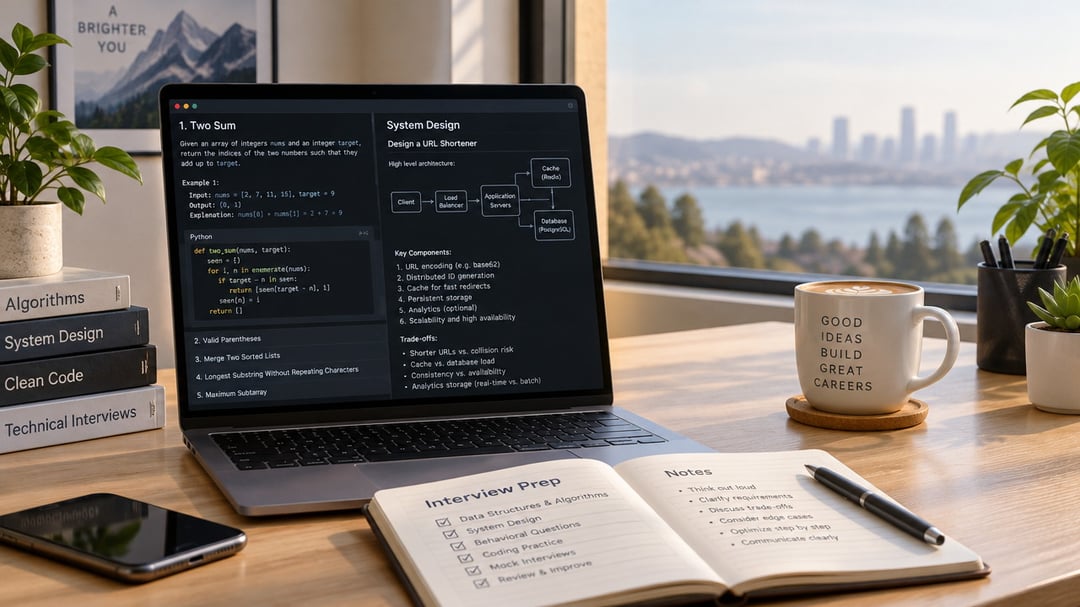
Effective tech interview prep starts with understanding what the employer will assess. Coding exercises matter but preparation also needs to address communication, technical decisions and testing. Microsoft's interview guidance explicitly identifies problem-solving, design, coding and testing as evaluation areas.
A focused preparation routine connects those expectations to realistic exercises and measurable improvements.
What to expect in a tech interview
Technical interviews can combine coding exercises, behavioral questions and discussions about previous projects. Confirm the actual format before choosing practice material.
Coding, behavioral questions and project discussions
A coding exercise requires more than producing a working solution. Practice explaining assumptions, comparing approaches and checking the result.
For project discussions, prepare to distinguish personal contributions from team accomplishments. Explain what you built, why you chose that approach and what you'd change.
Ask the recruiter about stages, permitted languages, available tools and assessment criteria.
How expectations change by role and seniority
The advertised role should determine the technical syllabus. Microsoft lists distinct preparation areas including algorithms, data science, machine learning and networking.
System design questions typically target experienced engineers rather than interns. Don't allocate equal preparation time to every possible topic.
Tech interview prep: Build foundations that improve answers
Strong preparation connects technical concepts to decisions that can be explained and tested.
Coding fundamentals: Correctness, complexity and edge cases
Review relevant data structures and practice explaining why an approach works. Time complexity describes how computational work grows with input size. Space complexity describes how memory requirements grow.
Consider detecting duplicates in a list. Comparing every pair repeats work as the list grows. Tracking previously seen values offers another approach with different memory requirements.
Test an empty list, repeated values and a list without duplicates. This exercise combines reasoning, implementation and testing, matching Microsoft's stated evaluation areas.
System design fundamentals: Requirements before architecture
Start design exercises by clarifying expected usage and constraints.
Scalability concerns handling growing demand. Availability concerns whether a service remains accessible. Consistency concerns what guarantees readers receive about stored data.
For a URL shortener, discuss traffic, identifier generation and storage before introducing caches. Practice defending choices rather than listing architectural components.
How to practice for a tech interview effectively
Practice complete interview behaviors rather than collecting solved problems. Educative recommends explaining reasoning aloud and using an environment similar to the expected interview setup.
Practice the complete problem-solving sequence
Use a repeatable sequence:
- Clarify requirements and identify constraints before choosing an approach.
- Describe a straightforward solution and explain its limitations.
- Implement the solution while communicating important decisions clearly.
- Test edge cases and discuss time and space complexity.
Confirm whether documentation, autocomplete or AI assistance is permitted. Reproduce those conditions during practice.
Use mock interviews to diagnose weaknesses
Evaluate each mock against correctness, clarity, testing and pacing.
Record specific failures instead of vague judgments such as “bad at algorithms.” An entry like “started coding before confirming duplicate handling” identifies a repairable behavior.
Reattempt the exercise after correcting that behavior. Use the next mock to check whether the improvement transfers to unfamiliar problems.
Prepare behavioral answers and project evidence
Use STAR, meaning situation, task, action and result, to organize experience-based answers.
Choose examples involving disagreement, uncertainty or a technical mistake. Explain personal actions and use only outcomes that can be substantiated.
For a project deep dive, rehearse requirements, alternatives, implementation decisions and lessons learned. Educative includes project review and behavioral preparation alongside technical practice.
A focused tech interview preparation plan
Build a weekly routine around the weaknesses revealed by a diagnostic mock.
Alternate targeted coding exercises with project review and role-relevant design practice. Finish the cycle with another mock and compare the feedback.
Treat this schedule as adjustable rather than a universal preparation formula. Prioritize recurring mistakes over increasing the number of completed exercises.
Before the interview, verify the platform, audio, editor and connection. Request accommodations early if needed; Microsoft explicitly provides an accessibility request process.
FAQ: Practical questions about tech interview prep
How long should tech interview preparation take?
Use a diagnostic mock to identify the work required. Existing skills and interview scope should determine the schedule.
Which programming language should I practice?
Choose a familiar language that the employer permits. Confirm restrictions before investing practice time.
Does every technical interview include system design?
No universal format applies across roles and experience levels. System design typically targets more experienced candidates.
What should I do when I get stuck?
Restate the constraints and work through a small example. Explain a simpler approach before attempting optimization.
Conclusion: Practice what the interview will actually assess
Effective tech interview prep makes reasoning visible and weaknesses actionable. Confirm the interview format, schedule a diagnostic mock and use the results to choose the next practice session.