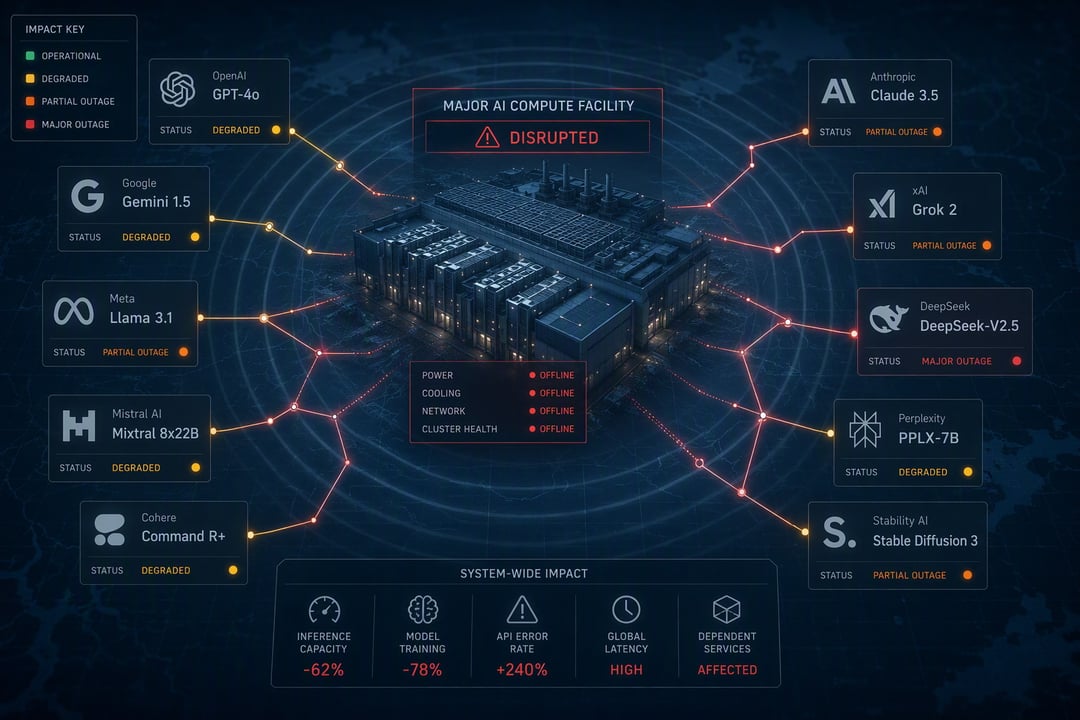
Three major AI platforms went offline within minutes of each other on September 3. OpenAI’s ChatGPT, Anthropic’s Claude, and xAI’s Grok all dropped, cutting off millions of users. Services returned fully by early afternoon Pacific time. The episode left clear questions about how much these platforms actually share under the surface.
Two Separate Causes, Not One Cascade
The near-simultaneous timing looked like a single failure at first. It was not. Claude and Grok opened incident reports four minutes apart—at 1:26 PM and 1:30 PM UTC. ChatGPT’s problems showed up 92 minutes later, at 2:58 PM UTC.
SpaceXAI confirmed Grok’s outage started at its Memphis compute center. The company issued an unusual apology to “impacted compute partners.” That was the first public acknowledgment from any of the three labs that outside customers had been hit.
Anthropic announced a compute partnership with xAI’s parent in May 2026 and leases capacity in Memphis. Anthropic has not confirmed any link to the Memphis site. The four-minute gap between its outage and Grok’s still points strongly to a shared facility.
ChatGPT’s disruption was unrelated. An OpenAI engineer who identified as the incident commander wrote on Hacker News that a routing error inside OpenAI’s own infrastructure caused it. The problem had no connection to the GPT-6 Astra launch the next day. OpenAI’s status page listed elevated errors across ChatGPT and Codex.
Downdetector recorded more than 37,000 user reports for ChatGPT. Claude and Grok each drew roughly 1,300 reports. Microsoft logged no Azure incident in that window. Cloudflare said its systems ran normally. Those statements closed off two popular theories about the root cause.
Shared Infrastructure Among Competing Platforms
The outages made one structural fact hard to ignore. Rival AI companies often run on overlapping infrastructure. Jeff Watkins, chief AI officer at NorthStar Intelligence, put it plainly: people tend to treat OpenAI, Anthropic, Google, and xAI as fully separate platforms. Underneath, the AI ecosystem is far more interconnected.
Downstream tools felt the impact at once. Cursor, a coding environment used by millions of developers, confirmed its own outage. It depends on Claude and Grok under the hood.
Sayali Patil, CEO of IntentOps, highlighted a sharper risk for AI agents. An agent is not a person typing a question. It is already mid-execution. When the model provider disappears mid-action, the work does not pause cleanly. It simply stops.
Enterprise Exposure to AI Downtime
The five-hour disruption sharpened questions about business readiness. Rob Demain, CEO of e2e-assure, framed the core issue: if critical functions run on cloud-based AI—whether a security operations center, service desk, or production line—can the business still operate when the AI goes down? For most organizations the answer is no, and few have tested that scenario.
As of Friday, neither OpenAI nor Anthropic had published a full technical postmortem.


