
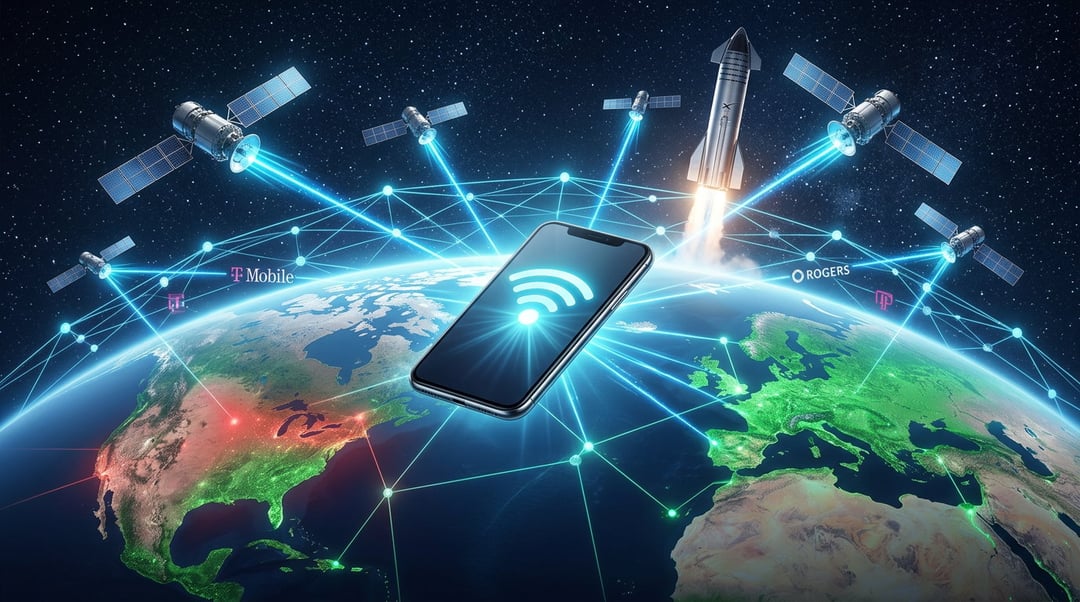
Starlink Mobile Rebrand Signals a Bigger Ambition for Satellite Connectivity
SpaceX has officially rebranded its “Direct to Cell” service as Starlink Mobile, marking a significant step in its effort to deliver satellite connectivity directly to unmodified smartphones.
The company has its sights set on something massive: serving hundreds of millions of devices globally. That’s a bold leap from where things stand today. The first-generation system already spans 650 satellites and has connected over 16 million unique users. On a monthly basis, around 10 million active users access the service through partner carriers such as T-Mobile (US), Rogers (Canada), and KDDI (Japan).
And that number isn’t static. SpaceX expects monthly users to surpass 25 million by the end of 2026.
This isn’t just a branding refresh. The new Starlink Mobile identity signals a long-term push to position satellite-to-phone connectivity as a core part of global telecom infrastructure.
Starlink Mobile Coverage: The Largest 4G Geographic Footprint in the World
Satellite-Based 4G Coverage Beyond Cell Towers
Because Starlink Mobile relies on orbiting satellites instead of ground-based cell towers, it delivers what SpaceX describes as the largest 4G coverage by geographic area in the world.
That distinction matters.
Traditional cellular networks depend on physical towers. If you’re outside their reach—remote highways, rural farmland, mountain regions—you’re often out of luck. Starlink Mobile steps in precisely where terrestrial networks fall short.
The system is designed to:
- Serve users in cellular dead zones
- Provide backup connectivity when towers fail
- Augment networks during periods of congestion
It’s not framed as a replacement for terrestrial networks. Instead, SpaceX describes satellite connectivity as complementary—a hybrid model combining ground infrastructure with orbital coverage.
Second-Generation Starlink Mobile Satellites: Massive Capacity Expansion
1,200 Satellites for Global Continuous Coverage
The next phase is where things get serious.
SpaceX plans to launch the first batch of second-generation Starlink Mobile satellites in mid-2027, using its upcoming Starship vehicle. Each Starship launch will carry more than 50 satellites, enabling rapid deployment.
The goal? Deploy a constellation of roughly 1,200 satellites within six months, capable of delivering global and continuous coverage.
And that’s only the beginning. Regulatory filings indicate SpaceX could scale the constellation to 15,000 satellites over time.
100x Data Density and Larger Phased Arrays
The second-generation satellites aren’t just more numerous—they’re dramatically more powerful.
Compared to V1 satellites, the new models will offer:
- Nearly 100 times the data density
- A phased array antenna five times larger
- Four times the bandwidth per beam
- 16 times more beams per satellite
- Smaller ground spot beams for improved performance
These upgrades are designed to solve one of the first-generation system’s limitations: bandwidth constraints.
Currently, Starlink Mobile delivers speeds around 4Mbps, supporting:
- Text messaging
- Select app connectivity
- Video calls
But peak speeds for the next generation are expected to reach 150Mbps per user, representing a major performance leap.
Spectrum Expansion and Device Compatibility
EchoStar Spectrum Deal Unlocks Higher Performance
A key piece of the puzzle is spectrum access.
SpaceX reached a deal to acquire valuable radio spectrum from EchoStar, the parent company of Boost Mobile. This spectrum will allow the second-generation satellites to harness additional radio frequencies, boosting speed and reliability.
The deal is expected to close on November 30, 2027.
There’s also a hardware component. Phone manufacturers are working on chips capable of receiving signals from the EchoStar spectrum, with a projected two-year development timeframe.
When the upgraded satellites launch in mid-2027, SpaceX expects the service to be available on most devices in the US.
Not Competing With Carriers: A Hybrid Network Strategy
Partnership Over Disruption
Speculation has swirled about whether Starlink Mobile could evolve into a global carrier competing directly with telecom giants.
At Mobile World Congress, SpaceX emphasized a different message.
Starlink Mobile is intended as a key component of a hybrid network, blending:
- Terrestrial cellular infrastructure
- Satellite-based coverage
Satellite networks cannot match the data density of ground-based systems in dense urban environments. But they can fill coverage gaps and provide additional capacity when needed.
That partnership-first positioning is reinforced by existing collaborations:
- T-Mobile brands the service as T-Satellite
- Rogers markets it as Rogers Satellite
While the rebrand to Starlink Mobile could introduce naming overlap, the strategy remains rooted in carrier alliances rather than direct competition.
Current Capabilities and Performance Limitations
The present version of Starlink Mobile already supports essential connectivity functions in dead zones, including:
- SMS messaging
- Video calls
- Limited app usage
However, speeds currently hover around 4Mbps, reflecting the bandwidth limitations of the first-generation constellation.
The second-generation satellites aim to transform the experience with significantly higher throughput, more beams per satellite, and enhanced phased array technology.
If SpaceX achieves its 150Mbps target, satellite-to-phone broadband could move from emergency backup to practical everyday connectivity in underserved regions.
Global Expansion Timeline and Deployment Strategy
The roadmap centers on mid-2027 as a pivotal moment.
Using Starship for deployment allows SpaceX to accelerate constellation build-out dramatically. Launching over 50 satellites per mission means rapid scaling toward the 1,200-satellite benchmark for global continuous service.
Beyond that, expansion toward a 15,000-satellite network would position Starlink Mobile as one of the largest satellite-powered mobile connectivity systems ever proposed.
The company’s objective remains clear: serve hundreds of millions of devices worldwide through a hybrid satellite-terrestrial model.