
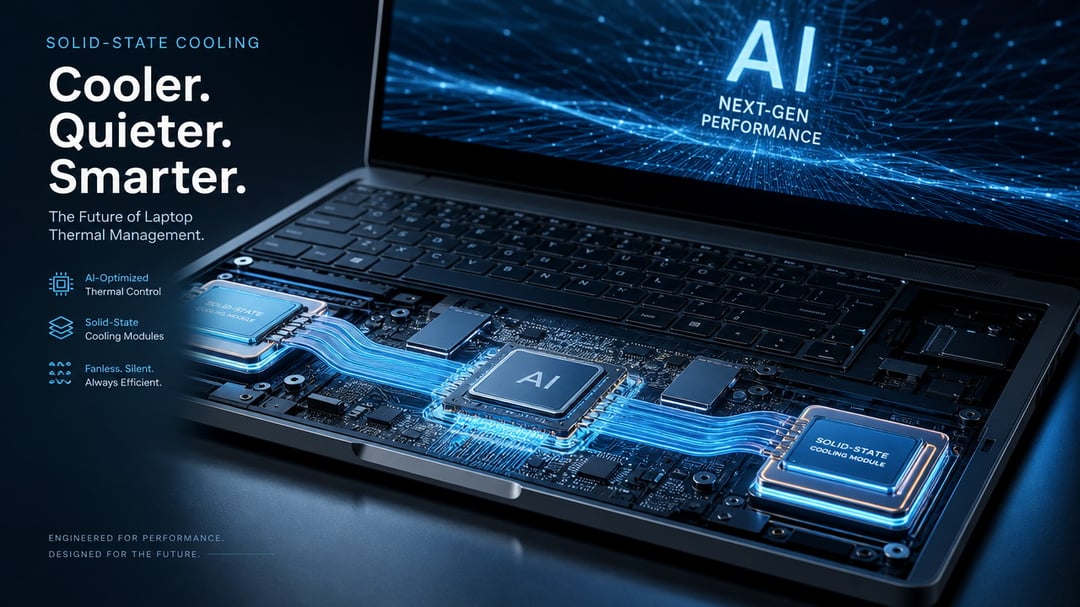
Memory bandwidth is reshaping what AI laptops can actually deliver, and traditional fan-based cooling is falling behind.
Your next laptop’s biggest limit may not be the processor itself. It could be how effectively the system stays cool under load. A white paper from Ventiva, prepared with analyst firm Moor Insights and Strategy, makes the case that thermal design is becoming the factor that decides how fast AI laptops run in real use.
Memory Bandwidth Sets the Pace for Local AI
Local AI performance is measured in tokens per second. That figure depends largely on memory bandwidth. Most current laptops still use 128-bit memory buses paired with LPDDR5 memory. That setup tops out around 150 GB per second. The number is too low for today’s more demanding AI models to run at usable speeds.
Chipmakers are already moving past this limit. Qualcomm has taken its Snapdragon X2 Elite chips to 192-bit buses. AMD and NVIDIA offer 256-bit options in their client silicon. Apple has gone the furthest with the M5 Max, which uses a 512-bit bus. That design can run large open-source models such as GPT-OSS 120 B entirely on the device.
The shift toward wider buses is expected to pick up speed with LPDDR6 memory. The new standard promises higher data rates and improved efficiency. Mainstream adoption is projected for 2027 and 2028.
The Layout Problem Wider Buses Create
Wider memory buses come with a hard physical requirement. Memory chips must sit extremely close to the processor, with traces shorter than 25 millimeters. That space is exactly where fans and heat pipes have traditionally lived inside thin-and-light laptops.
Apple avoids the conflict by placing memory directly on the chip package. Every other laptop maker has to solve the same spatial problem inside a conventional chassis.
Why Fan Cooling Struggles to Keep Up
Traditional fan-based cooling cannot scale easily with these denser memory layouts, especially as designs move to 256-bit and wider buses. The physical conflict leaves less room for the air-moving hardware that has been the default solution for years.
That pressure is putting solid-state cooling in a stronger position. The Ventiva report highlights the company’s ionic cooling platform, which moves air with charged particles. The system runs silently and has no moving parts.
Frore’s AirJet technology has already shown results in an Intel reference laptop only 11.3 mm thick. It delivered 15 watts of sustained fanless cooling while remaining noiseless. At CES, YPlasma demonstrated a plasma-powered laptop cooler that uses ionized gas instead of a spinning fan and claims operation at 17 decibels.
2027 and 2028 as a Practical Turning Point
The paper treats 2027 and 2028 as the period when wider memory buses and LPDDR6 are likely to become standard. If that timeline holds, laptop makers will have to treat cooling as a core design decision rather than an afterthought.