
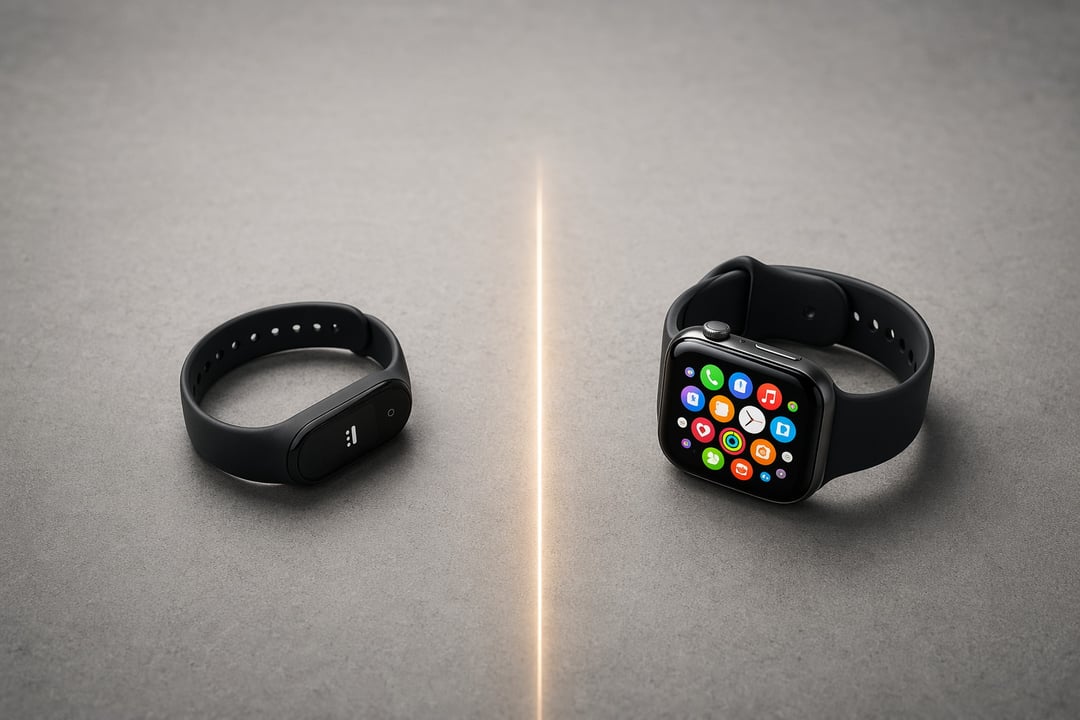
You're standing in the store. Or more likely, you've got fourteen browser tabs open. Two devices. Both count your steps. Both track your sleep. Both buzz when you've been sitting too long. One costs fifty bucks. The other costs four hundred. And everyone seems weirdly confident about which one you should get.
Here's the thing nobody tells you: the gap between a smartwatch and a fitness tracker isn't really about quality. It's about what you actually want from the thing on your wrist. Answer that, and the choice mostly makes itself.
What's Actually the Difference Between a Smartwatch and a Fitness Tracker?
Let's clear this up first, because the marketing has muddied it.
A fitness tracker is a specialist. It's built around one job — your body. Steps, heart rate, sleep, workouts, calories. It does those things well, stays out of your way, and barely sips battery.
A smartwatch is a generalist. Think of it as a tiny computer strapped to your arm. It tracks fitness too. But it also handles texts, calls, maps, music, payments, and a hundred apps you'll download once and forget about.
The honest framing? It's not better versus worse. It's specialist versus generalist. A chef's knife versus a Swiss Army knife. Both cut. They just cut differently — and the right one depends on what you're trying to slice.
What a Fitness Tracker Does Best
The simpler device has a few real advantages, and they matter more than spec sheets suggest.
Battery, first. A good tracker runs for days. Sometimes a week or two on a single charge. You almost forget it's something that needs charging at all, and that alone changes the experience.
Then there's comfort. Trackers are lighter and slimmer, which you'll appreciate at 2 a.m. when you're actually wearing it to track your sleep instead of leaving it on the nightstand.
And the price. You can get a genuinely good one for the cost of a nice dinner. Less money. Less fuss. Fewer notifications screaming for attention.
If your goal is straightforward — move more, sleep better, see your numbers — a tracker delivers all that without the noise.
What a Smartwatch Adds — and What It Costs You
A smartwatch earns its higher price by doing, well, almost everything.
Reply to a text without digging out your phone. Pay for coffee with a tap of your wrist. Navigate a new city. Leave the house with just your watch and headphones for a run. The premium models pile on serious health tools too — ECG readings, blood oxygen, fall detection that can literally call for help.
But all that capability comes with a tax. You'll charge it nightly, basically forever. It costs more, sometimes a lot more. And that bright, busy screen is designed to pull your eyes toward it. Which is great, until you realize your watch has quietly become one more thing pinging you.
You're paying for power. The real question is whether you'll actually use it.
The Differences That Actually Matter When You Buy
Forget the spec wars. Four things genuinely change how a device fits into your day.
Battery life — days of freedom versus a nightly ritual. Price — a casual purchase versus a real one. Comfort — barely-there versus a constant presence. And ecosystem, which trips people up the most.
Here's what I mean. An Apple Watch only works with an iPhone. Full stop. Many fitness trackers, on the other hand, happily pair with whatever phone you've got. So before you fall for a device, check that it actually likes your phone. Nothing stings quite like unboxing something gorgeous that refuses to talk to your hardware.
So, Which Should You Buy?
Time for an actual answer, not a shrug.
Buy a fitness tracker if you want simplicity, battery life that lasts, a friendlier price, and you mostly care about your health data. It's the right call for a huge number of people. Probably more than the ads would ever admit.
Buy a smartwatch if you want a phone extension on your wrist and you genuinely won't mind charging it every night or spending the extra cash. If you live in your notifications, it'll feel like home.
And if you're torn? Plenty of fitness-focused smartwatches now split the difference — solid health tracking, a handful of smart features, battery that stretches past a single day.
The One Question That Settles It
Strip away the specs and it comes down to this: do you want a tool, or a companion?
A tool does its job and disappears. A companion comes everywhere and asks for your attention. Neither is wrong. You just have to know which one you're shopping for.
So — tool or companion? Answer that, and you've basically already chosen.