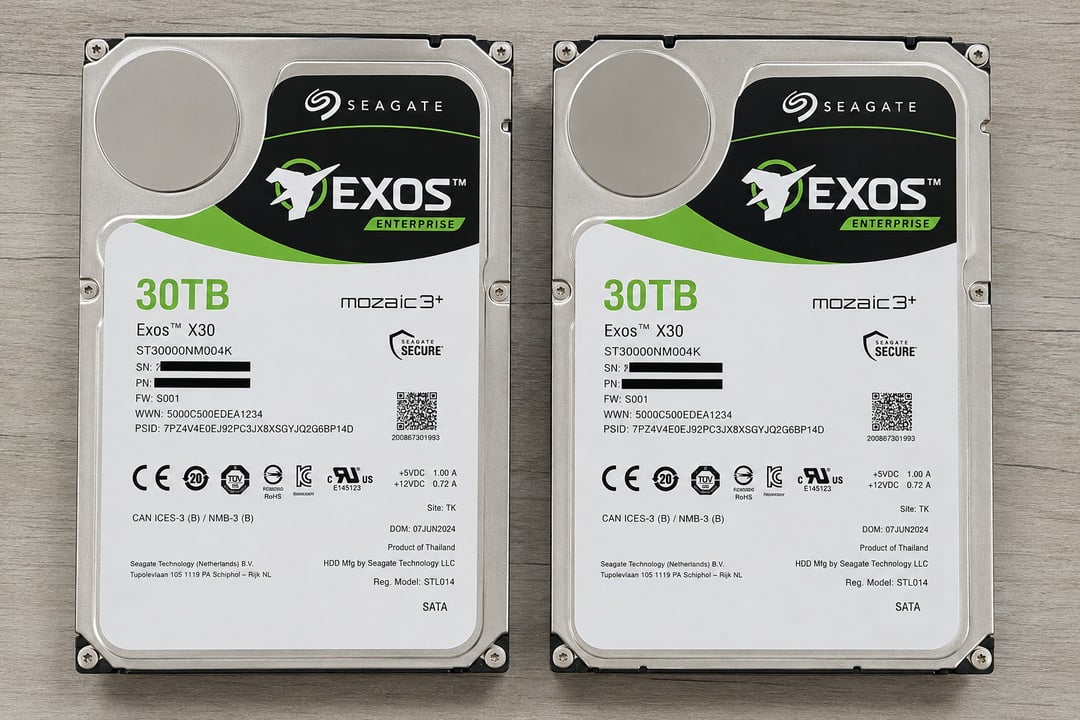
Seagate used its fourth-quarter fiscal 2026 results to lay out where its heat-assisted magnetic recording roadmap goes next, and the headline number is 50TB. Drives at that capacity are expected to reach customers for validation before long, with a broader market arrival penciled in for late 2027. The caveat worth stating up front: the customers in question are hyperscalers, cloud providers, and AI companies buying by the exabyte. These are not drives destined for a desktop tower.
Getting to 5TB per Platter
Chief financial officer Gianluca Romano said the company is on pace to push areal density past 5TB on a single platter. That threshold matters because of simple arithmetic. Stack ten platters holding a bit more than 5TB each inside one 3.5-inch enclosure and the drive clears 50TB without changing the physical form factor at all. No new chassis, no new rack design, no new footprint in the data center — just more bits packed into the same space.
That density level is unprecedented for a shipping product, and Seagate has already slotted it into the calendar for the back half of 2027.
Mozaic 4+ Now, Mozaic 5+ Next
The platform doing the work today is Mozaic 4+, the current generation of Seagate's HAMR implementation. It tops out at 44TB per drive, and the company expects Mozaic 4+ models to represent roughly half of all HAMR exabytes it ships to select customers by the close of 2026. That's a fast ramp for a technology that spent years being described as perpetually two years away.
The 5TB+ platters won't come from that platform, though. They require Mozaic 5+, which will be the third generation of the Mozaic line to actually reach the market. First units are expected to go out for customer qualification later in 2027.
How the Qualification Process Works
There's a gap between "Seagate can build it" and "you can buy it," and the qualification pipeline is what fills that gap. Drives first clear Seagate's own internal testing and validation. Only then do they go out to OEM partners and data center operators, who run their own approval process before signing off. Broader availability follows after that.
For anyone tracking the timeline, this is why a 2027 qualification date does not mean 2027 volume shipments to the general market. The validation stage is the front end of a longer sequence, and each customer runs it on their own schedule.
Why Areal Density Is the Entire Strategy
Seagate was direct about why it keeps chasing density rather than simply building more drives: it's the only path that keeps the economics working. Fitting more terabytes onto every platter lets the company hold hard drive costs relatively flat while still growing total exabyte output. The alternative — scaling production by pouring capital into new and expanded manufacturing capacity — isn't sustainable at the rate demand is climbing.
Put another way, density is how Seagate grows supply without growing capital expenditure at the same pace. That's a margin story as much as an engineering one, and the company positioned continued areal density gains as a core pillar of its strategy going forward.
AI Demand Is Driving the Numbers
The financial results underneath the roadmap were strong, and Seagate attributed that directly to AI hyperscalers and cloud service providers. Revenue for the June quarter came in at $3.6 billion, up 17% from the prior quarter and 48% compared to the same period a year earlier.
|
Metric
|
Q4 FY2026
|
|
Revenue
|
$3.6 billion
|
|
Sequential growth
|
+17%
|
|
Year-over-year growth
|
+48%
|
Demand for cold storage has gotten intense enough that CEO Dave Mosley said most of the company's nearline exabyte production is already committed well into 2028. Supply is spoken for years ahead of delivery.
Hard Drives as the Memory Layer for AI
The reason behind that demand is more interesting than the raw growth figures. Seagate now earns the bulk of its revenue from AI data centers and cloud giants, and those buyers are using hard drives to handle the long tail of their AI workloads — the data that has to persist and stay retrievable but doesn't need flash-level speed on every access.
Mosley framed cold storage as essential infrastructure for giving AI models and agentic systems their context. An AI agent that needs to remember what happened across many separate user interactions requires a durable, affordable place to keep all of it. That persistent data foundation is what's pulling storage procurement — and Seagate's revenue — to levels the company hasn't seen before.
It's a notable role reversal for a technology that spent the last decade being written off in favor of solid state. The economics of storing enormous volumes of infrequently accessed data still favor spinning platters, and AI has turned out to generate exactly that kind of data at enormous scale.