
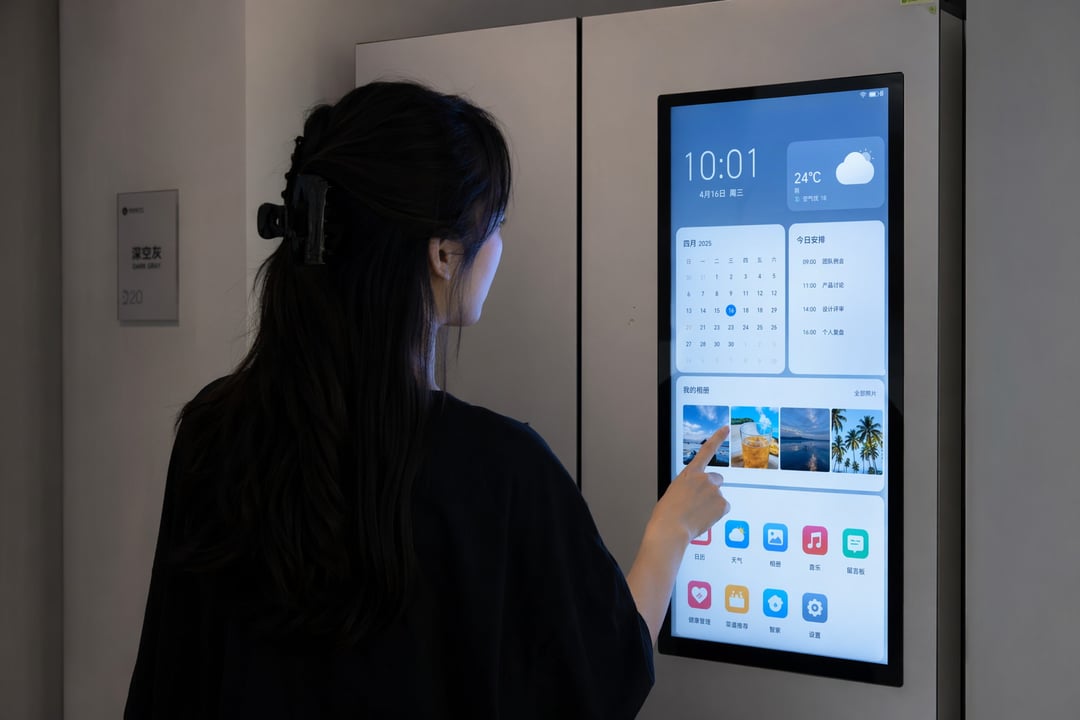
Your Fridge Is Getting Smarter — Whether You Asked for It or Not
There's something almost sci-fi about opening an app on your phone while you're standing in the grocery store aisle and seeing exactly what's in your refrigerator back home. No more buying a third jar of mustard. No more guessing whether you're out of oat milk. That's not a distant future anymore — Samsung is rolling it out right now.
The company is weaving AI into a new wave of home appliances, and the refrigerator is leading the charge. Using a technology called Vision AI, the updated fridge uses cameras to actually identify the food inside it. Not just detect that something's there — recognize specific items, like a can of Coke. That information shows up in a companion app on your phone, so you can check your supply without ever cracking the door open.
And here's where it gets genuinely useful: the fridge can suggest recipes based on whatever's already inside, and if something's missing, it can add it directly to your Instacart shopping list. So instead of standing in the produce section trying to remember if you have lemons, your refrigerator already told you.
Vision AI and the Technology Behind It
The food recognition features rely on a large language model to identify what it sees — the same kind of underlying technology powering a lot of the AI tools you're probably already using. Many of the AI features in Samsung's appliances are also powered by Google Gemini, which gives you a sense of the scale of the tech involved here.
Michael McDermott, executive vice president of consumer electronics at Samsung, described Vision AI as a way to capture what's in your fridge so you don't have to manually track it. And honestly, that framing gets it right. It's less about flashy tech and more about removing a small but genuinely annoying piece of daily mental load.
The more advanced food recognition improvements are set to roll out in May.
The AI Oven That Knows What You're Cooking
It's not just the fridge. Samsung's AI-powered oven comes with a built-in camera that can recognize the dishes you place inside — and from that, recommend a cooking time. Think about it this way: you slide a casserole in, and the oven figures out what it is and how long it probably needs. No more hovering over the recipe.
And there's a fun detail here for the food content crowd: the oven can also record video. If you're a food influencer who wants a close-up of something bubbling away in the oven, the camera is already there.
Bixby as Your Kitchen Companion
Samsung is also leaning into its own virtual assistant, Bixby, as a kind of household companion that lives in your appliances. The goal isn't just to respond to commands — it's to recognize who is speaking.
Voice ID, for example, could pull up personalized calendars and reminders depending on who walks up to the fridge and starts talking. Different family members, different experiences. McDermott described the broader vision as technology that "fades into the background while making your day easier," which is honestly the right benchmark for this kind of thing. The best home tech is the kind you stop noticing.
What This Costs
Let's be real — none of this is cheap. The AI-powered Bespoke AI Family Hub fridge starts at $2,799. The smart range starts at $1,349. These aren't impulse purchases.
That said, Samsung isn't alone in this space. LG is also pushing AI into its appliances, with a focus on learning your habits and automating key functions to make everyday tasks easier. Competition tends to bring prices down eventually, but right now, early adopters are paying a premium.
The fridge was first unveiled at CES earlier this year, so this rollout has been in the works for a while. It's not a concept — it's a product you can actually buy.