
What the Media Router Does
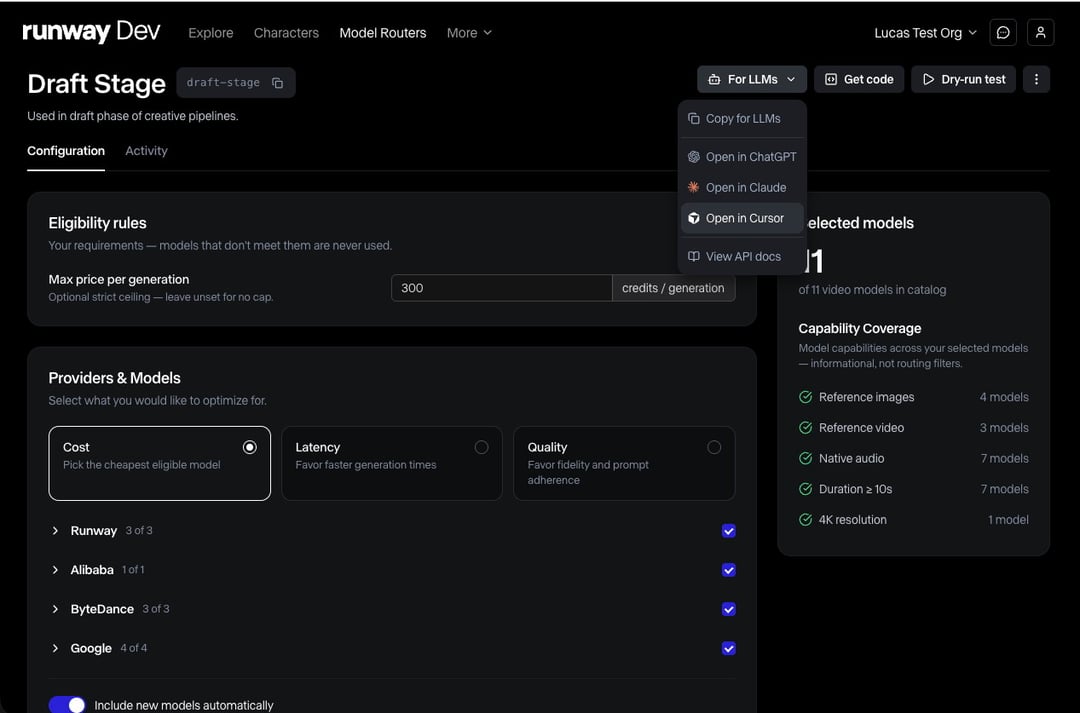
Runway has released Media Router, a system that picks the right generative model for a given job without the developer having to decide. Feed it a request for an image, a video clip, or an audio track, and it selects from a roster of available models based on what the developer says matters most: output quality, generation speed, or cost.
Model routing is already familiar territory in the language-model world, where switching between engines to control spend has become standard practice. Runway's claim is that no one had built the equivalent for visual and audio generation until now. Chief product officer Anthony Maggio frames it as the connective tissue in a broader pitch — a single place developers can plug into any kind of generative media model, without stitching together a dozen separate integrations.
Routing on Quality, Speed, or Cost
The three levers are the point. A team generating thumbnails at volume cares about cost per output. A team producing a hero video for a campaign cares about fidelity. A team powering a live product feature cares about latency. Rather than forcing one tradeoff across every request, the router applies whichever preference the developer has configured and matches it against what each model does well.
Runway Dev and the Move Toward Infrastructure
Media Router sits inside Runway Dev, the company's developer platform, which opened earlier this month. Runway Dev offers API access to a growing catalog of third-party image, video, and audio models alongside Runway's own — a deliberate signal that the company is willing to route customers to competitors' models when those models are the better fit.
The customer list already includes Adobe, Cloudflare, ElevenLabs, Expedia, Shutterstock, and Quora. What links them is that none of them are sending users over to Runway's consumer app. They are embedding generation directly into their own products through the API, which is exactly the position Runway wants to occupy: underneath other companies' software rather than competing for the same end users.
That represents a real repositioning. Runway spent years known primarily for the end-user experience — the creative tool people opened in a browser. Co-founder and co-CEO Anastasis Germanidis has described the company as having had to build a full stack to support that surface anyway: a developer platform, a suite of creative tools, and an inference layer running beneath everything. Customers, he says, have increasingly asked Runway to show up across all of it.
Why Model Sprawl Made a Router Necessary
The number of generative media models available has grown fast enough that evaluating new releases has become a genuine time sink. Maggio's argument is that most developers simply do not have the hours to benchmark every new model across video, image, and audio, or to map where each one outperforms the others on specific output types.
That evaluation burden is what Runway is selling. The router encodes judgments about which model handles which task best, then filters those judgments through whatever business constraints a customer has set.
Provider Preferences and the Geopolitics Problem
One of those constraints is where a model comes from. Chinese generative media models have grown notably popular, but plenty of businesses building commercial products are not comfortable depending on them. Media Router lets a developer set a preference for American providers instead.
That preference may get more common. The Trump administration has been exploring bans and sanctions targeting Chinese open AI models, which turns a procurement preference into something closer to a compliance requirement for some companies.
Token Costs as a Routing Signal
Pricing is the other constraint customers ask about most, alongside quality. Token costs became a live issue in 2026 as enterprises that committed heavily to agentic AI discovered how quickly the bills accumulate. Routing on price is already routine in the language-model world for exactly that reason, so extending it to media generation follows naturally.
The timing is also worth noting internally: Media Router arrives only weeks after Runway retired its unlimited subscription tiers in favor of token-based pricing, a change that some users pushed back on.
How Runway Decides What "Better" Means
Quality routing is harder for media than for text. With language models, comparative benchmarks are relatively mature. With generative media, "better" splits into different questions depending on the format.
Runway's answer is an intelligence layer built on evaluation work done by its in-house creative team — people who have spent time assessing output across every media type. The criteria are format-specific:
- Video models: how convincingly they handle motion
- Image models: how well they handle composition
- Voice models: how accurately they handle lip syncing
That layer was not built from scratch for this launch. Runway had already developed much of it for its agent product, released in May, a conversational creative partner that turns text prompts into fully edited multi-shot videos and marketing campaigns. Media Router takes the same routing technology Runway was already using internally and exposes it to outside developers.
Where Runway Sits in the Model Race
The strategic context matters. Runway's most recent frontier video model, Gen 4.5, shipped in December and topped leaderboards at the time, beating comparable models from incumbents including Google. Runway also released its first world model that same month.
Since then the release cadence on frontier video has slowed. Aside from an upgrade to its video editing model, Aleph 2.0, in May, the company has not put out a new dedicated frontier video model in months, and it has not said when Gen 5 might arrive.
The leaderboard picture reflects that gap. Aleph 2.0 still ranks among the leading video editing models according to Artificial Analysis, but Runway's text-to-video and image-to-video models no longer sit at the top. The top 20 spots are occupied by models from Google and from Chinese labs including ByteDance and Alibaba.
The Orchestration Bet
Read against that backdrop, Media Router is a hedge with a thesis behind it. Instead of asking developers to bet that one model stays ahead, the product assumes the leader will keep changing — and positions Runway to profit from the churn rather than lose to it. If Runway is not shipping the single best model in a given month, it can still be the layer that knows which model is.
Germanidis makes the case that strong underlying models remain necessary but are no longer sufficient. When customers are assembling entire campaigns or complete multi-scene generations, the orchestration on top of the raw pixel models starts to carry serious weight. The router is one way that layer reaches users directly.
Maggio's framing is broader: research focus paired with building toward where the space is heading, which he describes as the through-line of the company's work since 2018.


