
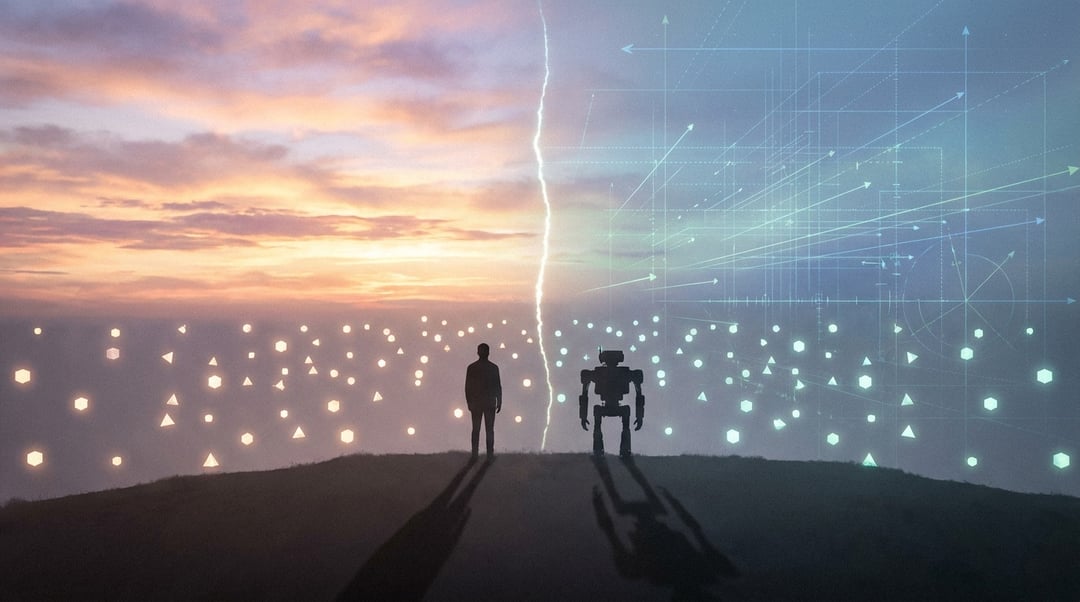
Here's the strange thing about May 2026. The most capable AI systems can draft a legal brief, debug a production codebase, and pass medical licensing exams. And yet, when researchers gave the best of them a set of ARC-AGI-3 puzzles, the top system scored just 12.58%. Over a thousand regular humans played those same games and cleared thousands of them without much trouble.
That gap is the whole story of where we actually are. So let's look at it honestly.
What we even mean by "AGI"
This part trips people up. There isn't one definition. There are two camps. They're mostly talking past each other.
One camp — closer to how OpenAI frames it — measures AGI by economic value. Can a system do most of the cognitive work humans get paid for? By that standard, we're surprisingly close.
The other camp — DeepMind, plenty of academics — wants something deeper. A system that learns like we do, reasons about new situations, generalizes to domains it's never seen. By that standard, we're not close. We might not even be on the right path.
Which definition you pick basically determines your timeline. Keep that in mind whenever someone confidently tells you when AGI will arrive.
Where the frontier actually sits
What today's models do shockingly well
The MMLU benchmark, which dominated AI evaluation for years, is finished. Every frontier model now scores above 88%, and differences at the top are essentially statistical noise. The thing we used to measure intelligence by has been beaten.
More telling: autonomous agents are now executing multi-step workflows in law, medicine, software engineering, and corporate finance. Not demos. Actual work. On OpenAI's GDPval — tasks designed by professionals with 14+ years of experience — performance more than doubled from GPT-4o to GPT-5.
What they still can't do
Then there's the embarrassing part. On the ARC-AGI-3 preview, the best AI system reached just 12.58% action efficiency while over 1,200 human players completed more than 3,900 games, most successfully.
And in production? Enterprise agentic systems show a 37% gap between lab benchmark scores and real-world deployment. Models look smarter on paper than they do in the field.
The roadblocks nobody's solved yet
Four problems remain wide open. Scaling alone hasn't cracked any of them.
Reasoning that isn't pattern matching. Bigger models remember more. They don't reliably think better. That's why ARC-AGI exists — it's designed to be unGoogleable.
Long-horizon agency. A system that nails a ten-step task often falls apart at a hundred steps. Errors compound. The agent forgets why it started.
Continual learning. Today's models can't really update themselves from yesterday's experience without expensive retraining. Humans learn constantly. Models mostly don't.
Embodiment. Most human intelligence is grounded in moving through a physical world — picking things up, dropping them, learning that fire is hot. Language models live in pure text.
The timeline debate, honestly
You'll hear confident predictions from people who should know better. Here's what the actual experts say.
Sam Altman believes AGI could happen in the next few years. Google DeepMind's Demis Hassabis has often pointed to a timeline extending into the mid-2030s. Researchers like François Chollet think we haven't even identified the architecture that'll get us there.
That's not three people slightly disagreeing. That's a ten-to-fifteen-year spread among the people closest to the work. The spread itself tells you something important. Nobody actually knows.
Anyone who sounds certain is selling something. A product, a thesis, a vibe — but something.
So what should you actually do?
Don't wait for AGI to start paying attention. The systems we have right now — the ones that can't solve a child's puzzle but can refactor your codebase — are already enough to change how most of us work. That's the realistic roadmap. Not a finish line. A series of capabilities that keep arriving, faster than most people are ready for.
The question isn't really when AGI shows up. It's whether you've been paying attention along the way.