
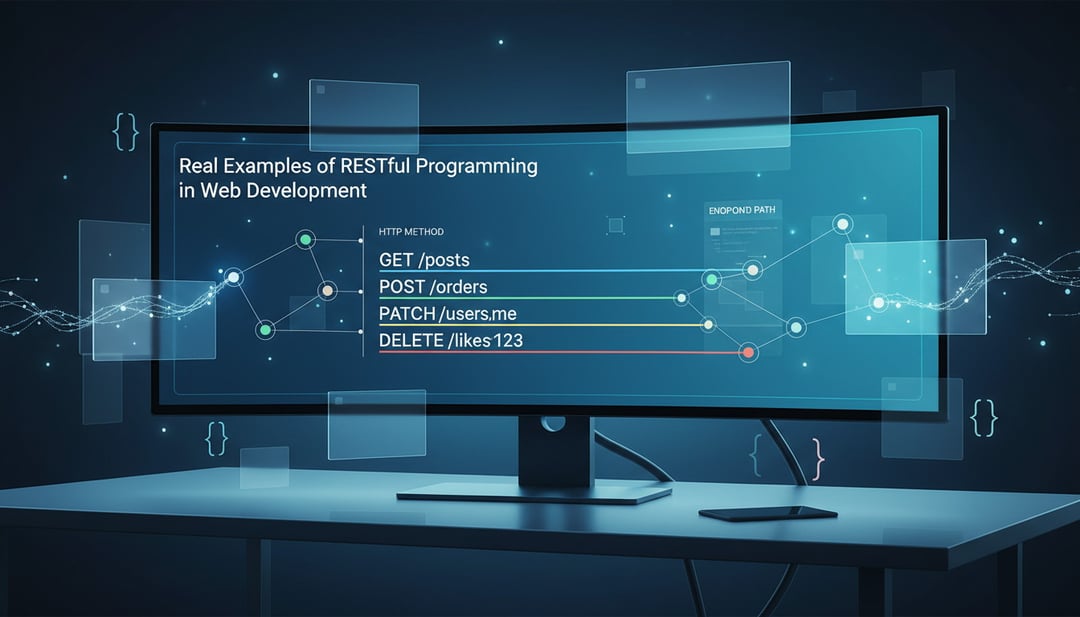
REST can feel weirdly abstract at first. People throw around words like resources, statelessness, and uniform interface as if everyone woke up already knowing what they mean. But once you look at real examples of RESTful programming in web development, the whole thing gets much simpler. It stops feeling like theory and starts looking like the apps you already use every day.
At its core, RESTful programming is just a structured way to build web APIs. A client asks for a resource through a URL. The server responds with a representation of that resource, usually JSON. HTTP methods such as GET, POST, PATCH, and DELETE signal the action. That’s the big picture. Simple on purpose.
What RESTful Programming Means in Web Development
In web development, REST treats application data as resources. A resource might be a user, a blog post, a product, or an order. Each resource gets a predictable URL. For example, /posts refers to a collection of posts. /posts/12 refers to one specific post. The URL names the thing. The HTTP method tells the server what to do with it.
That separation is what makes REST useful. Instead of building messy endpoints like /createPostNow or /deleteUserAccount, a RESTful API keeps the structure clean. You work with nouns in the URL and verbs in the HTTP method. POST /posts creates a post. DELETE /posts/12 removes one. It’s tidy, readable, and easier to maintain.
And that matters more than people admit. Good API design is not about elegance for its own sake. It’s about making systems easier to understand when the codebase gets large and several people need to work on it without stepping on each other.
Real Example 1: A Blog Platform API
A blog is one of the clearest real-world REST API examples. Imagine a publishing platform with articles, authors, and comments. The API might expose endpoints like these:
GET /postsGET /posts/123POST /postsPATCH /posts/123DELETE /posts/123
When a reader lands on the blog homepage, the frontend sends GET /posts to load recent articles. When the reader clicks a title, the app sends GET /posts/123 to fetch the full article. When an editor creates a new article in the admin panel, the system uses POST /posts. That is RESTful programming in web development in action. Nothing fancy. Just consistent structure.
Comments fit the same pattern. A comment collection might live at /posts/123/comments. The frontend can retrieve comments with GET and submit a new one with POST. The resource model stays easy to follow because each URL points to something concrete.
Real Example 2: E-Commerce Products and Shopping Carts
Online stores rely heavily on RESTful API examples because e-commerce is basically a giant machine for moving resources through predictable states. Products, carts, customers, and orders all map neatly to resource-based endpoints.
A store might use:
GET /productsGET /products/42POST /cart/itemsPATCH /cart/items/42DELETE /cart/items/42POST /orders
Here’s what that looks like in practice. A shopper browses products through GET /products. They open a product page through GET /products/42. When they add the product to their cart, the frontend sends POST /cart/items. If they increase the quantity from one to three, the app uses PATCH /cart/items/42. If they remove the item, it sends DELETE /cart/items/42.
This example also shows where REST needs some judgment. Checkout is not just a static resource. It’s a workflow with inventory checks, payment processing, tax rules, and shipping calculations. Even so, many developers keep the design mostly RESTful by creating an order resource with POST /orders and then retrieving its state later. That balance is practical. Purity is overrated when clarity does the job.
Real Example 3: User Accounts in a SaaS Application
User account management gives another strong example of RESTful programming in web development. A software platform might offer endpoints such as:
GET /users/mePATCH /users/meGET /subscriptionsPOST /password-reset-requests
These endpoints support common account actions. A dashboard loads profile data with GET /users/me. A settings page updates the profile with PATCH /users/me. A billing page may call GET /subscriptions to show plan details.
The password reset example is especially useful because it shows how REST can stay flexible. A reset request is not always something users think of as a resource. But from the server’s perspective, it behaves like one. The user submits a request. The system creates a reset process. That’s why POST /password-reset-requests makes sense.
This is where beginners often get stuck. They assume REST means every endpoint must look perfectly textbook. Real systems are messier than that. Good RESTful design is about predictable patterns, not robotic rule-following.
Real Example 4: Social Media Features
Social platforms offer some of the most familiar examples of RESTful web services. Think about posts, likes, comments, and feeds. An API could include:
GET /posts/99POST /posts/99/commentsPOST /likesDELETE /likes/123GET /feed
A “like” is a great design case. Many weak APIs would use something like /likePost. That works, technically. But it drifts into action-driven design. A stronger RESTful model treats a like as a resource. You create it with POST and remove it with DELETE. That structure scales better as features grow.
Feeds are a little more complex because a feed is often an assembled view from many sources. Even then, the REST pattern still holds if the API exposes the feed as a defined resource representation. The rule is not “every resource must equal one database row.” The rule is closer to “the interface should stay consistent and understandable.”
What Makes RESTful Programming Good
Strong RESTful API design tends to share a few traits:
- clear resource names
- correct use of HTTP methods
- meaningful status codes like
200,201,400, and404 - consistent JSON response formats
- useful error messages
- predictable pagination and filtering for large collections
Weak APIs usually reveal themselves fast. They use verb-heavy URLs, ignore status codes, or force every action through POST. That kind of design may work short term, but it creates confusion later. And confusion is expensive. It slows developers down, increases bugs, and makes integrations harder than they need to be.
Why These RESTful Programming Examples Are Important
The best way to understand REST is to stop treating it like philosophy. It’s a design pattern for making web systems more predictable. URLs identify resources. HTTP methods express intent. Responses describe state. Each request should carry what the server needs to process it.
That’s it, really.
Once you see real examples of RESTful programming in web development through blogs, stores, SaaS dashboards, and social apps, the concept clicks. You start recognizing the shape of good API design everywhere. And from there, building cleaner web applications becomes much easier.


