
Buying a gaming PC in 2026 feels less simple than it should.
You see a prebuilt tower with RGB lighting, a shiny GPU name on the box, and a promise that it’s “game ready.” Then you price out the same parts yourself and wonder if building a custom PC is still worth the effort.
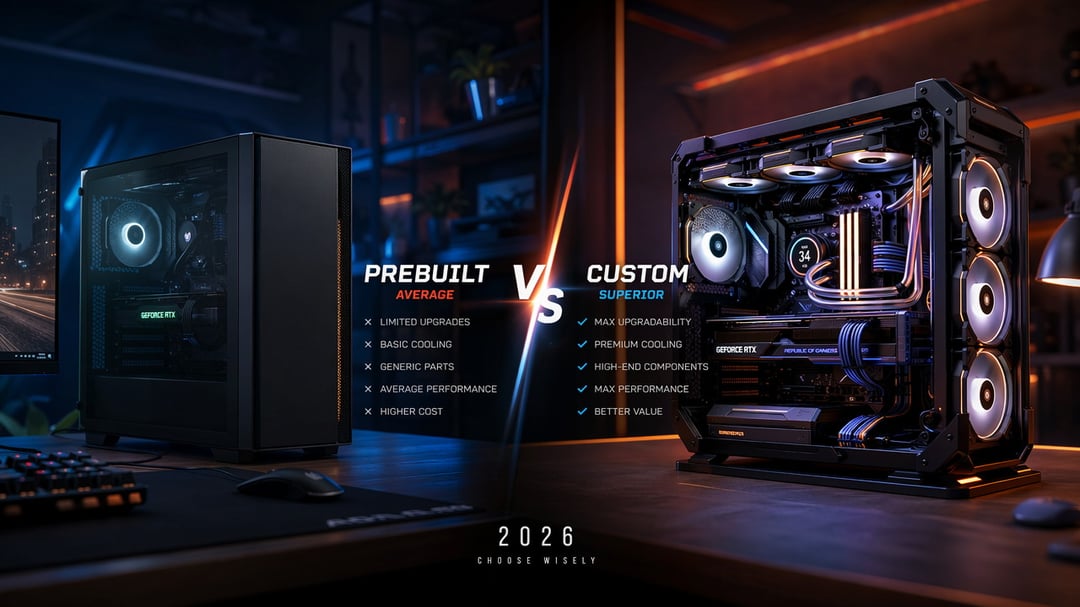
For gaming, the answer is clear: a custom PC wins in 2026.
Prebuilt PCs still make sense for some buyers. They’re convenient. They arrive assembled. They usually include one warranty. But if the goal is better gaming performance, longer upgrade life, and stronger value after the first year, a custom gaming PC gives you more control over the parts that actually matter.
And in 2026, having control will be more important than ever.
Why the Prebuilt vs Custom PC Debate Changed in 2026
A few years ago, this debate mostly came down to price. During GPU shortages, prebuilts sometimes looked like the smarter buy because large PC makers had easier access to graphics cards.
That advantage has narrowed.
Today, the bigger issue is balance. Modern games lean hard on GPU power, fast memory, reliable storage, and steady cooling. Newer graphics cards can push impressive frame rates at 1440p and 4K, but only when the rest of the system supports them properly.
A prebuilt gaming PC may look strong on paper. The problem sits in the details.
Many manufacturers advertise the GPU and hide the compromises: a weak power supply, a cramped case, single-channel RAM, basic cooling, or a motherboard with limited upgrade options. Those parts don’t always show up in big bold text. You feel them later through heat, fan noise, stutter, crashes, and shorter upgrade life.
A custom PC avoids that trap. You choose the exact parts. You decide where the money goes. For gaming, that usually means spending more on the GPU and less on flashy extras that don’t raise frame rates.
Performance: Where Custom Gaming PCs Pull Ahead
Your Budget for a GPU Is More Important Than the Specs
The graphics card drives most gaming performance, especially at 1440p and 4K. That’s why a smart custom build puts a large part of the budget into the GPU.
With a prebuilt, the parts list can be less honest than it looks. A system might include a strong graphics card but pair it with slower RAM, a low-end motherboard, or a power supply with little headroom. The PC technically has the advertised GPU. It just may not let that GPU perform at its best for long gaming sessions.
A custom build lets you avoid that mismatch. If you want high-refresh 1440p gaming, you can prioritize the GPU and choose a CPU that supports it without wasting money. If you play esports titles, you can shift more budget toward a stronger processor and faster memory.
That flexibility matters because “gaming PC” does not mean one thing. A Fortnite player chasing 240 FPS does not need the same system as someone playing Cyberpunk 2077 with ray tracing enabled.
Better Cooling Means Better Gaming
Gaming performance is not just about peak benchmark numbers. It’s about what your PC can sustain after one or two hours of play.
Heat changes everything.
When a CPU or GPU gets too hot, it lowers its clock speed to protect itself. That process is called thermal throttling. You may not notice it on a spec sheet, but you’ll notice it when frame rates dip during a long match or a demanding open-world scene.
Custom builds usually handle heat better because you can choose a case with real airflow, quality intake fans, a capable CPU cooler, and enough room around the GPU. Mesh-front cases and properly placed fans often make a bigger difference than people expect.
Prebuilts often cut costs here. Some use tight cases with poor ventilation. Others include the minimum cooling required to pass basic testing. That may be fine for light use. It’s not ideal for modern gaming workloads.
For a deeper look at how thermals affect performance, resources like Gamers Nexus and Tom’s Hardware regularly test cases, CPUs, GPUs, and cooling setups under sustained load.
The Hidden Weak Spot in Many Prebuilt Gaming PCs
The most overlooked part in a gaming PC is often the power supply.
That’s risky.
Modern GPUs can pull sudden bursts of power. A low-quality power supply may work fine during casual use then fail under heavy gaming load. At best, that means crashes. At worst, it can damage other components.
Custom builders can choose a reputable power supply with enough wattage, proper efficiency, and room for future upgrades. That one decision can extend the life of the entire PC.
Prebuilt systems also tend to use more proprietary parts. Some come with custom motherboards, unusual power connectors, or cases that make upgrades harder than they should be. That’s fine until you want to install a larger GPU, replace the motherboard, or move the parts into a better case.
A gaming PC should not feel disposable after three years. A good custom build gives you a path forward.
Where Prebuilt Gaming PCs Still Make Sense
Prebuilt PCs are not bad. They just don’t win this specific fight.
A prebuilt makes sense if you need a gaming PC quickly, don’t want to assemble anything, or prefer one warranty from a single company. For beginners, that peace of mind has value. Not everyone wants to troubleshoot BIOS settings or cable routing on a Saturday afternoon.
There’s also a budget exception. Under roughly $700, a decent prebuilt can be practical if it includes a reasonable GPU and dual-channel memory. At that price, the custom-build advantage shrinks because every dollar is tight.
But once you move above entry-level pricing, custom builds pull away. The more you spend, the more every bad prebuilt compromise hurts.
The Verdict
So, prebuilt vs custom PC for gaming: which wins in 2026?
Custom PC wins.
A custom gaming PC gives you better part selection, stronger cooling, cleaner power delivery, easier upgrades, and more control over performance. It also helps you avoid the quiet compromises that often hide inside prebuilts.
Choose a prebuilt if convenience matters more than performance. That’s a fair trade.
But if you care about frame rates, long-term value, and keeping your system useful through the next wave of games, build custom. You don’t need the flashiest parts. You need the right parts working together.
That’s where custom builds still have the edge. And in 2026, that edge is big enough to call the winner.