
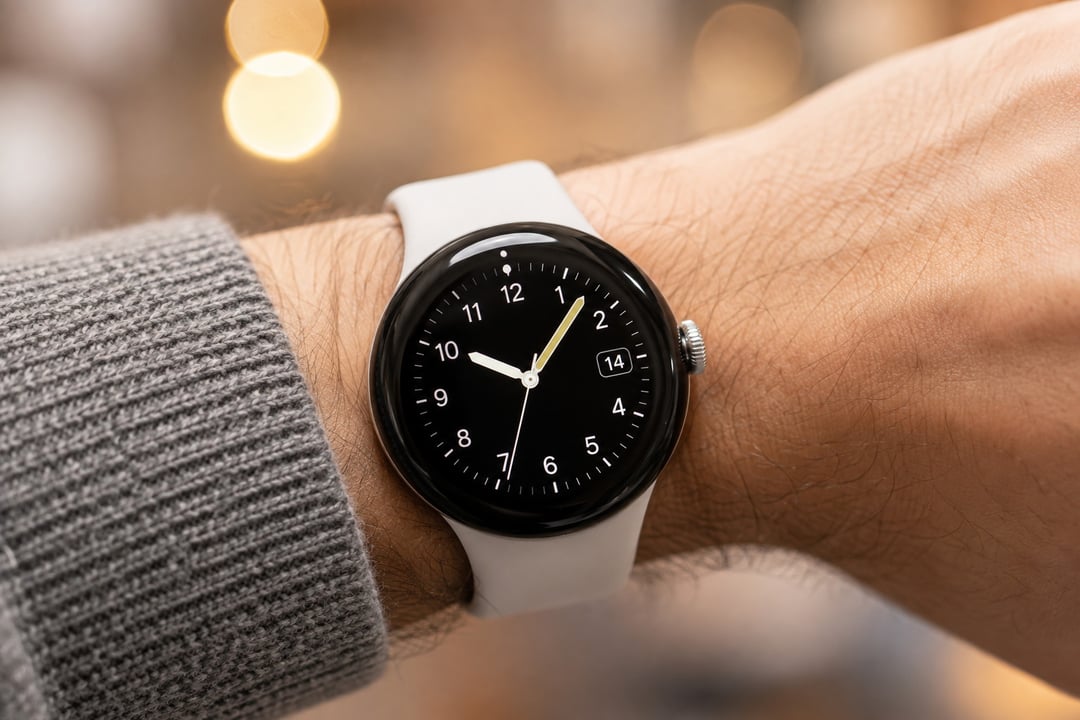
The Pixel Watch 5 looks less like a new smartwatch and more like last year's smartwatch with a bigger hard drive. Marketing material and a technical document surfaced by MyMobiles, working with @OnLeaks, point to the same Snapdragon W5 Gen 2 chip, the same 3,000-nit panel, the same charging speeds, and the same battery-life estimates as the Pixel Watch 4. The clearest hardware change is storage: 64GB, double last year's capacity.
Everything else Google seems to be betting on lives in software — Wear OS 7, Gemini, and a refreshed set of health features.
The hardware carries over almost untouched
Both sizes reportedly keep the Actua 360 LTPO AMOLED display, which shifts between 1Hz and 60Hz and peaks at 3,000 nits. That's the same screen story as before.
The processor is the part that stings a little. Snapdragon W5 Gen 2 returns, even though there was hope Google would move to a newer wearable chip this time. It didn't happen.
Storage is the one spec that jumps. Going from 32GB to 64GB matters most if you load music, maps, or offline files onto your wrist. An earlier Google Play Console listing suggested RAM would climb from 2GB to 3GB, but the most recent documentation doesn't confirm the memory figure, so treat that one as unsettled.
Slightly bigger batteries, identical endurance claims
The cells grow, just barely. The 41mm model moves from 325mAh to 332mAh, and the 45mm goes from 455mAh to 465mAh.
Here's the thing: those extra milliamp-hours don't seem to buy you anything. Google still rates the two watches at up to 30 hours and 40 hours respectively — exactly what the Pixel Watch 4 promised.
Charging is unchanged too:
- Both sizes hit 50% in roughly 15 minutes
- A full charge takes about 45 minutes on the 41mm
- The 45mm needs around an hour
Gemini Intelligence is the real pitch
Google's promotional material spends most of its energy on software, starting with Gemini Intelligence. The assistant is described as proactive — surfacing information before you go looking for it, and suggesting replies based on whatever conversation is on the watch face in front of you.
That's the reframe Google appears to be going for. Not a faster watch. A watch that anticipates you.
Sleep tracking gets the biggest health upgrade
According to the slides, Google is claiming its most accurate sleep tracking yet on the Pixel Watch 5. The watch tracks sleep stages and breathing rate, then turns that into a personalized sleep score.
That score feeds a morning Insights screen, which pulls together readiness data and the day's weather in one place — a quick "how did you actually sleep, and what are you walking into today" summary.
Safety features: Loss of Pulse Detection and Satellite SOS
Loss of Pulse Detection shows up prominently in the material. The feature can detect when a wearer's pulse is no longer present and automatically contact emergency services. Worth knowing: it isn't new or exclusive here — it debuted on the Pixel Watch 3 in supported markets.
Satellite SOS is expected to return as well, reportedly included at no extra cost for two years after activation.
The leaked images show the watch in Natural Silver, Pyrite, and Warm Gold.
US pricing is going up across the board
The latest report lines up with pricing claims Dealabs published earlier:
|
Model
|
Wi-Fi
|
LTE
|
|
41mm
|
$399
|
$499
|
|
45mm
|
$429
|
$529
|
If those numbers hold, every US configuration costs more than the equivalent Pixel Watch 4. You're paying more for hardware that's largely the same, which is a tough sell without the software delivering.
Launch timing and the competition
Google is expected to unveil the Pixel Watch 5 on August 12, with wider availability rumored for August 20.
There's still room for this to land better than the spec sheet suggests. Tighter Wear OS 7 tuning, deeper Gemini Intelligence integration, and Pixel-exclusive software could squeeze more out of aging hardware than a raw comparison implies. But on paper right now, the Samsung Galaxy Watch 9 is the stronger option for Android users — better hardware, lower price.