
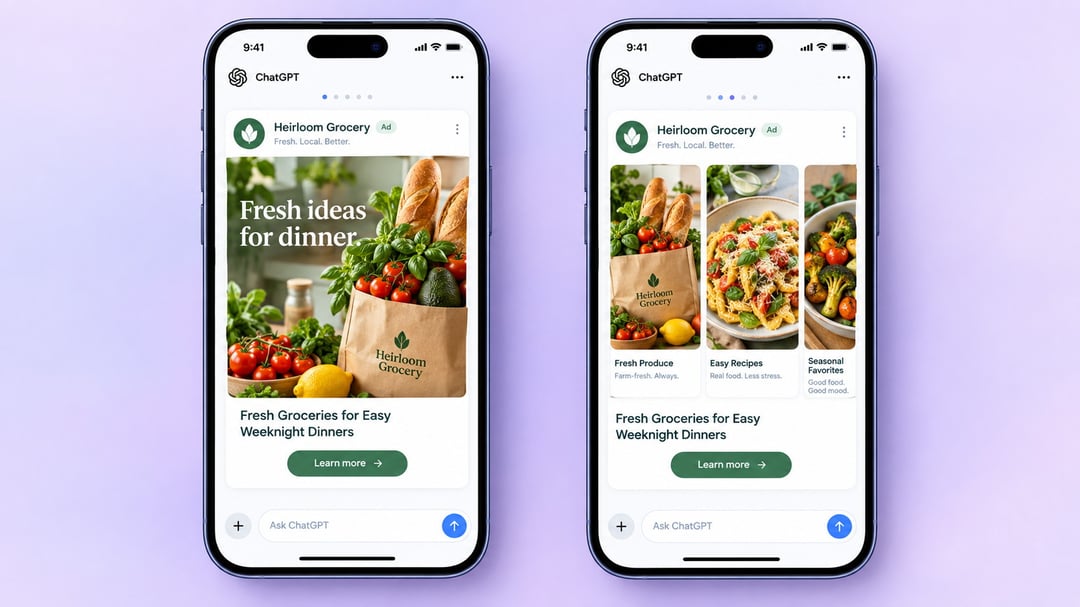
OpenAI is adding visual display ads that show up next to images users generate in ChatGPT. The company is also expanding its ad measurement tools, growing its partner network, and working on new methods for checking brand suitability.
These visual ads start appearing later this month, but only in the United States for now. They will feature products and services from an initial test group of advertisers. OpenAI says the ads will be clearly labeled and will not influence the answers ChatGPT gives.
The timing comes after Meta launched Muse, a free agentic AI app that competes with leading chatbots like ChatGPT. OpenAI first introduced ads earlier this year to support its free and lower-cost subscription plans. It expanded those ads to India in August.
The goal is to attract online advertisers who prefer visual imagery to reach potential customers. Once the ads go global, advertisers will be able to reach ChatGPT’s 1.2 billion weekly users. At the same time, the ads could disrupt the experience for some users. That disruption may encourage more casual users to pay for a subscription so they can skip the ads.
Expanded Measurement Tools and Partner Network
Alongside the new display ads, OpenAI is growing its measurement tools and partner list. The click attribution partners now include AppsFlyer, Triple Whale, Adjust, DV Rockerbox, Northbeam, Branch, Singular, Kochava, Airbridge, and Tenjin. Full-funnel and advanced measurement partners are Fospha, Measured, and INCRMNTAL.
OpenAI has also teamed up with Haus, Measured, and WorkMagic. These partnerships let advertisers run geo-based experiments with the ads.
Brand Suitability Evaluation Pilots
The company is running brand suitability evaluation pilots with DoubleVerify (DV) and Integral Ad Science (IAS). These tools are meant to help advertisers better understand the ChatGPT ads environment.
Taken together, the changes aim to turn ChatGPT into a workable ad-supported business for people on free and low-cost plans.