
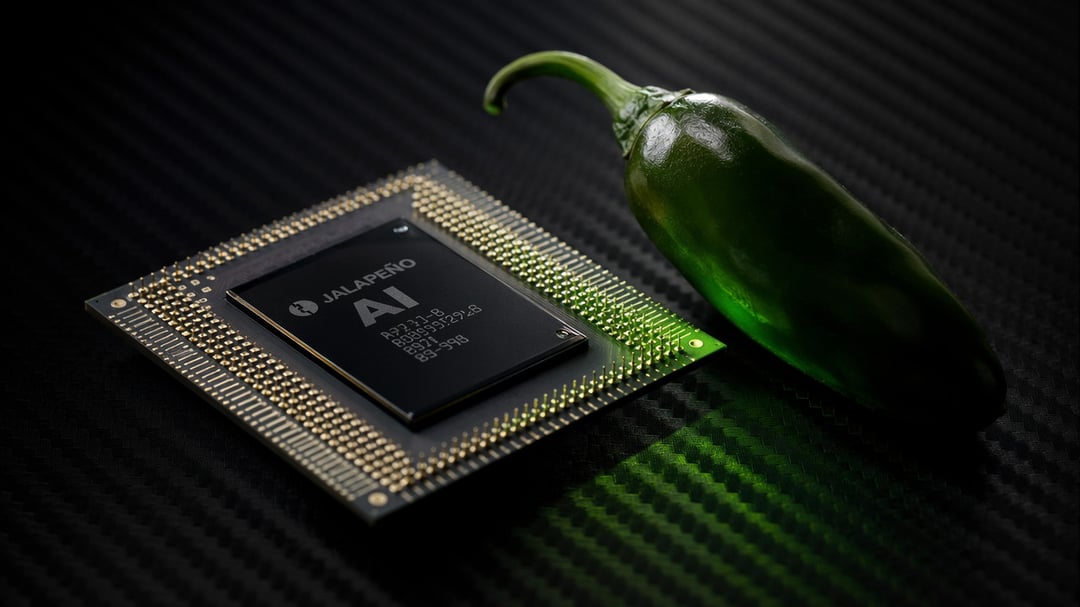
What Jalapeño Actually Is — and Why It's a Big Deal
OpenAI has officially unveiled its first custom-built inference processor, a chip named Jalapeño developed in partnership with Broadcom. And here's the thing — this isn't just a hardware flex. It's a real signal about where AI economics are heading and how OpenAI plans to own more of the infrastructure its products depend on.
The chip is designed specifically for inference: the process of running pre-trained AI models in real time, every time a user sends a request. That part tends to get overlooked in the broader AI conversation — but it's the part that happens constantly, at enormous scale. At OpenAI's level, even modest improvements in how efficiently that computation runs translate into meaningful cost reductions across billions of daily interactions.
Early results are promising. Jalapeño is still in testing, but OpenAI says initial benchmarks already show significantly better performance-per-watt than current alternatives. That metric — how much useful work you get per unit of energy — is one of the most important numbers in data center economics. Improve it, and the cost structure of running AI at scale quietly shifts in your favor.
The Broadcom Partnership: How It Came Together
The collaboration between OpenAI and Broadcom was officially announced in October, though the rumors of OpenAI building its own chips had been floating around well before that. What makes the actual announcement interesting isn't just the chip — it's that OpenAI's own AI models played a direct role in developing Jalapeño. The company made a point of flagging that detail, and it says something real about where AI-assisted engineering is actually headed.
OpenAI president Greg Brockman explained the company's approach on its in-house podcast shortly after the partnership went public. He described how the team starts from a deep understanding of its own workloads, actively looking for underserved use cases where purpose-built hardware could unlock performance that general-purpose silicon simply can't deliver.
That mindset is worth sitting with. Jalapeño isn't just faster hardware doing the same thing — it's hardware shaped around a very specific problem, designed by people who run those workloads every day and know exactly where the bottlenecks live.
Why OpenAI Needed to Reduce Its Nvidia Dependence
The AI industry has a hardware concentration problem. Nvidia's GPUs power virtually every major AI lab, and that dependence creates both cost pressure and strategic risk. Quietly reducing it has become a priority across the space.
Google did it with its TPUs. Amazon built Trainium. Both are what the industry calls AI accelerators — chips built specifically for machine learning workloads rather than the general computing tasks most chips are designed around. With Jalapeño, OpenAI now sits in that same category, joining its major rivals in controlling its own silicon destiny.
But there's an important nuance here. Jalapeño is built for inference, not training. The heavy computational work of pre-training large models will still rely on Nvidia hardware. That's not a gap in the plan — it's a deliberate choice. Inference is where OpenAI's products actually run at scale, and it's where efficiency improvements have the most direct impact on the business.
Inference Costs: The Silent Driver of AI Economics
Here's the thing most people miss about how AI companies actually spend money: pre-training a model is expensive, but it happens once. Inference is what happens billions of times — every request, every response, every time a product works exactly as intended. That continuous, relentless execution is where costs accumulate, and where hardware efficiency has the highest business leverage.
OpenAI specifically called out Jalapeño's low operating cost when running real-time coding models — a direct nod to products like Codex, its agentic coding tool. That framing makes clear this chip wasn't designed as an abstract engineering achievement. It was built around specific, real workloads already running in production.
Lower inference costs open up real options: reduce prices for users, widen margins, or run more capable models that would otherwise be too expensive to offer at scale. In a market where AI products are competing on both price and response speed, that kind of structural advantage compounds over time.
Owning the Entire Stack — Chip to Product
What OpenAI is really describing with Jalapeño is a vertical integration strategy, and the company has been explicit about it. In its announcement, OpenAI described an ambition that goes well beyond model development — covering the full infrastructure beneath its products, from chip architecture and memory systems to networking, scheduling, and deployment. Every layer built to serve the same goal.
The logic behind that approach is genuinely compelling. Most software companies are beholden to hardware decisions made by someone else. Most hardware companies don't build frontier AI models. Companies that do both can optimize each layer around a single shared objective in ways that purely software or purely hardware competitors simply can't replicate.
Jalapeño fits that picture not as a standalone product, but as one piece of a larger system — designed alongside the models it will run, the data centers that will house it, and the agentic products that depend on it. That kind of co-design is hard to imitate at any smaller scale. And that's exactly the point.