
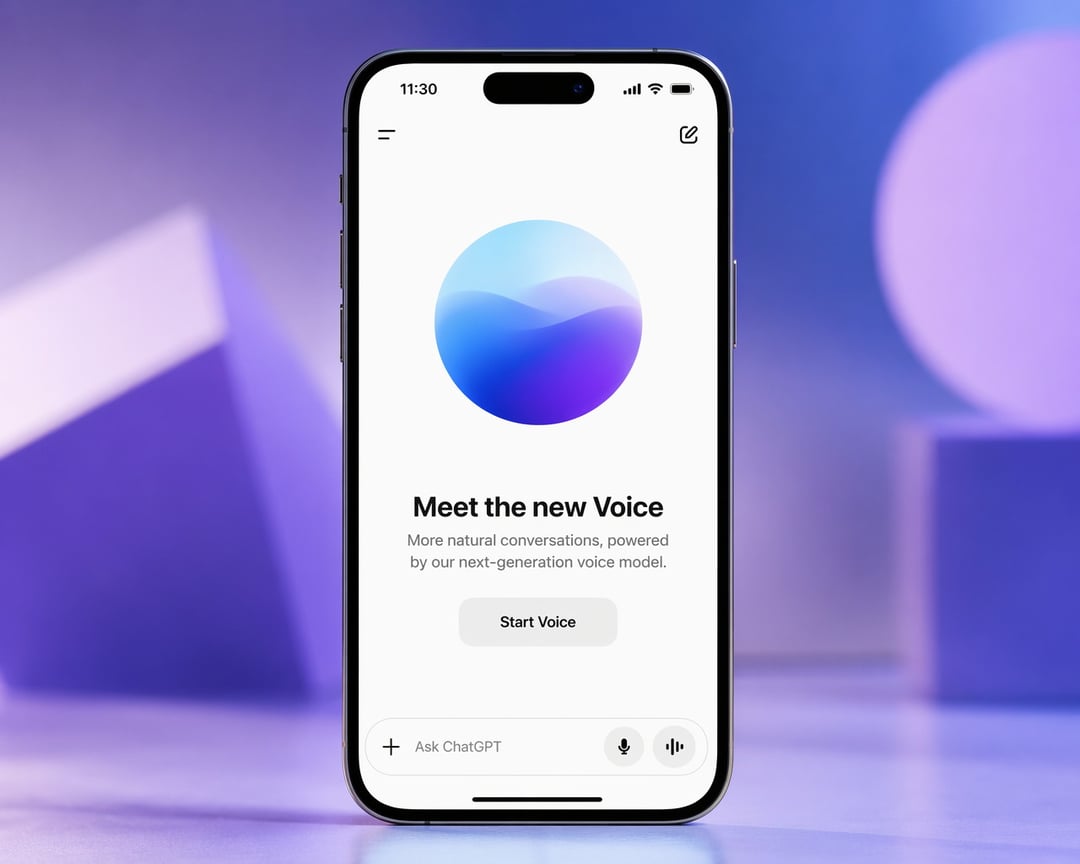
What Are GPT-Live-1 and GPT-Live-1 Mini?
OpenAI has introduced two new conversational AI models built specifically for real-time voice interaction: GPT-Live-1 and a smaller variant, GPT-Live-1 mini. Both are designed to sound more natural in conversation and to manage the back-and-forth rhythm of human dialogue more smoothly than earlier voice systems.
The defining technical feature of these models is full-duplex processing. Unlike systems that must wait for a speaker to finish before responding, full-duplex models can listen and speak at the same time. In practice, this means a user can interrupt the AI mid-sentence and have it adjust naturally, much like interrupting another person in conversation. This same architecture also opens the door to live translation, since the model can process incoming speech while simultaneously producing translated output.
How This Differs From the Previous Voice Architecture
Earlier versions of ChatGPT's voice mode relied on a three-step pipeline: a speech-to-text model converted spoken audio into text, a separate large language model generated a response, and a text-to-speech model converted that response back into audio. Each stage added latency and created friction, particularly around timing and interruptions.
GPT-Live-1 consolidates much of this into a single, more integrated system. When a query requires deeper reasoning, search, or multi-step agentic capability, the model routes the request to OpenAI's latest text-based models, such as GPT-5.5, while keeping the conversation flowing rather than stalling.
Rollout Across ChatGPT
OpenAI is replacing the existing Advanced Voice Mode with GPT-Live-1 mini as the new default experience across ChatGPT. Subscribers on paid tiers will get access to the larger, more capable GPT-Live-1 model. This tiered rollout mirrors how OpenAI has historically distributed its most capable models to paying users first while keeping a lighter-weight version available broadly.
Extended Conversations and Contextual Awareness
One of the more notable behavioral upgrades is the model's ability to stay quiet for extended periods without losing track of the conversation. Rather than needing constant prompting, GPT-Live-1 can absorb context passively and only respond when it's directly addressed, similar to how a person might listen quietly during a group discussion before jumping in with something relevant.
Because the new voice mode connects to more advanced underlying GPT models, it can also incorporate visual elements into its responses rather than being limited to audio alone. This puts OpenAI in the same lane as other companies working on multimodal, visually responsive assistants, including startups pursuing similar interactive approaches after raising early-stage funding from firms like DST and Lux Capital.
According to OpenAI's product lead for ChatGPT Voice, internal testing has included conversations lasting 30 to 40 minutes, conducted during activities like walking, suggesting the company is designing for sustained, hands-free use rather than short transactional exchanges.
Voice as the Future Interface for Complex Work
OpenAI's broader ambition is for voice to eventually serve as a primary way people interact with computers, particularly for long-running, complex, and agentic tasks. The company has drawn a direct comparison to the kinds of advanced workflows already emerging in tools like Codex, suggesting it sees voice as the eventual front end for that same class of work rather than a separate, simpler feature.
This ambition also connects to persistent reports that OpenAI may be preparing to launch AI-enabled earbuds at some point this year. However, the company has not shared any details about hardware plans alongside this software release.
How Competitors Are Responding
OpenAI isn't alone in pushing toward more natural, expressive voice assistants. Apple has recently added the ability to customize Siri's pace and expressiveness. Amazon has expanded Alexa's conversational capabilities and made its AI assistant broadly available across the U.S. Newer entrants are also active in this space: a conversational AI startup founded by an Oculus co-founder recently launched an iOS app built around more natural conversation combined with background task completion.
This wave of competition suggests that voice interaction is becoming a central battleground for AI assistants, with major players and startups alike racing to make spoken interaction feel less robotic and more genuinely conversational.
Safety Guardrails and Current Limitations
OpenAI has stated that GPT-Live-1 includes built-in safeguards, including age-appropriate response handling for teenage users and mechanisms to surface support resources if a conversation touches on self-harm. The company has also been explicit that the goal of this update is not to position ChatGPT as an AI companion product.
Despite the improvements, the new voice mode isn't without rough edges. During a live demonstration of the translation feature in Hindi, the model spoke with a noticeably American accent and used phrasing that sounded stiff and overly formal rather than natural. OpenAI has said the new mode is optimized for "most spoken languages" without specifying which languages perform best, suggesting quality may vary depending on the language in use.
Scale of Current Voice Usage
Voice interaction is already a significant part of how people use ChatGPT. OpenAI has said that more than 150 million people currently use voice-based features, including Voice and Dictation, underscoring why the company is investing heavily in making this mode of interaction more fluid and capable.