
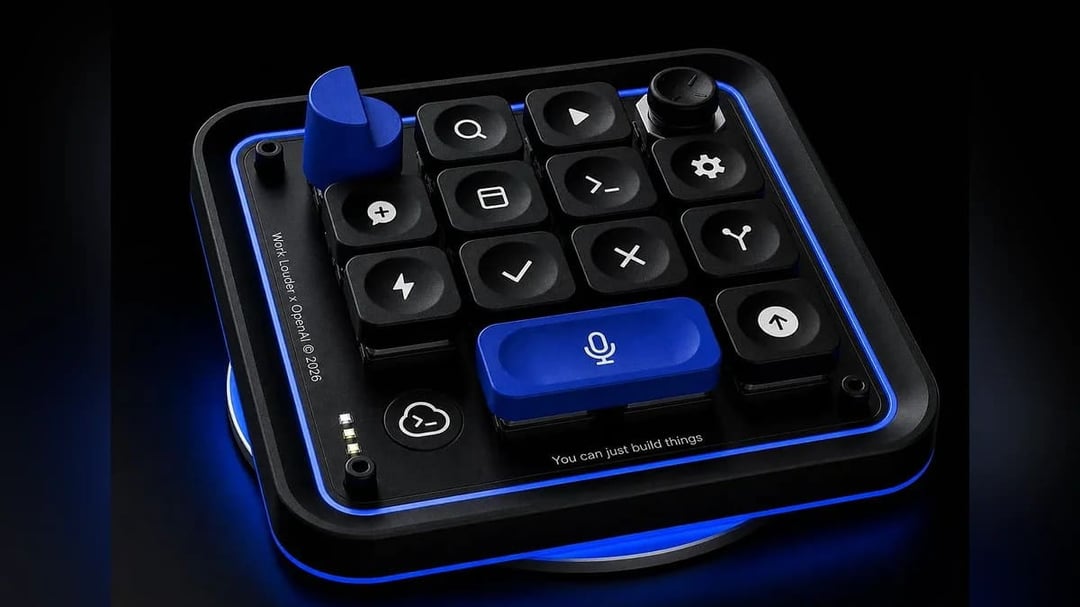
A Macro Pad Built for Codex, Not a Phone
OpenAI has shipped its first piece of branded hardware, and it isn't the pocketable AI gadget the industry had been speculating about for months. The product, called Codex Micro, is a compact programmable macro pad developed in collaboration with keyboard manufacturer Work Louder. Rather than positioning it as a new consumer AI platform, OpenAI built the device specifically for developers who rely on Codex, the company's AI coding assistant, giving them dedicated physical controls for tasks they'd otherwise handle through typed commands.
The device had already surfaced publicly before its official release. It was shown for the first time at the AI Engineer World Fair in San Francisco in late June, where OpenAI's Dominik Kundel framed it as a keyboard built to push people's Codex usage further. That framing lines up with how the company has talked about the product since: not as a general-purpose gadget, but as an accessory tied tightly to one workflow.
What the Codex Micro Actually Does
Functionally, the Codex Micro is designed to cut down on repetitive prompt-typing. Instead of manually entering the same instructions to launch a coding session, review a pull request, debug an issue, or trigger a repetitive automation, a developer can map those actions to a single physical press. The pitch is speed and friction reduction for people already deep in Codex-based workflows, not a new way of interacting with AI for a broader audience.
Specs, Design, and Pricing
The hardware itself is based on Work Louder's existing Creator Micro 2 layout. It carries 13 mechanical keys, a joystick, a rotary encoder, and touch-sensitive controls, all of which can be programmed to trigger specific Codex actions. As of launch, OpenAI hadn't confirmed full technical specifications or an official price. For context, Work Louder's comparable Creator Micro 2 retails for $199 in the United States, which gives a rough sense of where the Codex Micro is likely to land.
How Codex Micro Fits Into OpenAI's Broader Hardware Plans
OpenAI has been explicit that this device is a separate effort from its higher-profile hardware collaboration with former Apple design chief Jony Ive, which is expected to produce a portable consumer device. Coverage from The Verge has drawn a clear line between the two: the Codex Micro is a developer productivity accessory, while the Ive-linked project is aimed at a different kind of AI hardware entirely. Keeping those two efforts visibly separate appears to be a deliberate choice, avoiding any confusion between a niche coding tool and OpenAI's more ambitious consumer hardware bet.
Codex as a Core Product Line
The launch also underscores how central Codex has become to OpenAI's product strategy. Since April 2026, Codex access has run on a token-based credit system, with plans stretching from a free tier up to $200 a month. That was followed in May by the general availability of subagents, allowing up to eight parallel agents to run at once. Seen against that backdrop, the Codex Micro reads less like an experiment and more like an extension of a product line OpenAI has been steadily investing in for months.
A Deliberate, Developer-First Hardware Strategy
Rather than entering the hardware space through a flashy consumer device, OpenAI chose a narrow, developer-focused accessory for its debut. TechRadar pointed out that the release came just weeks after CEO Sam Altman told staff internally that the company should think of itself as "the CEO of apps," a comment interpreted as a push to stay focused rather than chase side projects. Read alongside that internal messaging, the Codex Micro looks like a calculated move: something built to deepen engagement among developers already using Codex daily, rather than an attempt to pull in new categories of users.