
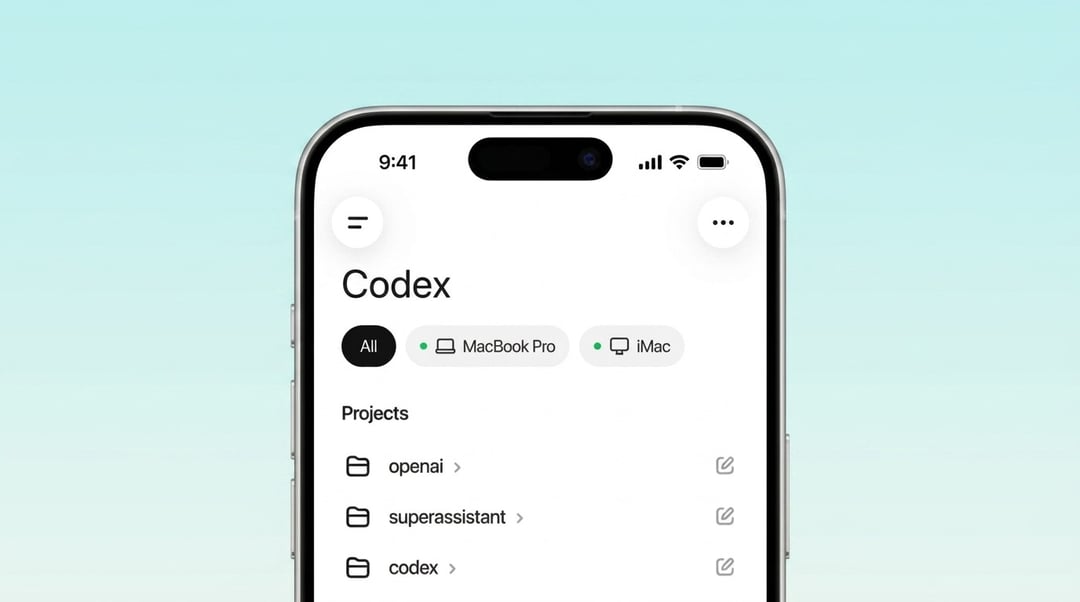
Developers Can Now Run and Monitor Coding Sessions From Their Phones
You know that feeling when you're away from your desk and something breaks in the codebase? Or you just want to keep a build moving while you're out? That gap — the one between "I need to code something" and "I have to be at my computer to do it" — just got a lot smaller.
OpenAI has launched a preview of its Codex coding agent directly inside the ChatGPT mobile app, for both iOS and Android. And honestly, it's a bigger deal than it might sound at first.
Rather than building a separate standalone app, OpenAI embedded the whole Codex experience right inside ChatGPT — turning your phone into what's essentially a remote control for coding sessions that are already running on a connected machine. That could be your laptop, a Mac mini, or a managed remote environment. Wherever Codex is running, you can now reach it from your pocket.
What You Can Actually Do From Your Phone
Here's what I mean when I say "fully-featured" — because OpenAI used that exact phrase and it's worth unpacking.
When you connect to a machine running Codex, the mobile app loads the live state from that environment. So you're not just glancing at a summary. You can:
- Review outputs in real time
- Approve commands
- Switch models mid-session
- Follow terminal activity as it happens
- Work across active threads, plugins, and project context
And here's the part that matters for security: your files and credentials stay on the host machine. Nothing gets pulled onto the phone itself. Think of the phone as a window into the session, not a copy of it.
This mirrors something Anthropic already introduced with Claude Code Dispatch — a similar setup that lets developers supervise agentic coding remotely. OpenAI's version is now in that same space, and it closes a gap that developers had been vocal about for a while.
Why This Took So Long — And Why It Matters Now
Codex only became available as a desktop app on macOS back in February, with Windows support coming in March. So mobile access was always going to be the next step, but developers weren't shy about saying they needed it sooner. Feature requests had been piling up on OpenAI's GitHub discussions and community forums since early 2026, with people citing the lack of phone control as a reason to look at competing platforms instead.
More than three million developers use Codex weekly, apparently. That's a lot of people who now have a reason to stay in the ecosystem even when they step away from their desks — during on-call shifts, commutes, or any of those moments when work doesn't pause just because you're not sitting down.
Built on a Bigger Codex Push
This mobile launch isn't happening in isolation. It builds directly on last month's "Codex for (almost) everything" update, which expanded the tool well beyond pure coding. That update brought:
- Computer use on macOS
- An in-app browser
- More than 90 plugins
- SSH connections to remote development environments
So Codex has been quietly becoming a much broader tool — and the mobile access makes all of that more reachable in everyday life.
On the enterprise side, things are expanding too. Remote SSH is now generally available, and Hooks — a framework that lets developers inject custom scripts into the agentic loop — continues to roll out alongside the mobile launch.
Who Gets Access and When
The mobile preview is available across all ChatGPT subscription tiers. Free users, Go users, everyone. OpenAI had briefly opened Codex to free-tier users when the desktop app launched in February, and this continues that pattern of wider access.
One thing still pending: Windows support for Codex remote connections. That's listed as coming soon, so Windows users aren't fully there yet for the remote connection piece specifically.