
The Problem With How Most AI Systems Are Built Today
Here's something that bugs a lot of enterprise developers, even if they don't always say it out loud: most AI agent systems are basically duct-taped together. You've got one model handling speech recognition, another doing visual understanding, a third managing language reasoning — and every time data passes between them, you're losing time and context. It's like playing a game of telephone with your own infrastructure.
That's the exact problem Nvidia decided to tackle head-on with the launch of Nemotron 3 Nano Omni, a new open multimodal AI model that consolidates all of that into a single architecture. No more fragmented pipelines. No more context bleed between systems. Just one model doing the whole job.
What Nemotron 3 Nano Omni Actually Does
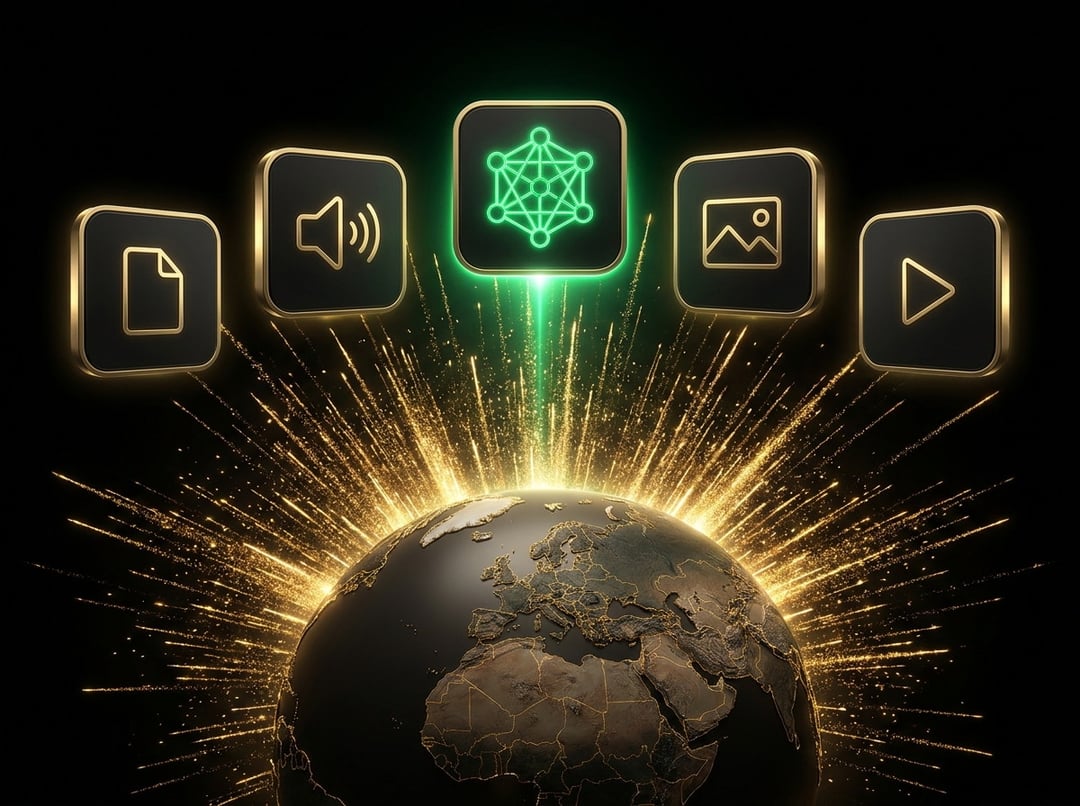
So what can it handle? Honestly, quite a lot. The model processes text, images, audio, video, documents, charts, and graphical interfaces as inputs and produces text as output. That's not a shortlist — that's basically everything an enterprise AI agent might need to look at or listen to in a given workday.
Under the hood, it runs on a 30-billion-parameter hybrid mixture-of-experts architecture, with roughly 3 billion parameters active per inference. Think about what that means practically: you get the knowledge capacity of a much larger model, but at a fraction of the compute cost. That's the kind of efficiency trade-off that actually matters when you're running things at scale.
How the Architecture Comes Together
Three key components make this work as a unified system rather than a patchwork:
- A Parakeet speech encoder for audio processing
- A C-RADIOv4-H vision encoder for visual understanding
- A dedicated GUI-trained visual system for graphical interface comprehension
All three feed into one reasoning loop. That's the key difference. There's no handoff, no translation layer, no dropped context. The model just… reasons across everything at once.
The Performance Numbers Worth Paying Attention To
Nvidia isn't being shy about the benchmarks here. They're claiming up to 9x higher throughput than comparable open omni models with similar interactivity. For video reasoning specifically, the model delivers roughly 3x higher throughput with 2.75x lower compute. Those aren't incremental gains — that's a meaningful shift in what's possible on more modest hardware.
The model also supports a 256K-token context window, which matters enormously for document-heavy workflows. And it currently tops six leaderboards for complex document intelligence and video and audio understanding, according to Nvidia.
Who's Already Using It — and What They're Saying
This isn't just a research release. Companies are already deploying it. Foxconn, Palantir, and H Company have adopted the model, while Dell, Oracle, and Infosys are among those currently evaluating it.
H Company's CEO, Gautier Cloix, put it plainly: their agents can now analyze full HD screen recordings — something that was previously unfeasible. That's not a subtle upgrade. That's a capability door swinging open.
Where You Can Get It
Nvidia released Nemotron 3 Nano Omni with open weights, datasets, and training recipes, which means developers can actually customize and deploy it rather than just using it as a black box. It's available on:
- Hugging Face
- OpenRouter
- Amazon SageMaker JumpStart
- Vultr
- More than 25 additional partner platforms
It's also accessible through Nvidia's NIM microservice. Whether you're deploying on local hardware or cloud infrastructure, there's a path in.
Where This Fits in Nvidia's Bigger Picture
Nemotron 3 Nano Omni isn't a standalone product — it's the perception layer within Nvidia's broader Nemotron 3 family. The family also includes Super and Ultra models designed for heavier reasoning workloads, so the idea is a tiered system where the Omni handles sensory input and the heavier models handle deeper reasoning.
The Nemotron 3 series as a whole has crossed 50 million downloads in the past year, which suggests this isn't a niche developer experiment — it's becoming infrastructure.