
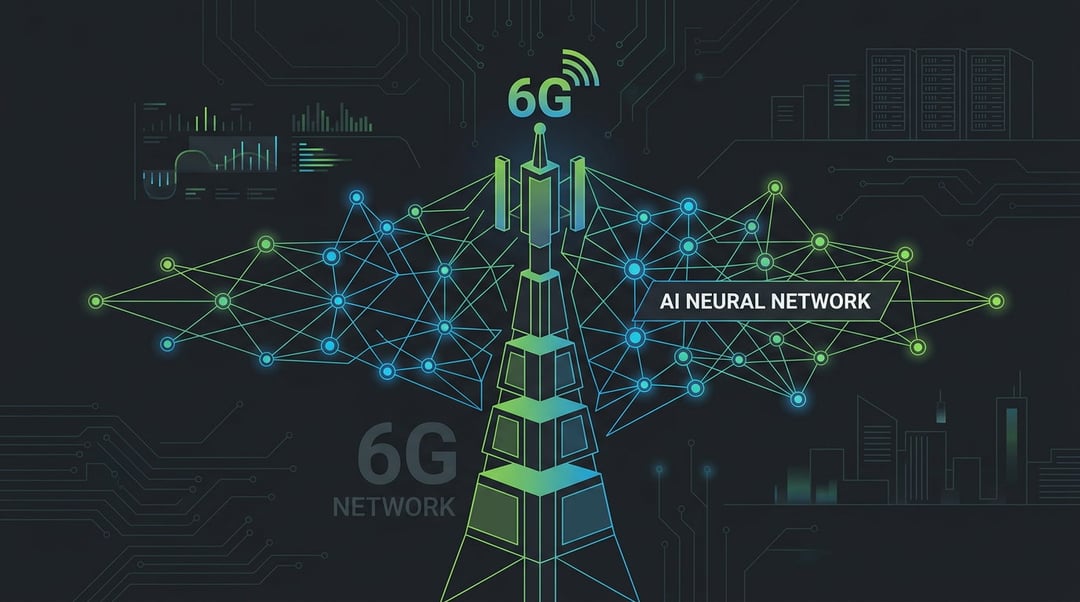
Nvidia’s 6G Strategy: Building AI-Native Telecom Infrastructure
Nvidia is shifting its AI ambitions straight into the heart of global telecom networks. At Mobile World Congress, the company announced plans to collaborate with major telecom infrastructure players to help shape 6G—and it wants that future to be open source.
This isn’t just a side project. Nvidia’s message is clear: AI is redefining computing, and telecommunications is next. The company argues that the next generation of mobile connectivity must be built as AI-native infrastructure from the ground up. Not bolted on later. Designed for it from day one.
The goal? Create an AI-capable backbone that can support billions of AI-connected devices—devices that will demand security, speed, and reliability at a scale we haven’t seen before.
Strategic Partnerships With Global Telecom Leaders
Telecom Giants Back Nvidia’s AI-RAN Initiative
Nvidia is working alongside BT Group, Cisco, Deutsche Telekom, Nokia, SK Telecom, Softbank, and T-Mobile. That’s not a casual list. These are foundational players in global telecom.
Together, they aim to develop an AI-powered radio access network (AI-RAN) that transforms traditional telecom infrastructure into distributed AI platforms. Instead of networks simply moving data from point A to point B, they would actively support AI workloads.
And that changes the equation. Mobile networks stop being just connectivity layers—they become intelligent infrastructure.
AI-RAN: Transforming Radio Access Networks Into AI Platforms
The concept of AI-RAN centers on embedding AI capabilities directly into the radio access network layer. Nvidia describes this as turning telecom networks into “AI infrastructure everywhere.”
That means:
- Enabling seamless onboarding of billions of AI-connected devices
- Delivering the security and trust required for AI-driven applications
- Supporting real-time AI processing at the network edge
In other words, 6G isn’t just about faster speeds. It’s about building networks that think.
Open-Source 6G vs. Proprietary 5G Infrastructure
How 5G’s Proprietary Model Shaped the Market
The 5G rollout was largely dominated by proprietary hardware and software from companies like Ericsson and Nokia. That model centralized control and limited flexibility. Innovation often required navigating licensing fees and vendor lock-in.
Now, Nvidia is advocating a different path.
Why Nvidia Argues 6G Should Be Open Source
An open-source 6G framework, according to Nvidia, would allow smaller companies to innovate without restrictive licensing costs. It could reduce dependency on foreign technologies—something that has caught the attention of the US government.
Open-source platforms promise broader participation. More developers. More experimentation. Less gatekeeping.
But open source doesn’t mean neutral.
The Role of CUDA and Nvidia’s Aerial Platform
Aerial: An Early Blueprint for AI-Powered RAN
Nvidia has already developed an early example of AI-RAN through its Aerial platform. Built in collaboration with DeepSig, Aerial serves as an open-source reference design for next-generation radio access networks.
It demonstrates how AI workloads and telecom operations can coexist on shared infrastructure.
CUDA Dependency and Hardware Limitations
Here’s where things get more complex.
Aerial requires developers to use Nvidia’s CUDA platform. It does not operate on general-purpose CPUs from Intel or AMD, nor on ARM-based systems. That means participation in this “open” ecosystem still revolves around Nvidia hardware.
Some analysts suggest this positions Nvidia as a keystone within the emerging 6G ecosystem. If CUDA becomes embedded into the backbone of future telecom networks, Nvidia’s dominance could deepen even further.
Open source, yes. But strategically aligned.
Industry Response and Competitive Dynamics
Nokia and Ericsson Take Different Approaches
Nokia is reportedly trialing Nvidia GPUs with “Layer 1” RAN software from T-Mobile in the United States. That signals real momentum behind GPU-accelerated telecom infrastructure.
Ericsson, however, is pursuing solutions designed to run on more general-purpose CPUs. That approach could broaden hardware compatibility and create more flexibility in how 6G networks are deployed.
The divergence highlights a central tension in the 6G race: specialization versus hardware neutrality.
Government Interest in Open 6G Networks
The US government is interested in open-source telecom platforms to lessen its dependence on foreign suppliers. Using an open 6G network design could change the balance of power in global telecom infrastructure.
That adds another layer to Nvidia’s initiative. This isn’t just a technology strategy. It’s also industrial policy and global influence.
Nvidia’s Long-Term Positioning in AI and Telecom
Nvidia already dominates AI hardware markets. By embedding CUDA and GPU acceleration into telecom infrastructure, it extends that influence beyond data centers and into the very fabric of global connectivity.
The scale of industry support behind open 6G development suggests momentum is building. But the strategic implications are clear: if AI-native 6G networks become the standard, Nvidia hardware could sit at their core.
In a world where AI drives everything from devices to cloud platforms to mobile networks, controlling the foundational infrastructure is a powerful position to hold.


