
Choosing between Next.js, Remix, and SvelteKit can feel weirdly personal. You start with routing and rendering. Then you end up debating caching semantics and deployment runtimes at midnight. That’s completely normal. In 2026, a meta-framework choice decides how your team ships, debugs, and sleeps.
This guide compares Next.js, Remix, and SvelteKit by looking at how well they fit your specific needs. You want built-in features that suit your project right from the start, but you also need the flexibility to make changes later without running into problems.
Why choosing between Next.js, Remix, and SvelteKit feels even harder in 2026
Meta-frameworks now own the full request lifecycle. They define routing, data loading, mutation patterns, and caching behavior. They also define where code runs and what it can touch. Consequently your framework decision becomes an operations decision.
Migration costs create the pressure. Teams rarely fail because they lack features. Teams fail because the chosen defaults fight the app’s shape. That friction shows up as brittle patterns, confusing bugs, and slow delivery.
What a “meta-framework” means in practice
A meta-framework is not just SSR plus routing. It is a bundle of opinions that shape your architecture.
- Routing plus code splitting that implies how teams organize code.
- Server rendering options including streaming and partial rendering strategies.
- Deployment targets across Node, serverless, and edge runtimes.
- Data primitives that formalize reads, writes, and validation.
- Caching hooks that decide what stays fresh and what goes stale.
When comparing Next.js vs Remix vs SvelteKit, define “right” clearly. Right means fastest path to reliable shipping under your constraints. Right does not mean most popular.
The criteria that actually separates Next.js vs Remix vs SvelteKit
Framework comparisons often get stuck on syntax. Syntax matters. Architecture matters more.
Rendering and delivery model
Ask how your app benefits from SSR, SSG, and streaming. Streaming helps when you can progressively reveal UI while data resolves. Edge rendering helps when latency dominates user experience. But edge constraints can block certain libraries and Node APIs.
Your goal is a predictable rendering plan per route. Mixed-mode apps need route-level clarity. Otherwise debugging becomes folklore.
Data loading and mutation semantics
Reads are easy. Writes create the truth. You should evaluate how each framework models mutations, validation, and error boundaries. Prefer a model that makes invalid states hard to represent. Prefer a model that makes retries explicit.
Caching strategy and invalidation ergonomics
Caching becomes your second database. Treat it that way.
You need clear answers to three questions:
- What caches by default
- What triggers revalidation
- What invalidates after a mutation
If your team cannot explain invalidation in plain language then production incidents will do it for you.
Routing and code organization
File-based routing reduces ceremony. It can also hide complexity until it explodes. Nested layouts and route composition help at scale. They also demand discipline around ownership of data and UI boundaries.
DX and team fit
Intermediate teams ship fastest when the mental model stays stable. Debuggability matters under SSR and streaming. Testing matters when server and client code interleave. Choose the ecosystem that matches your team’s existing reflexes.
Next.js in 2026: broad power with sharp edges
In the Next.js vs Remix vs SvelteKit conversation, Next.js remains the default React meta-framework. It offers enormous breadth. It also asks you to respect its boundaries.
Where Next.js tends to win
Next.js shines in mixed content and application portfolios. Marketing pages, docs, and app routes can coexist. Large teams benefit from standardized patterns and a deep hiring pool. Furthermore the ecosystem support stays unmatched in the React world.
Where Next.js tends to hurt
Next.js can hurt when caching behavior feels implicit. It can also hurt when server and client boundaries blur inside a codebase. Those issues rarely show up in week one. They show up after your first complex mutation flow.
Advanced notes you should not skip
Treat server and client code separation as a design constraint. Treat caching and revalidation as part of the data model. Add observability early for SSR and edge rendering. Logging request IDs and cache states saves days later.
Helpful references: Next.js docs https://nextjs.org/docs and React Server Components background https://react.dev/reference/rsc/server-components
Remix in 2026: web platform clarity for data-heavy apps
Remix positions itself as web fundamentals first. That choice makes forms and mutations feel native. In Next.js vs Remix vs SvelteKit, Remix often wins when correctness matters more than novelty.
Where Remix tends to win
Remix excels in CRUD products and workflow-heavy SaaS. Loaders and actions create a clear contract per route. Nested routes keep data dependencies local. Consequently you avoid sprawling client state for basic app behavior.
Where Remix tends to hurt
Remix can disappoint teams expecting an everything-included React platform. Some decisions require more explicit wiring. Some teams interpret that as missing features. It is really a different philosophy.
Advanced notes you should not skip
Lean into loaders and actions as the system of record. Use progressive enhancement as a capability not a fallback. Model validation and error states at the route boundary.
Helpful references: Remix docs https://remix.run/docs and web platform APIs https://developer.mozilla.org/
SvelteKit in 2026: performance and simplicity with different tradeoffs
SvelteKit changes the component model and the runtime feel. That shift can reduce overhead for many interfaces. In Next.js vs Remix vs SvelteKit, SvelteKit often fits teams that value velocity and performance.
Where SvelteKit tends to win
SvelteKit delivers strong performance with a direct mental model. Smaller teams often ship quickly with less ceremony. Interactive interfaces can feel lighter because the framework avoids some client complexity.
Where SvelteKit tends to hurt
SvelteKit can hurt when your org depends on React-only libraries. It can also hurt when hiring and shared tooling assume React. Ecosystem maturity keeps improving. But you should audit dependencies early.
Advanced notes you should not skip
Choose adapters early because they shape deployment constraints. Understand server load functions and route scopes. Watch hydration and bundle boundaries with intent.
Helpful references: SvelteKit docs https://kit.svelte.dev/docs and Svelte docs https://svelte.dev/docs
Scenario playbook: quick picks for common app shapes
You can reduce Next.js vs Remix vs SvelteKit to a few recurring scenarios.
Marketing site plus app
Choose Next.js when you want conventional React patterns across everything. Choose SvelteKit when you want speed and a simpler UI model. Choose Remix when the app portion dominates and forms drive the experience.
Forms-heavy SaaS
Remix often simplifies validation, mutations, and error handling. Next.js works if you impose strong conventions for data flow and invalidation. SvelteKit works when the team embraces Svelte and audits integrations early.
E-commerce storefront
Performance and caching dictate outcomes. Edge rendering can help with latency. But it can limit APIs and libraries. Focus on invalidation strategy and observability before framework loyalty.
Architecture diagram in words: the shared request pipeline
Picture the flow like a relay race.
- A request hits an edge or server runtime.
- The router selects a route module.
- Server data functions run for that route.
- HTML streams while data resolves when supported.
- The client hydrates then mutations trigger revalidation.
Now the differences. Each framework places the “cache switch” in different places. Each framework encourages different boundaries for data ownership. That is why Next.js vs Remix vs SvelteKit (2026) stays a real decision.
A practical selection checklist for intermediate devs
Pick the framework that makes your likely problems easier.
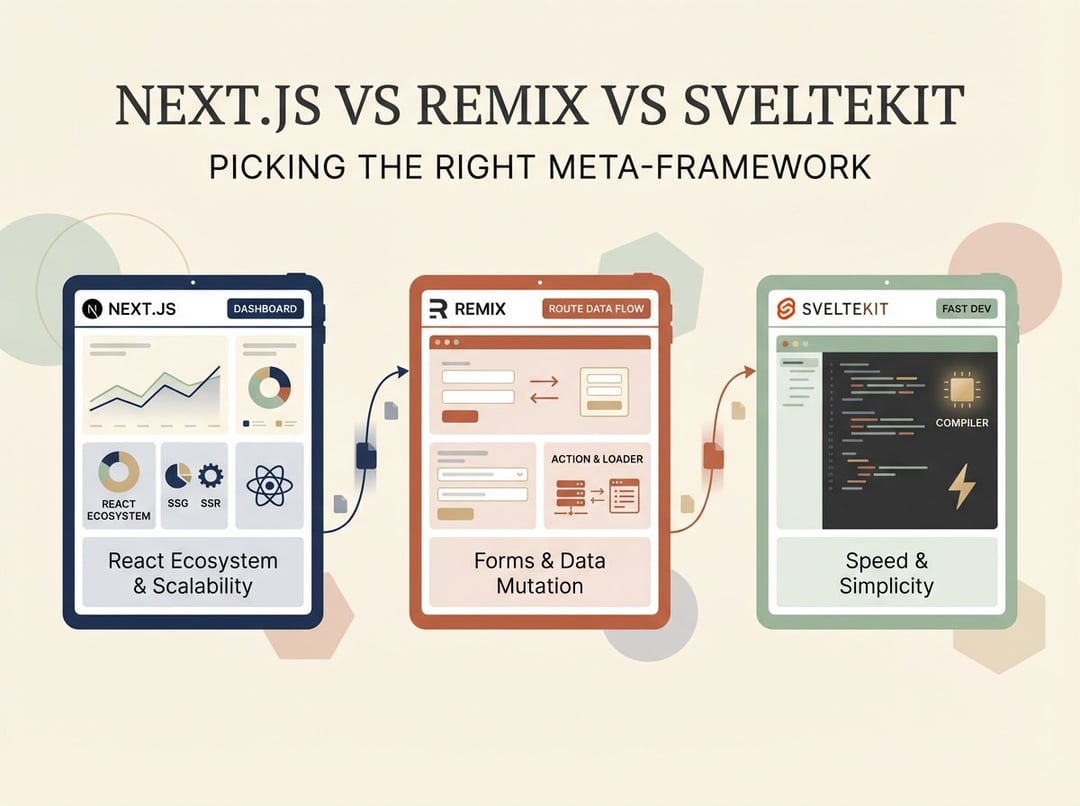
- Pick Next.js when you need broad React ecosystem support and standard hiring.
- Pick Remix when mutations and forms define the product’s daily reality.
- Pick SvelteKit when performance and simplicity beat ecosystem maximalism.
What to prototype in one day before you commit
Do three spikes. Keep them small. Keep them honest.
- Build one authenticated route with RBAC.
- Build one form flow with validation and error states.
- Build one caching scenario with a mutation-driven invalidation.
Success looks boring. Intermediate devs debug it fast. You can explain invalidation without hand waving. You can deploy the same day with logs that tell the truth.
In 2026, Next.js vs Remix vs SvelteKit is not about winning an argument. It is about choosing constraints you can live inside for years.


