
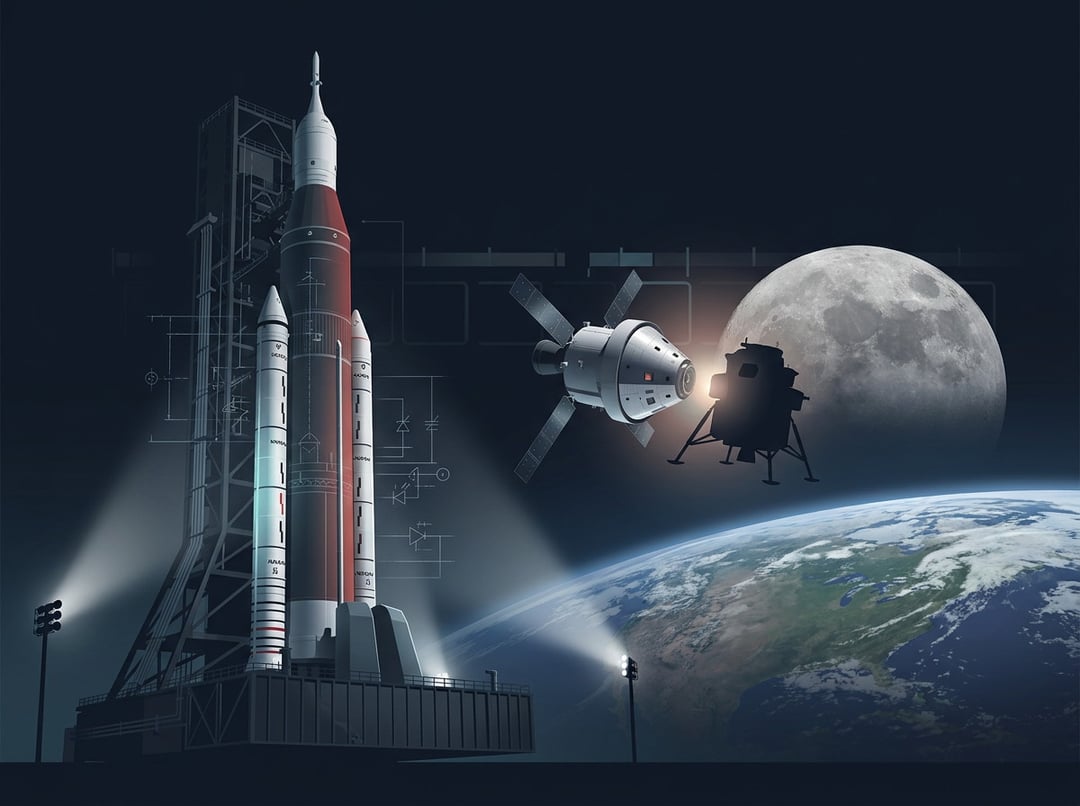
The Core Problem NASA Is Trying to Fix: Artemis Is Moving Too Slowly
NASA’s Artemis program has run into repeated operational friction—especially during prelaunch work—at the exact moment the agency feels pressure to pick up the pace. NASA leadership is increasingly worried that without a major reset, China’s accelerating human spaceflight efforts could reach the Moon before the US returns there this decade.
NASA’s administrator, Jared Isaacman, framed the moment bluntly: NASA needs a more standardized approach, a safer but higher flight rate, and fewer delays—because credible geopolitical competition is rising “by the day.”
The Big Artemis Program Changes NASA Announced
Cancellation of the Exploration Upper Stage and the SLS Block 1B Upgrade
NASA announced it will cancel the Exploration Upper Stage (EUS) and the Block 1B upgrade for the Space Launch System (SLS). This is a sweeping decision because EUS was the planned pathway to a more powerful SLS configuration later in the decade—and a multibillion-dollar development effort with Boeing as prime contractor.
Instead, NASA is pivoting toward flying SLS in a more repeatable way, without frequent “major configuration change” from mission to mission.
Artemis II and Artemis III will fly with the existing SLS upper stage
NASA will fly Artemis II and Artemis III using SLS with its existing upper stage, rather than waiting for the more capable Block 1B/EUS configuration.
This is a very specific signal: NASA would rather keep flying with what it already has (and can learn from) than hold the cadence hostage to an upgrade path that adds cost, complexity, and time.
Artemis IV and Artemis V will use a standardized upper stage (commercially procured)
NASA said Artemis IV, Artemis V, and any additional missions will use a standardized upper stage.
What matters here is the “standardized” piece: NASA wants a single stable configuration that can be produced, integrated, and flown repeatedly—more like an operational system and less like a custom build each time.
NASA also indicated it will procure this new upper stage commercially. The current upper stage is a modified Delta IV upper stage made by United Launch Alliance, but that production line is closed and NASA only has two more of these stages available. With EUS canceled, NASA needs a new plan for SLS upper stages going forward.
The most likely replacement cited is Centaur V, the upper stage flying on Vulcan rockets.
Artemis III Is No Longer a Lunar Landing Mission
Artemis III becomes an orbital docking mission in low Earth orbit
One of the biggest changes: Artemis III will not land on the Moon.
Under the new plan, Orion will launch on SLS, then dock in low Earth orbit with Starship and/or Blue Moon landers. That means Artemis III shifts from “first landing” to a mission focused on validating critical system behaviors—particularly rendezvous and docking with lunar landers—before attempting the first landing.
Artemis IV becomes the first lunar landing mission
NASA’s revised sequence makes Artemis IV the first mission to land humans on the Moon under Artemis.
This is essentially NASA borrowing a page from Apollo-era sequencing: build confidence step-by-step, reduce unknowns, and avoid stacking too many first-time events into a single mission.
Why NASA Is Reordering Missions: Risk Reduction, Apollo-Style
NASA’s previous Artemis template effectively skipped several kinds of crewed preparation steps that Apollo ran before Apollo 11. The Apollo run-up included:
- Apollo 7 (LEO test of the spacecraft)
- Apollo 8 (lunar orbit mission)
- Apollo 9 (LEO rendezvous with the lunar lander)
- Apollo 10 (lunar lander test descent without touchdown)
NASA’s earlier Artemis concept jumped from Artemis II (a crewed lunar flyby that tests SLS and Orion) straight to Artemis III (a full lunar landing). Industry officials viewed that leap as “enormous and risky.”
NASA’s new approach is intended to “buy down” risks for a modern lunar landing by proving the pieces and operations that can fail in messy, mission-ending ways, including:
- lunar lander performance and handling
- rendezvous and docking
- communications
- spacesuit performance
But there’s a trade: this approach also creates new challenges, including compressing timelines and accelerating integration work between Orion and commercial landers.
The SLS Flight Rate Problem: NASA Wants Something Closer to Operational Cadence
A central Isaacman complaint is that Artemis and SLS are launching too infrequently to be a sustainable pathway.
NASA pointed to historic human spaceflight cadence: from Mercury through Gemini, Apollo, and the Space Shuttle era, NASA averaged about one human launch every three months. By contrast, it has been nearly 3.5 years since Artemis I launched.
A senior NASA official tied these delays to hydrogen and helium leaks experienced during Artemis I and Artemis II prelaunch processing—issues that have caused months-long delays.
So the plan is to standardize SLS and increase cadence, with a goal of launching as frequently as every 10 months, and seeking annual Artemis missions, starting with Artemis III in mid-2027, followed by at least one lunar landing in 2028.
Commercial Lunar Landers: SpaceX and Blue Origin Get Pulled Closer to the Critical Path
NASA said it is working with:
- SpaceX (Starship)
- Blue Origin (Blue Moon)
…to accelerate development of commercial lunar landers for Artemis IV and beyond.
In the new architecture, NASA is making lander readiness and integration a core pacing item, not an “adjacent” program effort. And because Artemis III becomes a docking mission (not a landing), it also becomes a practical proving ground for lander rendezvous, docking, and operational coordination.
Contractor and Political Reality: Who’s On Board, and Who Might Not Be
NASA indicated its key contractors are aligned with the plan and that senior Congressional leaders have been briefed.
The most obvious potential resistance point is Boeing, given Boeing’s role as prime contractor for the now-canceled Exploration Upper Stage contract. Still, Boeing publicly expressed support in a NASA news release, emphasizing readiness to meet increased production needs as NASA accelerates the launch schedule and reiterating the SLS core stage’s capability.
The Upper Stage Supply Crunch: Two Stages Left and No Delta IV Production Line
A less flashy but extremely consequential detail: the current SLS upper stage comes from a line that’s no longer producing.
NASA has only two more of the modified Delta IV upper stages available. That reality forces urgency into upper-stage decisions, because cadence goals don’t mean much if the stack can’t be built after the near-term inventory is consumed.
By canceling EUS and moving toward a commercially procured standardized stage, NASA is trying to avoid being trapped between a closed production line and a long, expensive development program.
Open Questions NASA Didn’t Resolve: Launch Infrastructure and the Lunar Gateway
The Block 1B launch tower: scrap it or repurpose it?
NASA has been developing a larger launch tower intended to support the Block 1B SLS version. With Block 1B canceled, the tower’s purpose becomes uncertain.
The tower project has seen dramatic cost growth and delays, with costs ballooning from an initial estimate of $383 million to $1.8 billion. NASA did not clarify whether it will be scrapped or repurposed.
What happens to the Lunar Gateway?
NASA officials were also not specific about the future of the Lunar Gateway, a proposed space station in a high lunar orbit.
Key Gateway elements are already under construction, but the cancellation of EUS raises new questions because one major purpose of Block 1B SLS was launching heavier payloads—most notably Gateway elements. NASA did not address how Gateway logistics and assembly plans change under the new SLS/upper-stage architecture.