
The Pricing Paradox Nobody Saw Coming
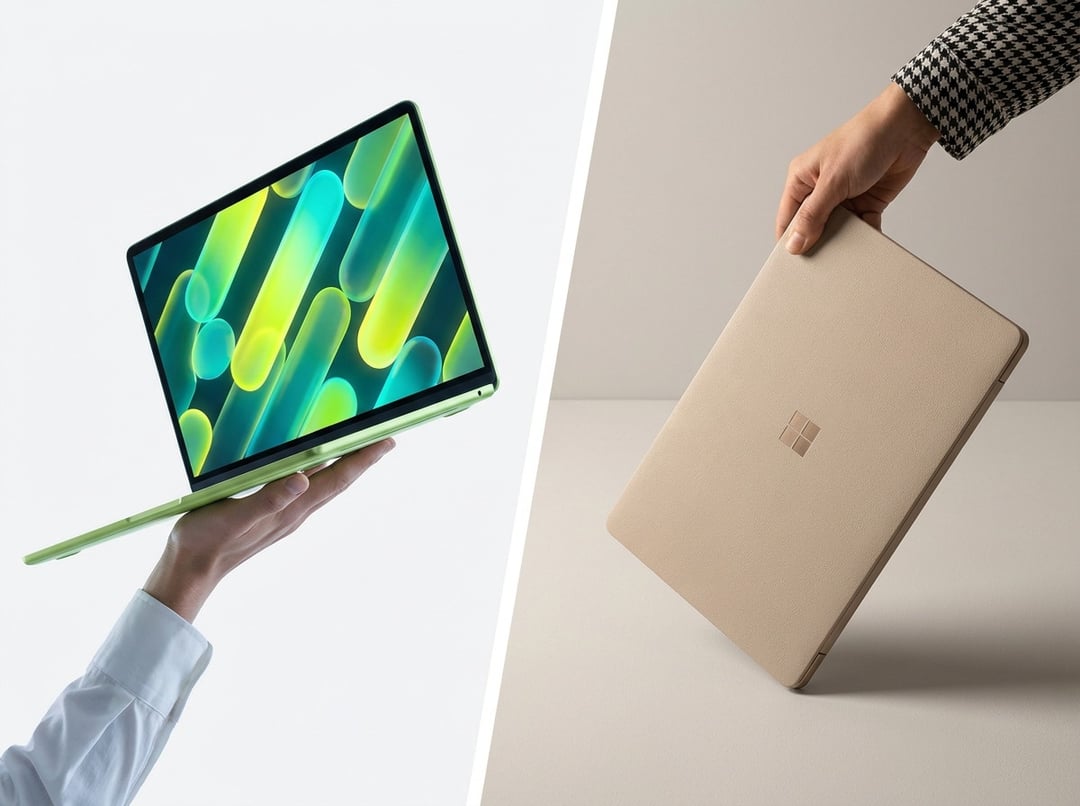
Something unusual is happening in the laptop market right now. Microsoft just hiked prices on its Surface lineup. Memory costs have more than doubled in less than a year. PC makers across the board are quietly retreating from budget options and chasing higher-margin, premium buyers. And right in the middle of all this? Apple walks in with a $599 laptop that promises to handle everything most people actually need a computer to do.
That's the MacBook Neo. And honestly, it's kind of a strange move for Apple — a company that's practically built its identity on selling premium hardware at premium prices. The Neo flips that script. It cuts corners, uses a phone-class processor, and ships with the bare-minimum RAM and storage. But here's the thing: it still outperforms a huge chunk of the Windows competition, at a price most Windows laptops can't touch right now.
So what's going on? Why can Apple afford to go down in price while Microsoft and other PC makers are going up? It comes down to who controls what.
Apple's Vertical Integration Gives It Pricing Power Nobody Else Has
Analysts are pretty clear on this one. Jim McGregor of Tirias Research put it directly: because Apple controls the entire product stack, it has pricing flexibility that no other player in the industry currently has. And that really is the crux of it.
When Apple designs its own chips — in this case, the A18 Pro — it doesn't have to go hat-in-hand to Intel or Qualcomm and negotiate a price. It knows exactly what the chip costs. It knows when components will arrive and how many are available. That kind of visibility is enormously valuable when the supply chain is chaotic and memory prices are going through the roof.
Compare that to Microsoft. Like most PC makers, Microsoft assembles third-party components into a finished product. It had a brief moment of co-designing the SQ3 chip with Qualcomm for the Surface Pro 9 (5G) back in 2022, but that collaboration is long gone. Today, Microsoft negotiates for processors and components just like everyone else — and since it's no longer among the top-tier PC makers by volume, it's probably getting squeezed harder than most.
The Chip Cost Gap Is Enormous
Dean McCarron at Mercury Research broke down just how dramatic the price difference is at the processor level. An Intel N100 or N150 chip — the kind that powers most budget Chromebooks — typically costs under $35, and possibly as little as half that. The Qualcomm Snapdragon X Elite and Intel Core Ultra Series 2 chips that power premium Windows laptops are both well over $100 each. That's before anything else even gets added to the bill of materials.
The A18 Pro sits in a category of its own. Since Apple designed and commissioned it, the per-chip cost follows Apple's own economics, not the open market. And there's even speculation — floated by Ben Thompson's Stratechery — that Apple may be using "binned" chips inside the Neo: silicon that failed quality checks for iPhone production and would otherwise be discarded, making them essentially free. That's not confirmed, but it's not hard to imagine given how Apple manages its supply chain.
Performance That Makes the Price Even More Surprising
Here's where it gets genuinely interesting. The MacBook Neo isn't just cheap — it's fast. In Geekbench 6 single-core scores, the A18 Pro scores 3,574. The Intel N150 scores 1,125. That's more than three times the performance. And single-core speed is what actually determines how snappy the operating system feels and how fast most productivity apps run.
More striking: the A18 Pro's single-core score beats Intel's Core Ultra X9 388H (Panther Lake) — a high-end chip — which clocked in at 2,908 in PCWorld's own testing. So we're talking about a $599 laptop with performance that punches well above its price class.
The Memory Problem — And Why It Hurts Windows More
If Apple's chip strategy is one half of the story, memory is the other half.
The MacBook Neo ships with 8GB of RAM. That's it. On the surface, that sounds like a compromise — and for a Windows machine, it would be. Basically every Windows laptop ships with at least 8GB, and most that land on reviewers' desks come with 16GB standard.
But here's the painful reality for PC makers right now: the price of 16GB of DDR5 memory quadrupled between October and April — jumping from roughly $100 to over $400. Microsoft has explicitly confirmed that soaring memory and storage costs are behind its Surface price increases.
Apple, by shipping the Neo with just 8GB of its own low-power DDR5X memory, sidesteps a huge chunk of that pain. Because Apple's unified memory architecture is more efficient than conventional desktop RAM, 8GB in a Mac genuinely goes further than 8GB in a Windows machine. It's not a like-for-like comparison. And Apple only needs to pay for what it actually installs.
Storage: One Area Where the Playing Field Levels Out
The Neo ships with 256GB of SSD storage, and so does Microsoft's cheapest 13-inch Surface Laptop. Here, Apple has no structural advantage — it buys SSDs from the same third-party suppliers as everyone else, and faces the same pricing pressures. This is one area where the cost calculus is roughly even between the two companies.
As McCarron put it, Apple's timing is genuinely good given current supply dynamics, and the Neo likely carries healthy margins relative to what the hardware actually costs — something Chromebook makers have struggled with for years due to their historically low price points.
The "K"-Shaped Market and Who Gets Left Behind
There's a broader economic context here that helps explain what's happening across the whole PC industry, not just with Microsoft.
Economists describe the current market as "K"-shaped: higher-income consumers get wealthier and keep spending, while lower-income consumers have less to work with. Over time, that pulls manufacturers up-market. Budget options disappear. Companies chase the customers who'll pay more. It's the same dynamic that's pushed car prices up, kept Las Vegas hotel rates climbing, and quietly erased affordable options from all kinds of consumer markets.
McGregor at Tirias was candid about this. He argued that a lot of what the PC industry is blaming on memory prices is really just opportunism: companies taking advantage of a moment of constrained supply to shift focus to premium segments and higher margins. AMD, Intel, and basically everybody across the board, he said, are using the situation as cover to exit the low end of the market entirely.
Microsoft's Strategic Bet: Go Head-to-Head With Apple at the Top
For Microsoft specifically, the calculus is deliberate. McGregor said Microsoft views its competition as Apple — full stop — and is targeting the premium segment where Apple's margins are fattest.
That's a significant strategic pivot. Not long ago, Microsoft was actively competing in the budget and mid-range markets with devices like the Surface Laptop Go and the Surface Go. Those products are gone now, quietly discontinued around the time Surface chief Panos Panay departed for Amazon. What's left is a Surface lineup that lives in the premium tier, running Windows on Arm and competing for the same high-end buyers Apple courts with the MacBook Air and MacBook Pro.
The problem is that this move leaves the affordable end of the Windows market almost entirely open — and Apple just walked right into it with the MacBook Neo.
Could This Be a Preemptive Strike?
There's one more angle worth considering. Nvidia's N1X Arm processor is expected to debut later this year, possibly at Computex in Taiwan in June. If that chip powers a new class of affordable, high-performance Windows laptops, the competitive landscape shifts again.
McGregor suggested the MacBook Neo might be Apple drawing a line in the sand: even if a compelling Arm-based alternative shows up from Nvidia or someone else, Apple is signaling that it can — and will — undercut on price while maintaining performance. That's a tough combination to compete against.