
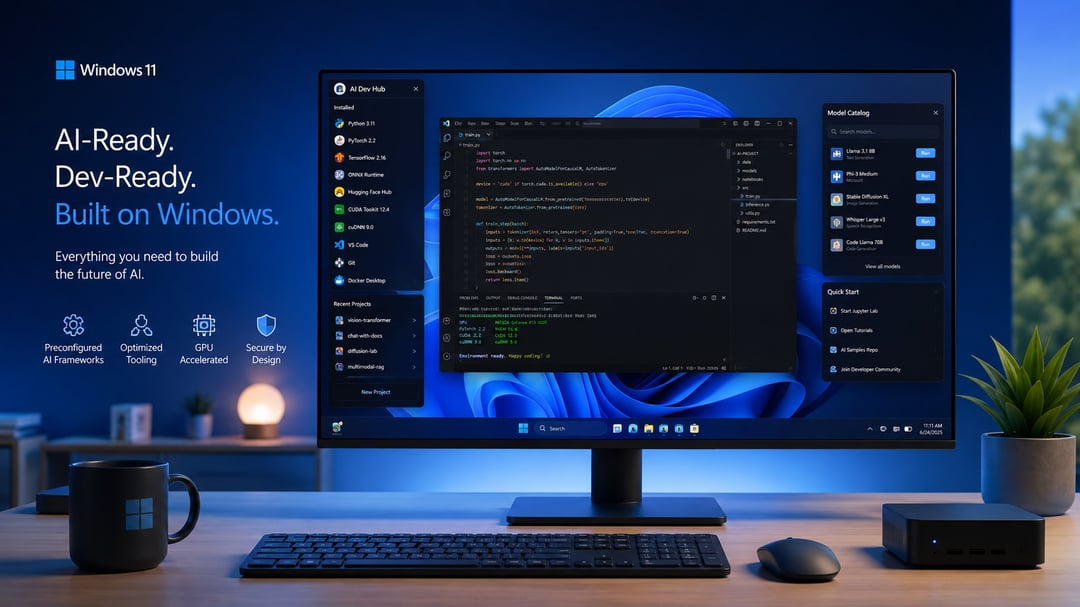
Microsoft has officially unveiled Project Zenith, a preconfigured Windows 11 experience built for developer-class PCs. The setup turns these machines into ready-to-code systems right out of the box. The company made the announcement on September 4, formalizing work it first previewed at Build 2026.
Project Zenith focuses on hardware that meets strict minimums: at least 64GB of unified memory and more than 250GB/s of memory bandwidth. On devices that clear those thresholds, developers can run AI models with 30 billion or more parameters entirely on the local machine. No cloud connection is required for inference, and there are no metered usage fees. The approach cuts reliance on cloud-based services and the costs that come with them.
Logan Iyer, corporate vice president of Windows platform and developer at Microsoft, described the intent this way: “Project Zenith devices come with a preconfigured Windows setup for development and a set of tools curated for what developers reach for first. Developers can run 30B+ parameter models locally and unmetered — accelerating experimentation while helping reduce reliance on metered cloud tokens.”
The machines arrive with several core tools already pinned to the taskbar. Visual Studio Code, GitHub Copilot, PowerToys, and Windows Terminal sit ready for use. Microsoft also adjusted the operating system itself. File Explorer now displays file extensions and hidden files by default. Start menu tips and account notifications stay off. Long-path support is turned on.
Hardware Requirements and Local Model Support
Project Zenith is not available on ordinary PCs. It targets a specific class of hardware capable of handling large local models without constant cloud calls. The 64GB unified memory floor and the bandwidth requirement above 250GB/s form the baseline. Once those are met, 30-billion-parameter models become practical on-device.
AMD introduced the first Project Zenith device on the same day as Microsoft’s announcement. At IFA Berlin, the company showed a miniature PC built around its Ryzen AI Halo chips. Those chips support up to 128GB of unified memory. Microsoft said more Project Zenith systems from other OEM and silicon partners will appear in the coming months.
AMD positions the Ryzen AI Halo platform against both Apple’s M4 Pro and Nvidia’s DGX Spark. Higher-end configurations of the AMD chips can run models as large as 300 billion parameters.
System Tweaks That Reduce Friction
Beyond the pinned apps, the Windows configuration itself receives deliberate changes aimed at developers. Showing file extensions and hidden files in File Explorer removes a common setup step. Disabling Start menu tips and account notifications cuts visual clutter. Enabling long-path support addresses a long-standing Windows limitation that often trips up larger projects.
These adjustments create what sources describe as a distraction-free Windows experience. The goal is simple: a developer should be able to open a new Project Zenith machine and begin work without first hunting through settings menus or installing a basic toolkit.
Keeping Developers Inside the Microsoft Stack
Project Zenith forms part of a larger effort to draw developers back from macOS and Linux environments that have often been preferred for AI and systems-level work. By removing the usual setup friction, Microsoft aims to keep more developers working inside its own tools—Visual Studio, GitHub, and Azure.
Iyer framed the broader commitment this way: “As AI continues to transform software development, we are committed to evolving Windows alongside the community that builds on it.”
The combination of preconfigured software, targeted hardware, and local model support gives Microsoft a concrete offering for developers who want to experiment with large models without paying cloud inference costs or waiting for remote responses.


