
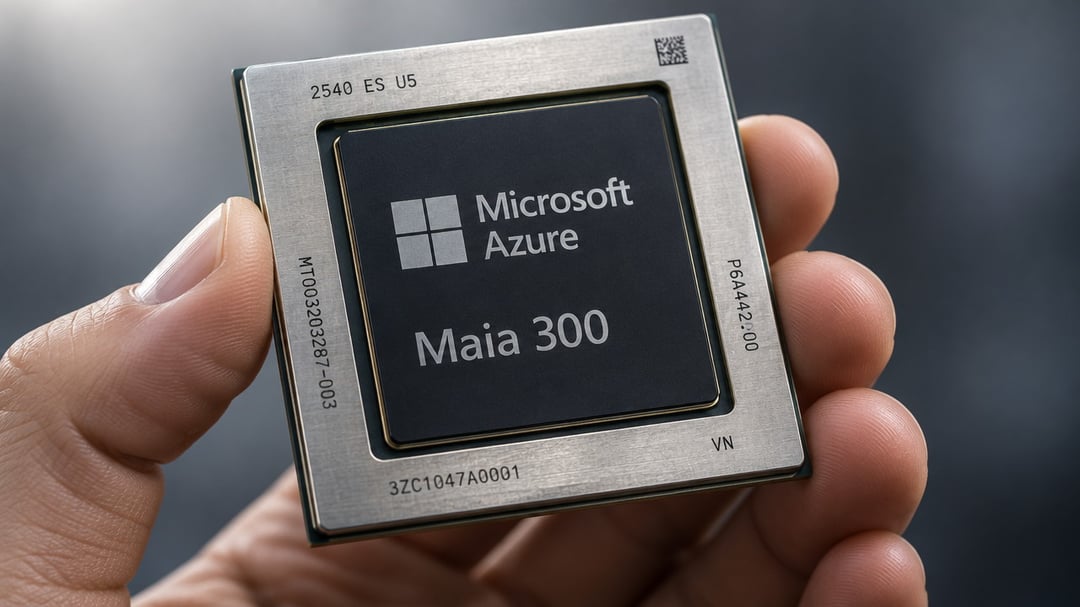
Microsoft has introduced Maia 300, the third generation of its custom AI chip family. The company plans to make Maia chips the primary inference system for Microsoft products and services beginning in 2027, with deployments intended to scale to multi-gigawatt levels.
The announcement is Microsoft’s most direct move toward operating AI services, including Copilot, on its own silicon rather than relying only on processors purchased from Nvidia and AMD. Microsoft has described the effort as a way to reduce costs.
Maia 300 Rollout and Microsoft’s 2027 Plan
Microsoft says Maia 300 will power its AI services from 2027. Reuters reported that the rollout could involve more than one million Maia 300 chips next year.
The company is also planning to expand the Maia family substantially. Its stated goal is to deploy the systems at a scale measured in gigawatts.
Microsoft presented Maia 300 at the OCP Global Summit in San Jose. More technical details are expected at Microsoft Ignite in San Francisco, scheduled for November 17–20.
Maia 300 Performance and Efficiency Claims
Microsoft says Maia 300 delivers 40% more tokens per megawatt than leading GPU-based systems. The company did not identify the GPU systems used in that comparison.
A full Maia 300 rack contains 96 chips and uses about 167 kilowatts of power. According to Microsoft, that rack can produce as much as seven times the token throughput of a Maia 200 rack.
For comparison, Reuters noted that Nvidia GB300 racks contain 72 GPUs and draw about 142 kilowatts.
Microsoft is positioning Maia 300 around inference workloads. Inference is the stage where an AI model runs after training. The chip is intended for:
- Long-context reasoning
- Conversational AI
- Agents that perform multi-step tasks
Rani Borkar, president of Azure hardware systems and infrastructure, told Reuters that the system is designed to provide more intelligence for each watt, dollar, and byte of memory through optimization across the full system.
Maia 300 Chip Architecture and Memory
Each Maia 300 chip includes eight stacks of HBM4 memory. Microsoft lists 288 GB of memory capacity and 18 TB/s of memory bandwidth within a 950-watt power budget.
The chip’s compute chiplets are manufactured using TSMC’s N2P process.
These specifications support Microsoft’s focus on inference use cases, particularly AI workloads that need long context windows, conversational responses, or multi-step agent behavior.
Maia 200 Is Already Running Microsoft AI Workloads
Microsoft’s prior-generation Maia 200 chip is already operating in the company’s data centers. It currently serves Microsoft Copilot and runs OpenAI models, Microsoft’s MAI models, and open-source models.
Microsoft says GitHub Copilot and Microsoft Foundry are expected to move to Maia 200 by the end of the year.
For AI features in Teams and Copilot, Microsoft says Maia 200 generates up to 1.7 times more tokens per watt than leading GPU infrastructure.
The earlier deployment gives Microsoft an existing platform as it prepares the Maia 300 rollout. In August, The Information reported that Microsoft was discussing production of more than 300,000 Maia 300 chips with TSMC for 2027.
Microsoft’s Move Away From Outside AI Processors
Maia 300 reflects a broader push by large cloud companies to develop their own AI chips. Amazon, Alphabet, Meta, OpenAI, and Anthropic are also building custom processors.
That trend could create pressure for Nvidia, which Yahoo Finance reported regularly receives more than half of its quarterly revenue from hyperscalers. After Microsoft’s announcement, Microsoft shares rose in Monday trading, while Nvidia and AMD shares fell.
Still, analysts have cautioned that the largest cloud companies are not expected to stop purchasing Nvidia chips entirely. Customers continue to need different processors for different workloads, and Nvidia chips remain the most in demand for now.