
Microsoft 365 E7 and the Rise of “Agentic” AI Workers
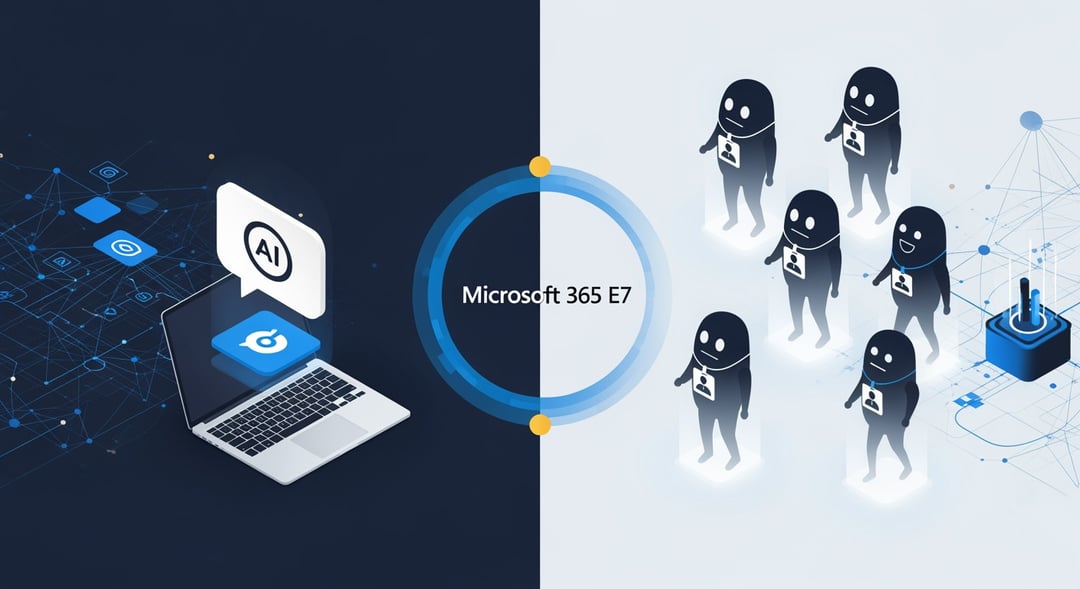
Microsoft is preparing a new Microsoft 365 SKU — Microsoft 365 E7 — positioned as a cornerstone in its plan to license “agentic” workers much like human employees. The strategy signals more than a product update. It reflects a shift in how Microsoft intends enterprises to perceive and deploy artificial intelligence.
Rather than framing AI as a productivity add-on, Microsoft is positioning AI agents as workforce participants. These agents are designed to operate continuously within defined roles, managing tasks such as sales data processing, workflow scheduling, and IT system monitoring. The emphasis is on structured autonomy: agents function within user-defined policies and corporate data access controls, aligning their activities with enterprise governance requirements.
AI Agents as Persistent, Billable Enterprise Assets
From Copilot Assistant to Operational AI Layer
Copilot began as an AI-powered enhancement to Microsoft 365 applications — effectively an advanced autocomplete and productivity assistant. The current shift reframes Copilot Studio explicitly as an agent platform. Microsoft states that agents “use AI to automate and execute business processes for a person, team, or organization,” and may take actions, automate workflows, and replace repetitive tasks.
This marks a transformation from reactive assistance to proactive execution. Instead of waiting for prompts, AI agents are intended to run persistently, integrating into daily operations as a continuous operational layer.
Subscription-Based AI Employees
The concept of “hiring” AI agents aligns with Microsoft’s established subscription model. Each agent can be licensed similarly to a user account, tied to a function or workload. This extends cloud consumption into workforce modeling, where enterprises provision AI capabilities in the same manner as onboarding personnel.
By framing AI licensing as workforce expansion rather than software procurement, Microsoft introduces a new economic narrative: AI agents as scalable, accountable, and revenue-generating assets within the enterprise.
Enterprise Workforce Transformation and AI Integration
Augmentation Today, Potential Substitution Tomorrow
Microsoft’s messaging emphasizes augmentation rather than immediate job replacement. AI agents are positioned as tools to handle repeatable knowledge work, enabling employees to focus on higher-value responsibilities. However, the structural capability of agents to assume defined roles suggests a longer-term evolution in workforce composition.
The distinction between human employee and AI agent becomes less conceptual and more operational. Enterprises are being encouraged to treat AI as a first-class workflow participant, complete with assigned responsibilities and measurable output.
Industry-Wide Movement Toward AI Agents
Microsoft isn’t the only company moving in this direction. Competitors like Salesforce, Google, and OpenAI are also likely to develop similar AI agent tools. This suggests that AI agents for businesses may soon become a regular part of cloud services, instead of something that sets one company apart from the rest.
Windows 12 and the AI-Centric PC Future
AI as Core System Architecture
Parallel to its enterprise AI push, Microsoft’s future Windows releases are expected to heavily integrate artificial intelligence. Reports and partner disclosures suggest a modular CorePC architecture that embeds AI into search, recommendations, and overall system behavior.
This approach signals that AI will not remain an optional feature layer but will become foundational to the operating system experience. Neural Processing Units (NPUs) and AI acceleration hardware are likely to play a critical role in enabling these capabilities.
Hardware Implications: New PCs and Rising Costs
Greater reliance on AI-driven features implies new hardware requirements. Organizations that upgraded systems for Windows 11 may face additional refresh cycles for Windows 12. Combined with increasing RAM prices and specialized NPU components, enterprises could encounter elevated hardware and infrastructure expenses.
The convergence of subscription software models and AI-optimized hardware investments represents a dual financial consideration for businesses evaluating long-term IT strategy.
Cloud-Centric Computing and the Decline of Standalone PCs
Microsoft’s broader trajectory reflects a sustained transition from standalone PCs and perpetual licenses toward cloud-based subscription models. AI integration reinforces this shift by embedding intelligence within cloud-managed services and centralized infrastructure.
In this model, provisioning an AI agent through Azure may become as routine as issuing a corporate laptop. The workplace evolves from device-centric computing to service-centric orchestration, where AI agents operate alongside — and sometimes in place of — traditional tools and personnel.
Strategic Considerations for Enterprises Evaluating AI Agents
Organizations considering Microsoft’s AI agent ecosystem must assess several factors:
- Governance and data control: Agents require access to enterprise data, necessitating robust policy management and security oversight.
- Cost modeling: Licensing agents as recurring subscriptions alters operational expenditure structures.
- Workforce planning: Determining where AI augmentation enhances productivity versus where human expertise remains essential.
- Infrastructure readiness: Ensuring compatibility with AI-optimized hardware and cloud environments.
Microsoft’s strategy tests whether enterprises are prepared to conceptualize AI not as a feature, but as a workforce component embedded in daily operations.