
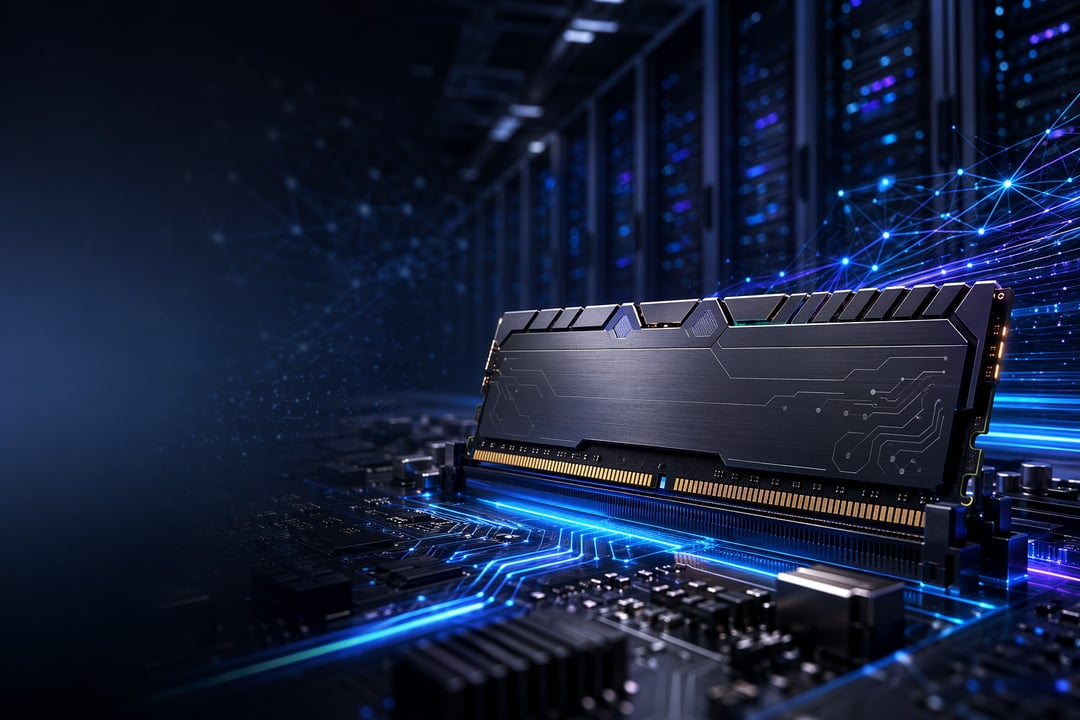
Micron’s 256GB DDR5 Module Targets AI Server Performance
Micron Technology has begun sampling 256GB DDR5 server memory modules to key customers, marking a product debut aimed squarely at AI server workloads. The launch comes as DRAM prices are rising at rates not seen in more than a decade, while Wall Street continues to raise expectations for the memory giant.
The new 256GB DDR5 registered dual in-line memory module is built on Micron’s 1-gamma process technology using extreme ultraviolet lithography. It is designed to reach data transfer speeds of up to 9,200 megatransfers per second, making it more than 40% faster than modules currently in volume production.
That speed matters, but power efficiency may matter just as much. A single 256GB module can reduce operating power by more than 40% compared with running two 128GB modules, according to Micron’s announcement. For AI data centers already constrained by power demands, that reduction is a key selling point.
Platform Validation Begins With Server Ecosystem Partners
Micron said the 256GB DDR5 modules are now sampling to server ecosystem partners for platform validation. Broader availability is expected to follow.
The sampling stage places the module in front of key customers and partners as AI infrastructure demand continues to reshape the memory market. For server platforms, validation is a necessary step before broader deployment, especially as AI workloads push memory capacity, bandwidth, and efficiency higher.
A Memory Market Defined by Scarcity
The launch arrives in a memory market under serious pressure. TrendForce reported in March that conventional DRAM contract prices are projected to rise 58% to 63% quarter-over-quarter in Q2 2026, following sharp increases in Q1.
NAND Flash contract prices are expected to climb even more sharply, rising 70% to 75% over the same period.
The shortage is being driven by structural shifts in memory production. Samsung, SK Hynix, and Micron have redirected production toward high-bandwidth memory chips used in AI accelerators. That shift has tightened supply for conventional DRAM and NAND.
An estimated 70% of high-end memory supply in 2026 is being absorbed by data centers. Micron CEO Sanjay Mehrotra has said key customers are currently receiving only “50% to two-thirds of their requirements” because of the ongoing crunch.
AI Demand Reshapes DRAM and NAND Supply
The pressure on conventional memory is tied directly to AI infrastructure demand. Suppliers continue reallocating wafer capacity toward high-bandwidth memory and server applications for AI, leaving less available supply for conventional DRAM and NAND.
That reallocation has helped create a pricing environment where memory contract prices are rising sharply across categories. For customers, the impact is straightforward: higher costs and tighter availability. For memory suppliers, the same environment has strengthened investor confidence in the current cycle.
Micron’s 256GB DDR5 server module fits into that market backdrop. It addresses AI server needs for higher capacity, faster transfer speeds, and lower operating power while arriving at a time when memory supply is already stretched.
Wall Street Raises Its Bet on Memory Stocks
The pricing environment has helped fuel a dramatic rally in memory stocks. Micron shares have more than doubled year-to-date. The broader memory complex, including SanDisk, Western Digital, and Seagate, has posted triple-digit gains in 2026.
Micron shares surged nearly 8% past $800 after DA Davidson reaffirmed a $1,000 price target, citing “increased conviction” in the AI-driven memory cycle. Deutsche Bank also holds a $1,000 target on the stock.
Not every analyst shares that level of optimism. Stacygon assigned an outperform rating but set a $510 target, implying more than 30% downside from recent levels. Micron shares traded lower early Tuesday, giving back some of the prior session’s gains.
Micron’s 256GB DDR5 Module in Context
The new module brings together several themes currently defining the memory industry:
- Higher memory capacity for AI server workloads
- Faster DDR5 data transfer speeds of up to 9,200 megatransfers per second
- More than 40% faster performance than modules currently in volume production
- More than 40% lower operating power versus two 128GB modules
- Sampling to key customers and server ecosystem partners
- Launch timing that overlaps with sharp DRAM and NAND price increases
For Micron, the product arrives during a moment when AI demand, limited supply, and investor expectations are all moving in the same direction. But the market reaction remains split, with bullish price targets sitting alongside more cautious views.


