
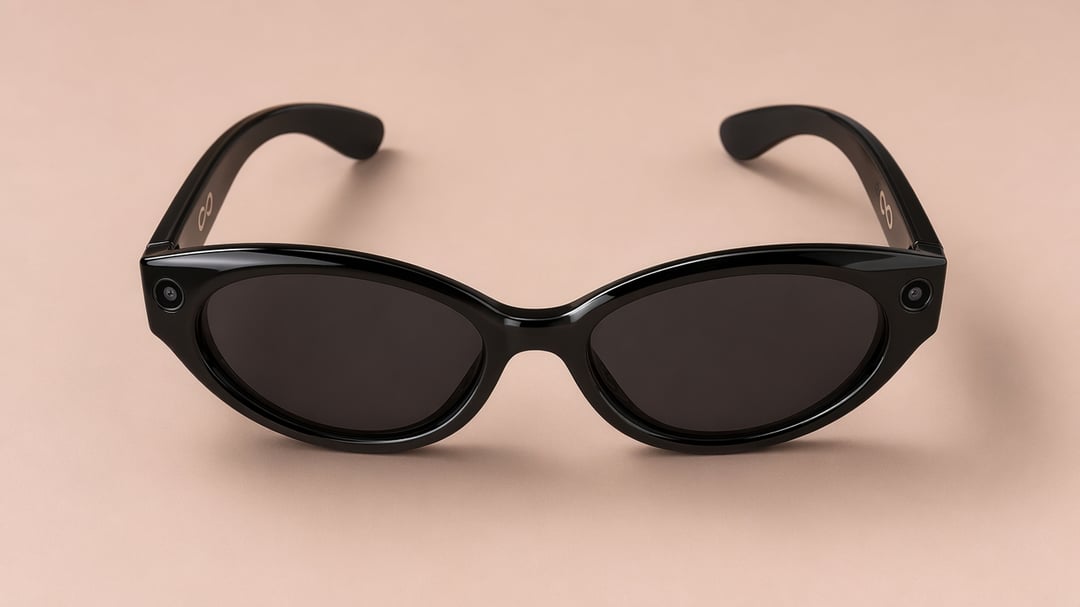
Meta Steps Out From Behind the Brand Names
For a while now, Meta's been putting smart glasses on people's faces under the cover of better-known fashion labels. Ray-Ban. Oakley. Names that carry enough cool-by-association to make the tech feel approachable — even normal — to wear in public.
But now Meta's making a different call. It's launching a new line of smart glasses under its own name — simply Meta Glasses — starting at $299. Still produced in partnership with EssilorLuxottica, the same company behind those Ray-Ban collaborations, but this time the frames carry the Meta brand directly. No borrowed credibility. No fashion house on the temple.
The glasses are available in several countries starting today, in a range of color and lens combinations. And that price point, relative to what else is on the market right now, tells you exactly who Meta is trying to reach.
What Meta Glasses Actually Include
A Camera, Speakers, and AI — No Screen Required
Let's get the obvious question out of the way: these glasses don't have a display. No floating notifications, no AR overlay, no visual feed projected into your eye line. If that's what you were hoping for, this isn't the product.
What you do get is a built-in camera, a pair of personal speakers, and a dedicated button that — by default — triggers the Meta AI assistant. That button is customizable, so you can remap it to launch a specific feature instead. Think of it less like a computer on your face and more like a voice assistant you actually wear.
Battery life lands at over eight hours of use. The on-the-go charging case that ships with the glasses adds up to 40 more hours on top of that — enough to last through several days without needing a wall outlet.
The Three Frame Styles
Meta is launching with a distinct lineup of frame options, each aimed at a different kind of wearer:
- Meta Adventurer — Rectangular frames in standard and large sizes. The straightforward, everyday option.
- Meta Fury — A boxier shape that leans into popular men's eyewear styles.
- Meta Glasses by Kylie — A slim oval frame developed in collaboration with Kylie Jenner, clearly positioned as the fashion-forward pick.
What the Meta AI Can Do From Your Face
Real-World Questions, Answered in Real Time
The Meta AI assistant built into these glasses is designed to handle the kinds of things you'd normally pull your phone out for — sports scores, local restaurant recommendations, general questions. But there's a layer beyond that: it can understand what you're actually looking at and respond to what it sees.
That visual awareness is what separates a smart speaker you wear from something that actually connects to your surroundings.
Turn-by-Turn Walking Directions Are Coming
Meta says "Pedestrian navigation" — a feature that gives turn-by-turn directions for walking — is coming soon to the glasses. The idea is straightforward: audio guidance as you move through a city, without ever pulling out a phone or staring at a screen.
Live Translation, Now in 14 More Languages
Meta is also expanding its live translation feature with support for 14 new languages, including Japanese, Chinese (Mandarin), Hindi, and Korean. For anyone who travels frequently or moves through multilingual spaces, that's a meaningful addition — not just a spec-sheet line item.
Where Meta Glasses Fit in the Bigger Picture
An 80% Market Share Is a Comfortable Place to Experiment From
Smart glasses are still a relatively young category, and the numbers make Meta's position in it pretty clear. Meta and EssilorLuxottica together hold an estimated market share of over 80%, according to data from Counterpoint Research. That kind of dominance gives Meta room to try new things — like launching under its own brand at a lower price — without the existential risk a smaller player might face.
Snap's $2,195 Specs Tell a Different Story
One week before Meta's launch, Snap unveiled its long-awaited consumer smart glasses, called Specs, priced at $2,195. That's not a rounding error. Snap is clearly chasing a different buyer — early adopters, enthusiasts, and developers willing to pay a premium for more advanced capabilities.
Meta, coming in at $299, is aiming somewhere else entirely: the mainstream. The two products aren't really in the same fight. But their back-to-back timing makes it obvious that smart glasses are transitioning from a novelty category into something companies are willing to place serious bets on.